
AI agents are not futuristic anymore; they’re becoming essential to business infrastructure. When considering customer support automation, enhancing internal processes, or creating AI-driven decision-making systems, the initial question on everyone’s mind is: What is the AI agent development cost ? It’s not just a single number, that is the answer. It will depend on complexity, integration, autonomy level, and long-term operating requirements. From the basics to the extras, this guide explains all of it, leaving you with clarity and confidence, not guesswork, when you’re planning your investment.
What Are the Main Factors That Determine AI Agent Development Cost?
To grasp AI agent pricing in 2026, one must first get to know what really matters when it comes to numbers. The price of creating an AI agent for business is not a random number, but rather a compilation of technical decisions, infrastructure options, and business needs.
Complexity and Autonomy Level
The more autonomous an AI agent must be, the more engineering there will be. An assistant answering FAQ’s is much cheaper than an autonomous agent that coordinates the systems, manages exceptions, and learns from results. The higher the autonomy of an AI agent, the higher the cost of its development.
LLM and Model Selection
Foundation model choices — GPT-4o, Claude Sonnet, Gemini — carry different performance and cost profiles. Larger models with bigger context windows drive higher token usage fees. If off-the-shelf models don’t fit your domain, custom fine-tuning adds another $5,000–$30,000 to your budget.
System Integrations
Every API connection — a CRM, ERP, database, payment gateway — adds approximately $2,000–$5,000 in development effort. An agent touching ten systems costs significantly more than one working in isolation.
Data Preparation
Raw data rarely comes ready for AI training. Cleaning, labeling, normalizing, and stripping sensitive information from datasets is time-intensive and often one of the most underestimated line items in any custom AI agent development cost estimate.
Compliance and Security
Regulated industries like healthcare and finance carry additional overhead. HIPAA, GDPR, SOC 2, and the EU AI Act (now fully enforced in 2026) require audit logging, governance controls, and legal review that can add $10,000–$40,000 to the base AI agent development cost.
Infrastructure and Deployment Model
Cloud hosting runs $200–$5,000/month depending on scale. On-premises LLM deployments add considerably more. The deployment environment you choose directly shapes your long-term AI agent maintenance and operating cost.
How Much Does AI Agent Development Cost by Complexity Tier?
This is where most businesses wish to begin. Let’s take a realistic look at the pricing of AI agents 2026 by complexity:
Tier 1 — Simple/Reactive Agents: $8,000–$35,000
These can be rule-based or RAG (Retrieval-Augmented Generation) customer support bots or FAQ agents. They employ ready-made models with little modification. Typical build time is 4-8 weeks. Mortgage payments are $500-$2000 per month. Low-level development cost, smaller-scale AI agents.
Tier 2 — Mid-Complexity Agents: $30,000–$80,000
Contextual agents that have short-term memory, multi-step workflow, and API integrations. These operate real business logic – read docs, trigger actions, interact with databases. The building time is 2-3 months. An option that fits businesses without requiring enterprise architecture.
Tier 3 — Advanced Autonomous Agents: $80,000–$200,000
Planning logic, tools, orchestration, and decision-making agents. These involve orchestration frameworks (LangChain, LangGraph, CrewAI), memory management, and safety guardrails. Deeper engineering investments and strong infrastructure drive AI agent development costs at this level.
Tier 4 — Enterprise / Multi-Agent Systems: $100,000–$500,000+
Compliance layers, legacy system integration, audit trails, and custom ML models with multi-agent orchestration systems. These are designed specifically for enterprise AI workflow automation for various business processes. The total cost of ownership, including infrastructure and maintenance, in year one is typically $250,000 – $450,000.
What Hidden Costs Do Most Businesses Miss?
The AI agent development cost you’ll be quoted is often not the final figure. According to industry data, 40-60% is the typical difference between the total cost of ownership as reported in most enterprise budgets and the real total cost of ownership. Here are some things that are typically overlooked:
- Integration overruns: When you add data schema differences, authentication and error handling, a “simple” CRM connection can quickly grow. There is a tendency for underestimation by 30% to 50%.
- Human-in-the-loop (HITL) systems: AI agent development costs are 15-20% higher with the integration of oversight dashboards, approval of workflows, and audit trails.
- Observability and monitoring: Logging pipelines (CloudWatch, ELK), assessment tools (LangSmith, Braintrust), and monitoring tools (Healthchecks, Grafana) cost an additional $300–$1,000/month. This is the secret of agents infiltrating production.
- Prompt versioning and evaluation: AI agent behavior needs ongoing tuning. Budget for prompt management to tooling and regular evaluation cycles.
- Multi-agent coordination overhead: Supervisor frameworks for coordinating multiple agents add $20,000–$60,000 to the base AI agent development cost.
- Vector database infrastructure: RAG-powered agents require vector storage pipelines — typically $15,000–$40,000 upfront plus $500–$3,000/month ongoing.
What Is the AI Agent Maintenance and Operating Cost After Launch?
Building the agent is only the beginning. AI agent maintenance and operating cost is an ongoing reality that businesses need to budget for day one.
Annual maintenance typically adds 15–30% of the original development cost every year. For a $100,000 agent, expect $15,000–$30,000/year in upkeep. Here’s what that covers:
- API and LLM usage fees: Depending on volume, $100–$10,000/month for model API calls
- Cloud hosting and compute: $200–$5,000/month for infrastructure
- Model updates and retraining: As business data evolves, agents need fine-tuning
- Bug fixes and performance optimization: Especially critical after production-scale deployment
- Security and compliance updates: Regulatory environments shift; your agent needs to shift with them
Teams that treat AI agent maintenance and operating cost as an afterthought consistently see higher total spend — and worse agent performance — over time. Planning this upfront is what separates successful deployments from expensive pilots that never reach production.
How Does AI Agent ROI Justify the Investment?
Here’s the question that should frame every budget conversation: what’s the return? AI agent ROI is strong when the agent is scoped correctly and deployed against a real business problem.
According to Deloitte’s 2026 research, nearly three-quarters of companies report their most advanced AI initiatives met or exceeded ROI targets, with around 20% seeing returns over 30%. The organizations achieving this aren’t necessarily spending the most — they’re spending precision.
AI agent ROI is driven by:
- Labor cost reduction: Agents handling repetitive tasks free up human capacity for higher-value work
- Error rate reduction: Automated, consistent execution reduces costly mistakes in data entry, reporting, and customer communication
- Speed of execution: Agents working 24/7 without fatigue compress timelines on tasks that previously took days
- Scalability without linear cost growth: More volume doesn’t mean proportionally more headcount
The most important lens for evaluating AI agent ROI isn’t just cost savings. It’s the compounding value of faster decisions, better data usage, and operational resilience over time. When paired with robust data analytics services, agents don’t just execute tasks — they surface insights that drive smarter business strategy.
Should You Build In-House or Use AI Development Services?
This is one of the most consequential decisions in the custom AI agent development cost equation. Both paths have merit depending on your situation.
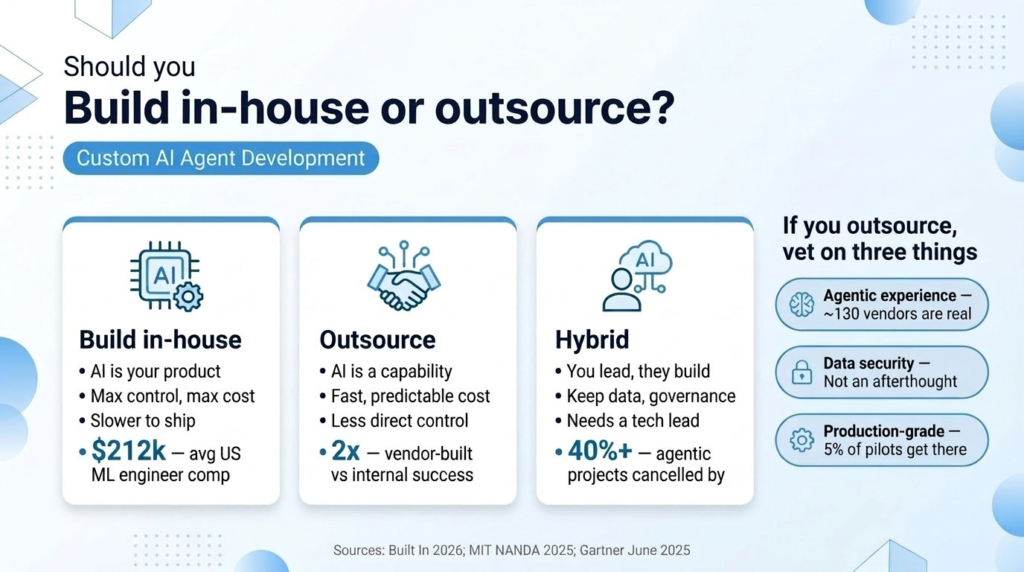
In-House Development
Best if AI is your core business or you have an existing ML team. Offers maximum control over architecture and data. However, it requires significant investment in talent (AI engineers, data scientists, DevOps), infrastructure, and ongoing management. Expect longer timelines and higher initial spending.
Outsourcing to AI Development Services
The most common path for businesses where AI is a capability, not a product. Partnering with experienced AI development services providers reduces hiring risk, accelerates delivery, and brings domain expertise your team may not have in-house. Custom AI agent development cost through outsourcing is often more predictable and includes built-in best practices.
Hybrid Approach
Keep strategic vision, proprietary data, and governance in-house. Outsource execution. This model works well for enterprises with internal technical leadership but limited AI-specific engineering capacity.
If you’re evaluating outsourcing, the key variables are the vendor experience with agentic architectures, their approach to data security, and their ability to deliver production-grade agents — not just functional prototypes.
How Do AI Development Services and Data Analytics Services Work Together?
One of the most underappreciated aspects of building AI agents is the role that data plays — not just in training, but in ongoing performance. AI agents are only as effective as the data infrastructure they operate on.
This is where data analytics services become a force multiplier. When your agent is built on a foundation of clean, well-governed, and continuously analyzed data, it performs better, hallucinates less, and generates measurably stronger AI agent ROI. Data analytics services help organizations understand what their agents are doing — which decisions they’re making, where they’re failing, and how outcomes are trending over time.
For businesses investing in AI workflow automation at scale, combining AI development services with data analytics services isn’t optional. It’s what turns an AI agent from a point of solution into a strategic business asset.
FAQs
Q1: How much does it cost to build an AI agent for a small business?
The price of a basic AI agent for a small business ranges from $8,000 to $35,000. The actual cost will depend on the use case, what integration is required, and the decision to use a custom build or platform-based approach.
Q2: What is the ongoing cost of running an AI agent after it is built?
The ongoing maintenance and operating costs of the AI agent typically range from 15 to 30% of the initial development expenses per year, and API, hosting, and monitoring fees for the agent can be anywhere from $500 to $15,000 per month, depending on usage volume.
Q3: How long does it take to build an AI agent?
Simple agents take 4-8 weeks to build; enterprise “multi-agent” systems 6-12 months. The most significant considerations that impact the timeline and AI agent development costs are scope, integrations, and compliance.
Q4: Is AI agent development worth the investment?
Yes, with a scope properly set up. Labor reductions, accelerated speed, and scalability are the main factors for strong AI agent ROI. According to the research published by Deloitte, almost 75% of companies with advanced AI programs achieved or exceeded ROI targets in 2026.
Conclusion
The range of AI agent development costs in 2026 is quite broad, with simple task-based agents costing $8,000 and enterprise-level multi-agent systems costing more than $500,000. However, it’s not as much about the number itself as the clarity that comes behind it: what factors cause the cost, what other costs are there to be anticipated, and how can you gauge the return on your investment? From initial exploration of your first AI agent to expanding an agentic architecture throughout your business, having the right partner is essential. We at AnavClouds Analytics.ai help businesses plan, build, and optimize AI agents that are crafted to perform in real-world scenarios — and not in demo mode.