
It can seem like shooting at a target that’s constantly shifting when it comes to budgeting for AI. Vendors quote vastly different prices; delivery dates move, and no two implementations are ever the same. In fact, if you just wanted to get a feel for the realistic AI implementation cost, you’ve come to the right place! This blog looks at what businesses of all sizes and in all industries are spending in 2026 — from development and infrastructure, to consulting services and operations. At the end of the day, you will have a better understanding of the factors that influence AI implementation cost, those that hold it back, and how to make your AI project budget smarter right from the beginning.
Why AI Spending Is Surging in 2026 — And What That Means for You
For competitive businesses, AI is a mandatory component of the strategy. Gartner predicts that AI will rack up $2.59 trillion in global spending by 2026, a 47% rise from the previous year, with enterprises moving quickly and decisively to keep up.
So “everyone is spending” doesn’t necessarily mean “everyone is spending wisely. Not only is it important to know how much your AI implementation cost, but it is also essential to realize which costs are the highest for your particular use case. Another way to blow your budget without making any impact is to use AI without a clear pricing model. It’s important to comprehend the factors that affect the AI implementation cost before taking a step forward.
What Factors Drive AI Implementation Cost?
It is important to grasp the factors contributing to the wide range of AI pricing before diving into the numbers. AI solutions are not often a one-size-fits-all solution, unlike off-the-shelf software. Both technical, operational, and strategic considerations affect the cost of implementing AI, and having a clear understanding of them from the start can save you from the unexpected expenses later.
Complexity and Scope of the AI Solution
The simple chatbot implementation on your website will be a fraction of the cost of a complete, custom AI solution, created from scratch, for predictive supply chain management. The number of layers that need to be developed – data pipelines, model training, system integration, user interfaces – the higher the total AI implementation cost. The more complex the use case, the more expensive the implementation of AI will be. The wider and more systems-based the use case, the higher the cost of implementing AI.
Data Readiness
AI runs on data. That’s a huge cost saver if your data is clean, well-organized, and accessible. When data is siloed, inconsistent, or is stored in legacy systems, you can bet that you’ll invest a significant amount of time in data preparation, even before you have a model trained. This is a step many businesses underestimate — and one that quietly inflates the total AI implementation cost before development even begins.
Build vs. Buy vs. Customize
There are three general strategies you can take in dealing with AI:
- AI tools that are built out of the box (such as off-the-shelf machine learning (ML) APIs or SaaS applications) — lowest initial investment, least flexibility
- Platform-based customization (e.g., fine-tuning models on pre-existing AI platforms) — mid-range cost.
- Full custom AI development is the most expensive, but also gives you the most control and accuracy over time.
When it comes to AI workflow automation for enterprise-grade needs, most will lie between the second option and the third, particularly if AI tools are required to be deeply integrated into existing business processes.
Team and Talent
The third option is likely to have a significant impact on the cost of your investments, as it involves deciding whether to hire in-house AI engineers, work with an AI consulting services provider, or collaborate with a managed AI implementation services team. Onshore experts tend to charge higher rates in AI consulting, whereas offshore experts come at a lower rate. One of the most direct levers to control the overall AI implementation cost will be how your team is organized.
Infrastructure and Cloud Costs
AI workloads that demand significant computing power, especially for deep learning or Large Language Models (LLMs), call for robust infrastructure. It’s the expenses for GPU to compute, cloud storage, and model inference that can come as a surprise to businesses long after their launch. These costs can often be hidden in your AI implementation pricing quote, but are included in your cloud bill, month after month.
AI Implementation Cost Breakdown by Business Size
Now for real-world applications. The cost depends on the size of your organization and how you want to use it.
Small Businesses and Startups
The cost of implementing AI can range from $5,000 to $50,000, depending on the type of AI tool being implemented. AI implementation costs are generally more affordable for startups and smaller teams, typically ranging from $5,000 to $50,000. This usually covers:
- Leveraging pre-existing AI tools and platforms (chatbots, analytics, automations)
- Limited Custom Configuration and Workflow setup.
- Basic AI integration services to connect tools to existing systems
- Onboarding and training employees.
At this stage, the AI implementation cost remain reasonable, because the intended use is likely to address a specific, defined problem – such as automating customer support, generating reports, or lead scoring – rather than enterprise-wide transformation.
Mid-Sized Businesses
Mid-market companies that are interested in the further integration of artificial intelligence into their business would typically spend $50,000 to $500,000. This is a level that can include:
- Developing or refining machine learning models with private data.
- Transforming business processes with AI (CRM, ERP, Logistics)
- Leveraging AI services for mapping out a roadmap and overseeing delivery
- The deployment of AI workflow automation across various departments. The introduction of AI workflow automation in various departments.
- Change management and structured team training.
The wider range here reflects how different companies approach scope. A company implementing AI for AI decision making across sales and customer service simultaneously will naturally face a higher AI implementation cost than one focused on a single use case.
Enterprise Organizations
In larger enterprises with complex multi-system AI environments, the AI implementation cost is often more than $500,000, and in some cases, it’s even in millions of dollars. Enterprise-level implementations typically feature:
- Full custom AI solution development for own workflows
- AI Platform with multiple teams’ service contracts.
- Investment in infrastructure in private cloud or on-premises AI environments.
- AIO Consulting Pricing: For ongoing monitoring, training, and optimization of AI models.
- Compliance and governance frameworks, particularly in regulated industries
At this scale, AI implementation cost is less than a one-time project expense and more of a permanent operational budget line.
Typical AI Project Budget Components
Regardless of business size, most AI project budgets are built from the same core components. Here’s what every business should account for when planning their AI project budget:
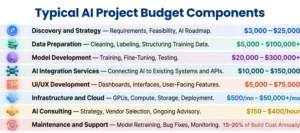
That last line — maintenance — is what most teams forget when drafting their initial AI project budget. AI models drift over time as real-world data changes, and without regular updates, performance degrades faster than you’d expect.
AI Consulting Pricing: What Does It Actually Cost to Hire Experts?
If you don’t have your own AI team, you’re going to work with an AI development service or AI consulting firm. In 2026, on average, AI consulting pricing would typically look like this:
- Freelance AI specialists: $80 – $250 per hour (depending on their skills and location)
- Average AI consulting firms: $75 – $150/hour or projects
- Project retainers range from $50,000 to $500,000+ for Enterprise AI partners.
- Indo offshore AI Developers: $25 – $80/hour — India-based offshore AI development teams are fundamental for custom AI development, particularly for their value for quality ratios.
Just be sure to remember that the less expensive model isn’t always the best. The effectiveness of the AI consulting service will influence the quality of the final custom AI solution. It is much more expensive to correct poor model design or bad data architecture in the future than it would be to get it right in the beginning. Don’t consider only the costs of AI implementation services when examining an AI implementation services partner. Inquire into their track record of delivering, their domain knowledge, their model governance procedures, and their approach to their models’ post-deployment training.
The Hidden Costs Businesses Frequently Overlook
In addition to the apparent AI development cost line items, some expenses are not discussed a lot that come to light mid- project or after launch. Knowing them in advance will be the key to a well-managed AI project budget vs one that grows out of control.
Change Management: Teams are against new tools. The costs of training, internal communication, process redesign, and adoption support are real costs that are often overlooked – and these costs directly impact the ROI of the AI investment.
Compliance and Security: Industries regulated, like healthcare, banking, insurance, etc., have extra conditions on data privacy, model explainability, and regulatory compliance. These aren’t add-on features but are valuable and substantially contribute to the AI implementation cost in these sectors.
Model Retraining: AI models don’t stay accurate forever. As your data evolves, so must your models. Consider occasional retraining expenses – compute time and specialist time.
Vendor Lock-in: Early commitment to one particular cloud AI platform can result in high switching expenses in the long run. Plan your AI workflow automation to be portable from the start.
Integration Complexity: The cost of integration services for older infrastructure with AI can often be much higher than initially thought, especially if requiring custom middleware or data transformation layers.
How to Build a Realistic AI Project Budget
So, the key concepts that seasoned teams always remember to keep in mind to get your AI project’s budget right from the start are:
1. Define the use case tightly before scoping costs
Broad matches, such as “we want to use AI across the business,” are too broad and difficult to measure. Begin with a well-defined, high-value problem. It maintains the AI implementation cost within a reasonable limit and provides you with the proof of early returns to further build upon.
2. Run a discovery phase first
Before (full-scale) custom AI dev. Go through a discovery or proof-of-concept phase first before (full-scale) custom AI dev. A $5,000–$20,000 engagement can save you from a $200,000 mistake further down the line.
3. Build in a 20–30% contingency buffer
The rate of scope evolution is higher for AI projects than for traditional software projects, so 3% is a good contingency estimate. This is for planning purposes and should be a part of the AI project budget from the beginning; it is not being pessimistic.
4. Ask for total cost of ownership, not just build cost
A trustworthy AI consulting services partner should explain to you the infrastructure, licensing, maintenance, and re-training expenses – not just hand you a development bill and leave.
5. Measure ROI in concrete terms
ROI is linked to measurable outcomes such as a reduction in processing time, increased conversion rates, and a decrease in error rates. Here’s how to justify the AI implementation cost internally and ensure leadership buy-in throughout the project lifecycle.
AI Implementation Cost by Use Case
The cost structure of various AI uses is significantly different. Here is a handy reference guide to common implementations:
- AI-powered chatbot: $10,000 – $80,000
- Predictive analytics system: $50,000 – $250,000
- Computer vision solution: $80,000 – $400,000
- NLP and document processing: $30,000 – $200,000
- Recommendation engine: $50,000 – $300,000
- AI workflow automation platform: $40,000 – $500,000+
- Generative AI integration: $20,000 – $300,000
This is the AI implementation cost for development, integration, and initial deployment, but not operational costs, which need to be planned separately.
Conclusion
It’s not just a financial decision when it comes to understanding AI implementation cost; it’s a strategic one. Not all businesses spending the most money on AI in 2026 are the ones benefiting the most. They are the ones investing wisely – by having a clear use case in mind, cooperating with seasoned AI implementation services partners, and creating cost structures that take the entire investment lifecycle into account. From initial concept to expansion, the key to successful AI projects lies in the first day of the project budget. At AnavClouds Analytics.ai, we enable you to plan, build, and scale AI solutions that are designed for impact – not to impress.
Frequently Asked Questions
How much does AI implementation cost for a small business?
The cost of implementing AI in small businesses can range from $5,000 to $50,000, depending on the complexity of the solution and whether it is implemented through a pre-existing platform or custom-developed.
What is included in the cost of AI implementation?
The cost of implementing AI typically depends on the specific scope of the project and can include several key components: data preparation, model development, system integration, UI design, infrastructure setup, and maintenance.
How long does it take to implement an AI solution?
Simple tools can take a few weeks to develop, whereas enterprise-level custom AI solutions may take 6-18 months, depending on the data readiness, the complexity of integration, and project scope.
Is it cheaper to build a custom AI solution or use a pre-built platform?
Pre-built platforms are designed with less flexibility, which are less costly at the onset. AI solutions are more expensive upfront but can provide better ROI over time for enterprise and niche applications.