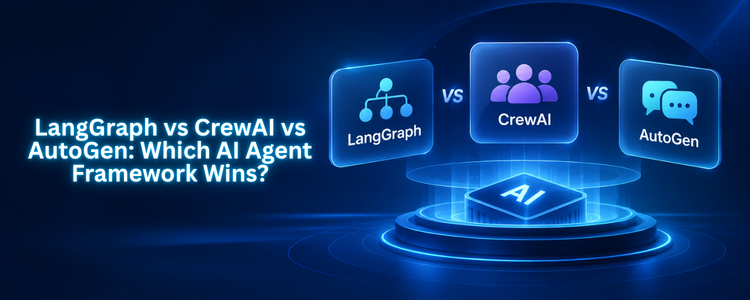
When building multi-agent AI applications, there is usually a three-way comparison that teams make: LangGraph vs CrewAI vs AutoGen. LangGraph models workflows as a graph over a persistent state, suitable for long-running production workflows in a regulated environment. CrewAI can be used to build an agent team according to their roles, perfect for structured business tasks, or for quick prototyping. The other good thing about AutoGen is that it’s one of the first to adopt a conversational multi-agent design; however, in October of 2025, Microsoft moved it into a maintenance phase and advises building new projects using the Microsoft Agent Framework. It relies on the level of control, extent of knowledge about team members, and risk of production that can be accepted. This guide will discuss each of the options in detail and how to make the decision.
Why Is the LangGraph vs CrewAI vs AutoGen Debate Still So Heated?
It’s important to realize that the stakes are higher than they appear. Choosing a framework is not something that can be done for a different code library next month. Defines how your agents are tied to each other, how they fail and how they are audited later.
The Cost of Choosing Wrong
We’re under the gun by the end of 2027: over 40% of agentic AI initiatives will be discontinued, driven by higher costs, a lack of business value, and inadequate risk management. A lot of those failures begin in the design with the selection of a framework that is used for a demo, not production.
Why This Comparison Matters Now
That’s why the LangGraph vs CrewAI vs AutoGen question deserves a proper look. With AutoGen in maintenance mode, every team choosing an agent framework for enterprise use is asking about migration. This guide shows AI agent frameworks compared side by side.
What Are the Main Agent Frameworks Teams Shortlist in 2026?
Four options dominate shortlists today. The LangGraph vs CrewAI vs AutoGen trio sits at the center, with Microsoft Agent Framework added because it now carries AutoGen’s future.
AI Agent Frameworks Compared at a Glance
| Framework | Core Model | Best For | Status in 2026 |
| LangGraph | Stateful graphs | Regulated, long-running workflows | Stable 1.0 since October 2025 |
| CrewAI | Role-based crews and Flows | Fast builds, business automation | Active 1.x releases |
| AutoGen | Conversational agents | Legacy codebases | Maintenance mode |
| Microsoft Agent Framework | Agents plus graph workflows | New Azure-centric builds | GA since April 2026 |
What the Snapshot Tells You
In one line each: LangGraph gives control, CrewAI gives speed, and Microsoft Agent Framework gives vendor backing. AutoGen offers a stable path for existing systems. That’s the short answer to LangGraph vs CrewAI vs AutoGen for busy readers.
What Is LangGraph and Where Does It Win?
LangGraph is LangChain’s low-level orchestration framework. In most LangGraph vs CrewAI vs AutoGen shortlists, it is the control-first option. You define nodes (steps) and edges (routing), and it tracks state as it moves through the graph.
Core Strengths
If you don’t like breaking changes, then you should consider LangGraph’s API Stability Commitment for stable 1.0 in October of 2025. These are the strengths of this in multi-agent framework production work:
- Safe execution: Checkpointers write state after each step; in case of a failure, the run doesn’t have to restart; it continues.
- Human-in-the-loop: Stop a process for approval prior to doing an action that is sensitive.
- Observability: LangSmith provides out-of-the-box traces and evaluation.
- Control: Clear and visible cycles, branching and parallel steps.
Trade-Offs to Expect
The downside is that it takes longer to learn. You’ll have to code more in the beginning, and simple ideas can be burdensome. When failure is costly, LangGraph is the winner in the “LangGraph vs CrewAI vs AutoGen” discussion.
What Is CrewAI and Where Does It Fit?
CrewAI is not a part of the LangChain family and is built independently by the team at CrewAI Inc. Describe the agents as roles (researcher, writer, reviewer), assign tasks, and let the crew work. When considering LangGraph vs CrewAI vs AutoGen, the one that is easiest to explain to non-engineers is LangGraph.
Key Strengths
In a LangGraph vs CrewAI vs AutoGen pilot, that mental model speeds up early buy-in. Its Flows layer adds event-driven control and state persistence, so production teams aren’t stuck with free-form agent chatter. Current 1.x releases include native support for MCP and the A2A protocol, which helps when agents must talk across vendors.
Best fit:
- Internal operations automation
- Research and content pipelines with clear handoffs
- Proofs of concept that need to ship in days, not months
Limitations to Weigh
The catch? Role-based abstractions hide detail. When something breaks deep inside a crew, debugging takes more effort than in a graph where every step is visible. For teams weighing LangGraph vs CrewAI vs AutoGen on speed alone, CrewAI usually leads.
What Happened to AutoGen, and Should You Still Use It?
AutoGen came out of Microsoft Research and popularized the idea of agents solving problems by talking to each other. It built a huge following. Then things changed. Its status matters in any LangGraph vs CrewAI vs AutoGen decision.
Maintenance Mode and Its Successors
Microsoft placed AutoGen in maintenance mode in October 2025, which means bug and security fixes only. The official successor, Microsoft Agent Framework, merged AutoGen with Semantic Kernel and reached 1.0 general availability on April 2, 2026, with Python and .NET support. A community fork called AG2, led by AutoGen’s original authors, continues separately.
Practical Advice for AutoGen Users
So in any fair LangGraph vs CrewAI vs AutoGen review, the honest advice is simple:
- Existing AutoGen systems keep working; plan a migration rather than panic.
- New Microsoft or Azure builds should start with Microsoft Agent Framework.
- New builds on other stacks should look at LangGraph or CrewAI first.
How Does LangGraph vs CrewAI vs AutoGen Compare Head to Head?
Here is how LangGraph vs CrewAI vs AutoGen stacks up on the factors that matter most, from learning curve to long-term support.
LangGraph vs CrewAI vs AutoGen Side by Side
| Factor | LangGraph | CrewAI | AutoGen |
| Learning curve | Steep | Gentle | Moderate |
| Control over flow | Very high | Medium, higher with Flows | Medium |
| Prototype speed | Slower | Fastest | Fast |
| Long-term outlook | Strong | Strong | Maintenance only |
How to Read the Results
Treat these AI agent frameworks compared as tendencies, not verdicts. Any of them can be effectively utilized with a capable team. When something breaks at 2 a.m., the real question is, which one costs less to maintain? To sum it up, LangGraph vs CrewAI vs AutoGen is a balance of control, speed, and support.
Which Is the Best Agent Orchestration Framework for Production?
The outcome of the competition between LangGraph, CrewAI, and AutoGen is far from definitive; there is definitely a winner emerging, though. The most successful agent orchestration framework is the one that makes it through real traffic, audits and outages.
Five Criteria That Matter
When choosing a multi-agent framework production teams can trust, look past demo speed and focus on these:
- Reliability: can a run resume after a crash or timeout?
- Governance: can you log, audit, and explain every decision?
- Human oversight: can a person approve high-risk steps?
- Cost control: can you cap loops and token spend?
- Maintenance: will the framework still be supported in three years?
How LangGraph vs CrewAI vs AutoGen Scores
LangGraph has the highest scores on these tests for regulated work like finance and health. CrewAI is effective when tasks are well-defined, and the payoff for the game is moderate. If Azure-first and vendor support are critical, Microsoft Agent Framework is a good choice for the best agent orchestration framework. AutoGen is a product that fails in the last test. Before you run any of the benchmarks, use this shortlist of five criteria to compare LangGraph vs CrewAI vs AutoGen.
What Makes a Good Agent Framework for Enterprise Use?
An agent framework for enterprise use has to do more than orchestrate agents. It has to fit your security reviews, your data estate, and your existing systems. It also has to survive procurement, which matters more than any LangGraph vs CrewAI vs AutoGen feature list.
Enterprise RAG Architecture Essentials
Most enterprise agents are only as good as what they retrieve. A sound enterprise RAG architecture usually includes:
- A clean ingestion pipeline with access controls carried over from source systems
- A vector store plus keyword search for hybrid retrieval
- A reranking step to filter weak matches before the model sees them
- Evaluation and tracing so you can measure answer quality over time
How the Frameworks Handle Retrieval
Any of the three frameworks can be used to trigger a retrieval tool, but answers will depend on your enterprise RAG architecture. LangGraph enables designing explicit retrieval, grading, and retry steps, and CrewAI can assign a researcher agent to retrieval. In terms of enterprise readiness, support, SLAs, and audit trails, LangGraph, CrewAI, and AutoGen can be considered feature-heavy.
n8n vs LangChain: Which One Do You Actually Need?
The tool that is always mentioned in nearly every LangChain, n8n, or AutoGen discussion is outside the shortlist that we have above. They restrict themselves to solving various problems.
n8n for Low-Code Automation
n8n is a workflow automation platform that works with a low-code approach. It has AI nodes that connect agents to apps like Slack, CRMs and email, without any complicated engineering. Use it when you want to get something integrated rapidly, and the logic is simple.
LangChain for Code-First Agents
As of LangChain 1.0, LangChain is a code-first library for creating agents and chains, and it now has LangGraph under the hood. Use LangChain for custom reasoning, testing, and deployment control in the n8n vs LangChain decision. Many teams will be using both: n8n will trigger the workflow, and the LangGraph service will think.
What Mistakes Do Teams Make When Choosing an Agent Framework?
Teams repeat the same errors when moving a multi-agent framework production rollout from pilot to scale, so watch for these.
Selection Mistakes
- Choosing by GitHub stars. Popularity is not production readiness, and AutoGen’s star count is proof.
- Starting with too many agents. Many use cases need one well-designed agent plus good tools, not a crowd.
- Ignoring evaluation. Without test sets and tracing, you cannot tell whether a change helped.
Build Mistakes
- Skipping the migration plan. Frameworks change fast, so keep business logic separate from orchestration code.
- Treating the framework as the product. Winning the LangGraph vs CrewAI vs AutoGen debate matters less than data quality, retrieval design, and guardrails.
How Do You Choose Between LangGraph vs CrewAI vs AutoGen?
A simple decision path beats a long debate. Work through these steps, then check the result against your team’s skills.
Decision Path for LangGraph vs CrewAI vs AutoGen
- Need audit trails, durable state, and human approvals? Choose LangGraph.
- Need a working prototype this month with a clear role-based process? Choose CrewAI.
- Already running AutoGen? Keep it stable and plan a move to Microsoft Agent Framework or AG2.
- Building fresh on Azure? Start with Microsoft Agent Framework.
- Still unsure? Prototype the same workflow in two frameworks and compare debugging time, not just output quality.
That last step saves more money than any comparison article, including this one.
When to Bring in AI Development Services
Be honest about your team. If your engineers can’t maintain it, it doesn’t work. For those who don’t have the in-house expertise, an AI development service provider can accelerate the transition from prototype to production, particularly in enterprise RAG architecture, evaluation, and monitoring. You also have the option to select an agent framework for enterprise without getting tied up with a particular one, with good AI development services. Not only is it easy to get agents running with either LangGraph vs CrewAI vs AutoGen, but it is also difficult. Getting agents running reliably is the hard part, not settling on LangGraph vs CrewAI vs AutoGen.
So, What Is the Final Verdict?
All that’s left to do is the question: What happens when your agents fail in production? When control, auditability, and recovery are required, LangGraph leads the way. A fast and easy-to-understand team metaphor is provided by CrewAI. AutoGen is a good tool to use for existing applications, but for new builds, it is best to use Microsoft Agent Framework or one of the other two. Use any of the above with solid retrieval, evaluation, and monitoring. AI development services by AnavClouds Analytics.ai experts enable enterprises to select, create, and grow agentic AI systems that have measurable business impact. Looking to take your prototype to production? Contact our team today.
FAQs
What is the difference between LangGraph vs CrewAI vs AutoGen?
The stateful graph paradigm is behind LangGraph, the roles paradigm behind CrewAI, and the conversational agent paradigm behind AutoGen, which is in maintenance mode, with the Microsoft Agent Framework being its replacement.
Is AutoGen still supported in 2026?
While AutoGen continues to receive bug and security fixes, Microsoft has ceased its efforts to add new features since October 2025. LangGraph is the only in maintenance mode in the two platforms: LangGraph vs CrewAI vs AutoGen.
What is the best agent orchestration framework for production?
Usually, the best option for production use is LangGraph due to the features of durable state, checkpointing, and human approvals. There are simpler structured workflows for which crewAI suits are better, and AutoGen isn’t recommended for new builds.
Is n8n better than LangChain for AI agents?
n8n is ideal for low-code automation in business apps, and LangChain is ideal for custom code-first agents. The n8n vs LangChain decision is where n8n is used for triggers and LangChain or LangGraph is used for reasoning.