Most of the dashboard’s reports tell you what happened last week. They don’t tell you much about it today, except to ask that you do it. This divide is what has brought the discussion of agentic AI vs traditional BI from tech blogs to boardrooms. It’s all about autonomy at the heart of it: waiting for analysts to pull reports or acting on data as soon as it arrives. That certainly is a sign of how quickly things are changing. By the end of 2026, 40% of enterprise applications will be connected to AI agents focused on specific tasks, up from less than 5% in 2025. Agentic AI vs traditional BI differ, and this blog explains the distinction, why it is essential to your analytics approach, and how businesses can get there without having to start from scratch.
What Is Traditional Business Intelligence, and Why Is It Losing Ground?
For more than 20 years, traditional Business Intelligence has been the basis for the development of Business Intelligence. It’s based on data warehouses, periodic reports, and data teams that scrub, shape, and present data to the leadership. It’s still useful for structured historical reporting and documentation for compliance purposes.
However, these restrictions are short-lived when things are rushed:
- Slow decision cycles: Insights are often provided weekly or monthly, which is too late when it comes to deciding.
- Analyst Bottlenecks: Each new business question requires another request in an analyst’s queue.
- Static dashboards: Reports do not update when data sources change or business priorities change, all at once.
- Traditional BI is designed for the past, not the future: Reactive by design.
Traditional BI was built for a time when a two-day report would be fine. For most businesses these days, that window simply doesn’t exist.
What Is Agentic Analytics, and How Does It Change the Game?
Agentic analytics turns the model on its head. Instead of humans extracting information from data, autonomous AI agents continually stream through the data, extracting the relevant information and recommending – or even triggering – the next step. There is no need to open a dashboard for the system to work.
This is the operational difference at the heart of agentic AI vs traditional BI: one waits; the other works.
There are three key capabilities for Agentic analytics:
- Autonomous Data Analysis – which analyzes information as it comes, rather than when it has been batched, cleaned, and formatted by hand.
- AI-Driven Decision Making – not just showing numbers, but suggesting specific actions on that basis, depending on context.
- Continuous learning loops – in which the system becomes more decisive with each new data point, but remains unchanged until someone retrains it.
The closest comparison is to a non-sleeping, non-missy, non-waiting analyst who reports on the next scheduled report cycle.
Agentic AI vs Traditional BI: What’s the Real Difference?
The clearest way to understand agentic AI vs traditional BI is side by side. Both aim to help organizations make better decisions, but the mechanics are fundamentally different.
| Criteria | Traditional BI | Agentic Analytics |
| Autonomy | Analysts interpret dashboards and build reports | AI agents detect patterns and recommend actions independently |
| Speed | Periodic reporting cycles (daily, weekly, monthly) | Real-time insights as data flows in |
| Adaptability | Manual updates needed for new data or priorities | Learns and adjusts continuously |
| Scalability | More data typically means more analysts | Agents absorb volume without added headcount |
| Decision style | Reactive — explains what already happened | Proactive — predicts and acts on what’s next |
In short, traditional BI explains the past. Agentic analytics acts on the present and positions you for what’s ahead. That single shift is what makes agentic AI vs traditional BI one of the most consequential strategy discussions in enterprise analytics transformation today.
Why Does Agentic AI vs Traditional BI Matter for Business Intelligence Development?
Business intelligence development teams are being asked to deliver quicker insights with shorter timelines, smaller teams, and even fewer resources. That pressure is where the conversation about agentic AI vs traditional BI becomes more than just theoretical—the real operational part.
The cost of building a traditional BI stack involves having to invest in ETL pipelines, governance layers, dashboard tooling, and analysts to maintain all this. Building an agentic layer means investing in model orchestration, data quality and data governance frameworks instead.
None of them is a complete substitute for the others. The most mature data organizations are finding themselves at a hybrid architecture of traditional BI for historical reports, auditable, and compliant with the regulators and executives. Moreover, agentic layers for those reports that are real-time, actionable, and required by the operations team at that moment. Treating agentic AI vs traditional BI as an either/or misses how enterprise teams are actually building today.
How Does Predictive Analytics Fit Into Agentic AI vs Traditional BI?
Predictive analytics existed well before agentic AI, but agentic systems make it far more actionable. A traditional BI dashboard can display a demand forecast. An agentic system goes a step further — it uses Predictive analytics in healthcare to flag a risk before it materializes and surfaces the specific action recommended to address it.
Take retail as an example. Predictive AI inside an agentic system might identify a stockout risk three weeks in advance and automatically trigger a reorder recommendation, rather than simply charting historical sell-through rates on a report that someone reviews every Friday. That shift from insight to action is one of the sharpest practical dividing lines in the agentic AI vs traditional BI comparison.
What Role Does Real-Time Anomaly Detection Play in Autonomous Data Analysis?
Real-time anomaly detection is one of the most immediately valuable capabilities agentic systems bring to enterprise analytics. Traditional BI catches anomalies after the fact — usually when someone notices something unusual on a report and flags it manually. Autonomous data analysis, by contrast, scans metrics, transactions, and logs continuously, surfacing irregularities the moment they appear.
This matters most in industries where minutes carry real cost:
- Finance: Identifying suspicious transactions before exposure scales
- Healthcare: Catching early clinical indicators before a situation escalates
- Manufacturing: Detecting equipment irregularities before they trigger downtime
What makes autonomous data analysis genuinely different is that it doesn’t just surface the anomaly — it can recommend the immediate response, a capability that static dashboards were never designed to provide.
How Is Conversational BI Shifting AI-Driven Decision Making Across Teams?
There’s a growing acceptance of conversational BI as one of the most sought-after features in enterprise analytics, shifting the thinking of non-technical teams from agentic AI to traditional BI in everyday usage. Rather than requesting a report and waiting 2 days for an analyst’s response, a business user asks a natural language question and receives an answer based on real data right away.
This is the most approachable form of AI-based decision-making. A sales director doesn’t have to have SQL access or a data analyst on call; they just ask the system, it responds, and the decision is made quicker. Conversational BI is best served by well-governed, high-quality data, and the same holds in terms of the adoption of conversational BI in enterprises that start with data quality.
What Are the Business Intelligence Trends 2026 Every Enterprise Should Know?
Business intelligence trends 2026 point clearly in one direction: autonomy layered on top of governance. The enterprises moving fastest aren’t replacing their BI stacks — they’re augmenting them. A few patterns define how this is playing out:
- Agentic layers on existing BI infrastructure, rather than costly rip-and-replace migrations
- Conversational BI interfaces are replacing report request queues for business users
- Governance-first agentic rollouts, because agents working on poor data produce unreliable outputs at scale
- Industry-specific agent deployment in finance, retail, healthcare, and manufacturing rather than generic, one-size-fits-all tools
- Decision intelligence frameworks that treat decisions themselves as something to be measured, optimized, and improved over time
Enterprise analytics transformation in 2026 is not about replacing analysts — it’s about giving them tools that eliminate the low-value, repetitive work so they can focus on higher-order judgment.
How Do You Measure AI ROI When Comparing Agentic AI vs Traditional BI?
Measuring AI ROI is where many agentic AI projects stall out. Gartner has flagged that a significant portion of agentic AI projects will be abandoned due to unclear business value and governance gaps — which makes building measurement into the rollout non-negotiable.
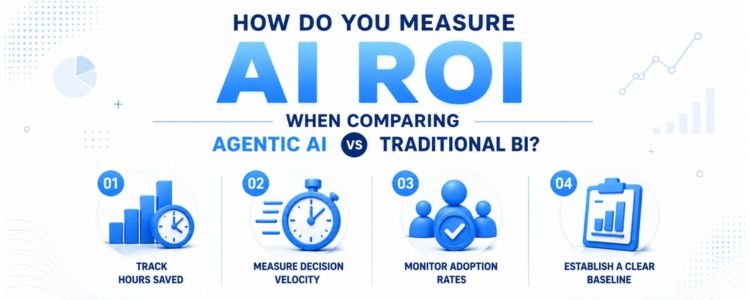
Practical ways to approach measuring AI ROI in the context of agentic AI:
- Track hours saved on manual reporting, data preparation, and analyst queue management
- Measure decision velocity — how long it takes from data arriving to action being initiated
- Monitor adoption rates, not just deployment metrics — an agent nobody trusts delivers zero ROI regardless of its technical performance
- Establish a clear baseline using your existing traditional BI benchmarks before layering agentic capabilities
Enterprises that skip this step find themselves unable to defend continued investment in the agentic AI vs traditional BI shift, even when the technology is working.
Why Is Decision Intelligence the Next Frontier Beyond Agentic AI vs Traditional BI?
Decision intelligence is the discipline of combining data, models, and business context to design, execute, and continuously improve decisions — rather than just producing reports or surfacing recommendations in isolation. In this framework, agentic AI vs traditional BI is a stepping stone, not the destination.
Agentic AI feeds intelligence naturally. It already operates in a monitor-recommend-learn loop that maps directly onto decision design. Traditional BI contributes too, but only after a human converts a report into a decision manually — a step that adds latency and introduces judgment variance at scale.
The organizations moving toward decision intelligence today are building the architecture that will define their competitive edge over the next five years.
How Should Enterprises Approach AI Adoption for Business Without Disrupting What Works?
There’s no need to transform your entire platform on day one by introducing AI. Those making the best use of agentic systems take a strategic and measured approach:
- Find one high-friction process that requires manual effort, e.g., manual reporting cycles, fraud checks, churn prediction, inventory management, etc., are common places to start
- Data quality is a prerequisite — agents amplify data quality, which means that clean and governed data is essential for the introduction of the agent.
- Set measures of success before, not after, deployment — Gartner research repeatedly shows that the inability to define ROI metrics is a key reason for project failure.
- Only scale what proves to be effective — do not scale an agent’s scope before it has been demonstrated in a controlled environment.
- Ensure traditional BI is maintained concurrently for compliance, historical auditing, and regulatory reporting purposes.
Partnering with the right AI Development Services team at this stage ensures deployments stay scoped around business outcomes, not just technical delivery. This way, the process doesn’t have to be a no-brainer between agentic AI vs traditional BI, providing leadership with the proof they need to invest in wider enterprise AI solutions.
Agentic AI vs Traditional BI: The Bottom Line for 2026
The agentic AI vs traditional BI conversation isn’t about picking a winner — it’s about understanding what each one is actually built for. Traditional BI earns its place in compliance, auditing, and historical analysis. Agentic AI brings the real-time, proactive intelligence that fast-moving businesses need to act before opportunities close or risks grow. The organizations getting ahead aren’t choosing between them — they’re building architectures that use both deliberately. If your team is working through the agentic AI vs traditional BI question for your 2026 analytics roadmap, AnavClouds Analytics.ai is built to help you get there — with an outcome-first, hybrid approach that turns your data into decisions, not just dashboards.
FAQs
Will agentic AI completely replace traditional BI tools?
Not in the near term. Most enterprises run both in parallel — traditional BI handles compliance and historical reporting, while agentic AI layers real-time, autonomous intelligence on top of the existing stack.
Which industries benefit most from making the shift toward agentic AI?
Finance, retail, healthcare, and manufacturing see the clearest gains, as these sectors depend heavily on real-time decisions where delayed reporting directly impacts revenue, safety, or operations.
How long does it typically take to see measurable ROI from agentic AI?
Organizations with clean data and well-scoped use cases often see measurable results within a few months, particularly when starting with one focused, high-friction workflow and tracking specific baseline metrics.
Is clean data a requirement before deploying agentic AI systems?
Yes. Agentic systems amplify existing data quality — good or bad. Governed, well-documented data is a foundational requirement, not an optional step, for reliable AI-driven decision-making at scale.