
Doctors have always had partial information. Someone comes into a doctor’s office with a cough, gets blood tests, and the doctor decides without a real understanding of what’s happening on a molecular level. That isn’t a failure of medicine. In fact, that is simply the state of practice. Something changed when massive patient data became available — from EHRs and lab tests to wearables and genomic records. That shift made predictive analytics possible. Predictive analytics combines patient data with machine learning to generate clinical signals. It doesn’t replace physicians. It gives them earlier, clearer warnings — with time to act. That is the story here, and it needs to be understood in context.
The Basics — What Predictive Analytics in Healthcare Actually Does
At its heart, when you strip away the terminology, predictive analytics in healthcare uses historical information about a patient to predict what will happen in the future.
The data inputs will vary – patient history, medication history, images, demographical information, insurance claims – and the algorithms will vary from very simple regression models to complex deep neural networks running thousands of variables concurrently; but the output will always be something like a risk score, a flag, or a ranking of patients requiring attention for an operator or team to respond to.
According to research, “the global health care predictive analytics market size is expected to reach USD 67.26 billion by 2030, growing at a Compound Annual Growth Rate (CAGR) of 24.0% from 2024 to 2030”, which indicates a rapidly growing market in this technology.
This growth in spending on healthcare predictive analytics technology has nothing to do with a lust for technology; it is an effect of pressures on the system, increasing chronic illness, staff shortages, and the introduction of value-based care that causes negative health outcomes to have direct negative financial consequences. Healthcare predictive analytics, used well, addresses these problems all at once.
Where Predictive Analytics in Healthcare Is Actually Being Used — Real Applications, Not Theory
1. Catching Disease Before It Catches Patients
Early detection has always been medicine’s most valuable asset in predictive analytics in healthcare. A cancer caught at stage one looks nothing like a cancer caught at stage four — in terms of treatment options, patient experience, and cost of care. Predictive healthcare analytics promises that it can push that detection window even earlier, before the patient has any idea something is wrong.
Machine learning in healthcare has made this possible across several clinical areas. Deep learning models analyzing pathology slides and CT scans are identifying malignancies, retinal damage, and neurological markers at a resolution and consistency that meaningfully complement clinical review. Separately, population-level risk stratification tools are helping care managers proactively identify patients managing multiple chronic conditions simultaneously — the people most likely to end up in the emergency room if nobody reaches out first.
2. Hospital Readmissions – A Solved Problem
That one out of five adults admitted to a hospital ends up returning later for a subsequent admission, a statistic that is both evidence of clinical failings and post-discharge shortcomings, represents billions in waste for health systems. And it likely represents failure on our part to a patient.
AI based health data analytics derived from discharge data sets can create individualized patient risk scores that care coordinators will actually access. Predictive analytics in healthcare helps in flagging a high-risk patient alerts a coordinator that she should have a check in call placed, ensure medication access and schedule telehealth or other in-person check-in within 48 hours of discharge. It sounds easy, but consistently – at scale – closing that care loop is what creates sustained, tangible value from predictive analytics in healthcare.
3. Sepsis Detection – A Race Against the Clock
Few clinical scenarios in healthcare carry the time pressure of sepsis. One can go from mild to devastating over mere hours, and when managing a large number of patients it’s difficult for a clinician to recognize the earliest, subtlest signs of illness. Healthcare data analytics tools embedded in workflows continuously process vital sign monitoring, trend analysis of labs, and clinical documentation, and have changed that time window substantially.
The UC San Diego Health system is one example that incorporated deep learning models directly into EHR workflows. This helped to perform early sepsis prediction with live patient data running in the background while the physicians performed normal care, integrating it as an EMR notification rather than a separately check-able data point. The predictive analytics in healthcare integration of AI into a clinician’s workflow is critical for developing solutions that are important.
4. Predicting Surgical Risk
Another area where predictive analytics in healthcare has proven itself useful is surgical prediction. Artificial intelligence in healthcare has found meaningful tractions for ML models that can be trained on large data sets of surgical outcomes. This can include predicting specific adverse post-operative outcomes such as infection, cardiac events or stroke. Studies in both hepatic and colon procedures have showed models with up to an AUC of 0.98 for certain outcomes. Providing both the surgeon and the patient with increased confidence regarding the risk of post-operative complications enhances patient preparation and quality of physician-patient communication.
The Shift Toward Agentic AI in Healthcare
This is where things get genuinely interesting — and where the next few years will define how dramatically predictive analytics in healthcare changes.
Most discussions of AI in healthcare focus on prediction: the model scores a risk, a human decides what to do. Agentic AI in healthcare goes a step further. These systems don’t just generate predictions — they initiate actions. A care gap is identified, and the system autonomously schedules a follow-up. A readmission risk flag fires, and the system contacts the patient directly with discharge instructions. A deterioration signal appears, and the system alerts the on-call team through the appropriate channel.
Agentic AI in healthcare essentially closes the loop between insight and intervention — without requiring a human to manually move information from one system to another. For health systems dealing with workforce shortages and clinician burnout, this has real operational significance. It also represents a direction where AI development services are increasingly being tasked to build — not just predictive models in isolation, but end-to-end intelligent workflows.
AI-driven predictions paired with agentic execution could, over the next few years, fundamentally change what healthcare administration looks like — and free clinicians to focus on the work that genuinely requires their expertise.
Predictive Analytics in Healthcare Specialty
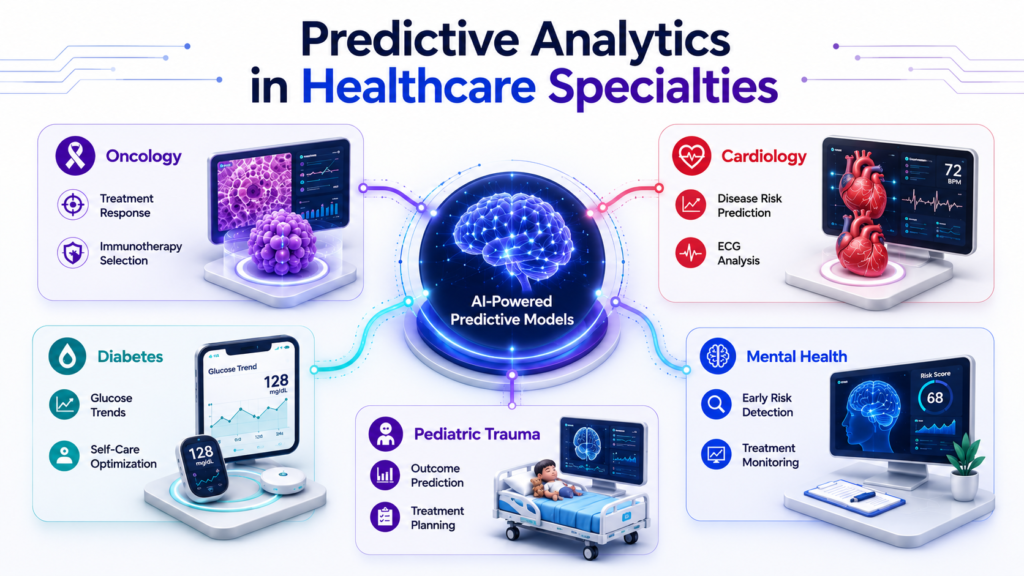
Predictive healthcare analytics is already used in every department, every scenario. This is what it looks like:
Oncology
The applications include the use of artificial intelligence in health analytics for prediction of treatment response to tumor immunotherapy and for classification of mutation burden in pathology imaging, enabling the selection of the correct treatment. By applying trained models on histopathological slides, it has become possible to determine how different patient profiles are likely to respond to immunotherapy, thus enabling the reduction of trial-and-error in one of the most complex areas of medicine.
Cardiology
The field of machine learning has made predicting such risks as those of aortic aneurysm, coronary artery disease, and post-operative events of a coronary artery bypass surgery now possible. With the use of deep learning on a resting ECG, the identification of cardiac autonomic risk markers without extensive, invasive measures is now possible.
Diabetes
Predictive analytics in healthcare is increasingly important in giving diabetic patients tools for managing self-care, including a predicted glucose trend, prediction of risk of complications, and an optimized diabetic profile for self-care. One Artificial intelligence in healthcare review shows an increasing acceptability of using AI techniques as medically justified for managing diabetes self-care in patients who were followed, which indicated a better level of quality of life in that patient group.
Mental Health
Predictive modeling using EHRs can identify patterns that represent such aspects as treatment failure, mental deterioration, increased risk of suicide, etc. Although it requires sensitive care in practice, the ability to promote an earlier detection of mental health problems may be extensive.
Pediatric Trauma
Studies applying machine learning in healthcare to pediatric traumatic brain injury datasets have found these models to be highly sensitive in predicting outcomes — offering clinicians a more structured basis for prognosis communication and treatment planning in a population where every decision carries particular weight.
The Challenges Nobody Should Gloss Over
Any honest conversation about predictive analytics in healthcare has to include what can go wrong — because the stakes are high enough that getting it wrong matters.
Bias in, Bias Out
Predictive models learn from historical data, and historical healthcare data carries the fingerprints of decades of systemic inequity. A readmission model trained predominantly on data from a particular demographic group will likely underperform for populations that weren’t well-represented in the training set. That’s not a theoretical concern — it’s a documented pattern. Responsible deployment of healthcare AI solutions requires explicit bias auditing, diverse training data, and ongoing fairness monitoring as the model runs in production.
Data governance isn’t optional
Patient health data is among the most sensitive information that exists. Every AI-powered healthcare data analytics deployment needs a serious data governance foundation — HIPAA compliance, appropriate consent frameworks, strict access controls, and clear audit trails. Organizations that treat this as a compliance checkbox rather than a genuine obligation tend to learn the hard way.
Clinicians have to actually use it
A well-performing model that clinicians ignore delivers zero clinical benefit. This is a more common problem than the technology community likes to admit. Healthcare AI solutions that are built in genuine collaboration with clinical teams — with transparent logic, low-friction workflow integration, and clear feedback mechanisms — get adopted. The ones that aren’t, don’t.
Models Age
A predictive healthcare analytics system trained on pre-pandemic patient data doesn’t automatically remain accurate for post-pandemic. Clinical populations change; treatment protocols evolve, and seasonal patterns shift. Continuous revalidation isn’t a nice-to-have — it’s a basic requirement for any system making clinically relevant predictions.
Conclusion
The case predictive analytics in healthcare doesn’t really need to be made anymore — the evidence is there, the adoption is accelerating, and the problems it solves are not going away. What matters now is execution: building on the right data infrastructure, addressing bias proactively, integrating into clinical workflows in ways that actually get used, and choosing partners who understand the difference between a working demo and a production-grade system. The organizations that get this right will be better placed to manage cost, reduce preventable harm, and deliver the kind of forward-looking care that patients and payers are increasingly expecting. That’s exactly what AnavClouds Analytics.ai is built to help healthcare enterprises do — through outcome-focused AI development services that go beyond prediction and drive real, measurable change.
FAQs
What is predictive analytics in healthcare?
It’s the use of patient data — historical and real-time — processed through machine learning and statistical models to forecast future health events, giving providers a chance to intervene before problems escalate.
How does predictive analytics actually improve patient outcomes?
It helps identify at-risk patients earlier, supports faster and more accurate diagnosis, reduces preventable hospital readmissions, and enables more personalized treatment decisions — all of which translate directly into fewer adverse events and better care quality.
What’s the difference between AI and predictive analytics in healthcare?
AI in healthcare is the broader category — it includes machine learning, natural language processing, computer vision, and more. Predictive analytics is a specific application within that space, focused on using patterns in existing data to forecast future clinical or operational outcomes.
Is predictive analytics in healthcare secure and HIPAA-compliant?
When implemented properly, yes. Compliant systems include end-to-end data encryption, role-based access controls, full audit logging, and governance frameworks aligned with HIPAA and applicable regional data protection regulations.