

AI budgets are growing faster than the proof of returns. According to a report, only 28% of AI use cases in infrastructure and operations fully succeed and meet ROI expectations — while one in five fails outright. That gap between spending and results is not a technology problem — it is a measurement problem. Organizations pour resources into AI initiatives without a structured approach to measuring AI ROI. This guide breaks down the frameworks, metrics, and practices that connect AI investment to actual business outcomes.
Why Measuring AI ROI Is Harder Than It Looks
Most business leaders assume measuring AI ROI follows the same logic as evaluating any other technology to spend. It does not — and that assumption is where things go wrong early.
There are a few structural reasons why AI return on investment is difficult to quantify:
- Benefits rarely surface directly. When AI helps a team work faster or reduces errors in a workflow, the gain shows up as productivity, not as a line item. Unless you are actively tracking time saved and connecting it to output, the value stays invisible.
- Costs are distributed and easy to miss. AI implementation cost goes beyond what appears on vendor invoices. It includes engineering hours, data preparation, model tuning, change management, training, and ongoing maintenance. Organizations routinely underestimate total ownership costs because much of the spend is buried in broader operational budgets.
- Baselines are missing. This is the most common failure point when measuring AI ROI. If you did not document how long a process took before AI, what the error rate was, or what it cost to run, you cannot prove that anything improved. Most enterprises deploy first and ask measurement questions afterward, by which point the baseline is gone.
- Attribution is genuinely complex. When sales performance improves after deploying an AI-powered lead qualification tool, is the gain from the AI, the new sales process, improved market conditions, or leadership change? Separating AI’s contribution from other variables requires a level of rigor that most commercial settings do not build in from the start.
Understanding these challenges is step one. What follows is how to systematically work through them.
Building an AI ROI Framework That Actually Holds Up
There is no need to make a structured AI ROI framework complicated. The framework should be consistent, based on real numbers, and linked to outcomes that are of interest to business leaders. This is a structure that is proven to work for various use cases and businesses:
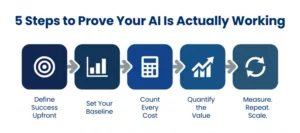
Step 1 — Define Success Before You Deploy
Before launching any AI system, define what success would look like in terms of specific and measurable outcomes. Measuring AI ROI without a predefined target turns into storytelling after the fact. The right definition of success is something like getting invoices processed from four hours per batch to 45 minutes or reducing escalations to customer support by 30% within 90 days. Specificity requires honest thinking and eliminates ambiguity during the evaluation process.
Step 2 — Establish a Baseline Every Single Time
Without a baseline before deployment, it’s hard to measure the ROI of AI. Identify each process you are looking to automate or supplement – and document how it is performed currently, including the time taken on each task, the expense per unit, the number of errors recorded, the volume of work, and the number of employees. This data will be the denominator for all subsequent ROIs.
Step 3 — Capture Total AI Implementation Cost
Correctly measuring the ROI in AI requires capturing all costs—the visible ones and those that are not. The complete cost picture encompasses:
- Direct costs — API usage, cloud compute, storage, software licenses
- Development costs — engineering hours, data labeling, model tuning, integration work
- Operational costs — ongoing maintenance, monitoring, user support, bug fixes
- Hidden costs — change management, compliance overhead, technical debt, opportunity cost
Organizations that only look at vendor costs when measuring AI ROI consistently arrive at inflated return figures that collapse under scrutiny.
Step 4 — Quantify the AI Business Value Generated
AI business value can be categorized into four main areas:
- Time savings – Determine hours saved x fully loaded labor cost. That’s just one efficiency gain that has an annual value of more than $31,000 for a five-person team, working $60 an hour.
- Error reduction — Determine the cost of errors prevented. With a process of 2,000 units/month, $120/defect, and a reduction of defect rates from 6% to 1%, it would result in over $144,000 in avoided rework per year.
- Revenue impact — In customer-facing applications, measure changes in conversion rate, upsell performance, and retention. It is here that the potential for ROI from AI is greatest and attribution is most complex.
- Risk reduction — estimate the value of the risk reduction that can be achieved in consequence of compliance, fraud detection, or quality control improvements. These don’t always result in tangible income; however, they lessen actual monetary risk.
Step 5 — Calculate, Then Keep Measuring
The core formula for measuring AI ROI is:
(Value created – Total Cost) / Total Cost x 100
However, a single calculation is not a measure of activity. The conditions of AI systems change, user habits change, and business conditions change. The organizations that demonstrate a high ROI on AI measure it regularly and track it monthly with leading indicators and quarterly with business-level indicators.
The Right Metrics for the Right Use Case
One of the most important shifts in measuring AI ROI is moving from generic metrics to use-case-specific ones. Here is how that looks across common enterprise applications:
Customer Support Automation
- Resolution rate without human escalation
- Average handle time before and after AI
- Cost per interaction — AI-assisted versus fully manual
- Customer satisfaction score change
Document and Data Processing
- Data extraction accuracy, field by field
- Touchless processing rate — documents handled without human review
- Exception rate — documents still requiring manual intervention
- Cost per document processed
Sales and Lead Intelligence
- Lead qualification accuracy versus actual sales outcomes
- Time from lead assignment to first meaningful engagement
- Conversion rate shift in AI-assisted versus non-assisted pipelines
- Revenue per AI-assisted opportunity
Risk and Compliance
- Policy compliance rate before and after AI monitoring
- Time-to-detect for violations or anomalies
- Cost of compliance versus value of violations avoided
- Audit pass rate on AI-related processes
The right AI ROI metrics are always the ones tied to decisions business leaders actually make — not the ones that are easiest to pull from a dashboard.
Common Mistakes That Undermine AI ROI Measurement
Having the right framework is half the battle. The other half is avoiding the errors that make even good frameworks produce misleading results.
- Counting activity, not outcomes.
“Our AI handled 50,000 conversations last month” tells you almost nothing about AI business value. Did those conversations resolve issues? Did they reduce support costs? Activity metrics feel like progress and rarely are.
- Overestimating captured time savings.
Time saved is only a real value if it converts to productive work. If employees fill reclaimed time with low-priority tasks, the efficiency gain disappears. Truly measuring AI ROI means verifying that saved capacity translates into output.
- Treating measurement as a one-time event.
Only 25% of AI initiatives deliver their expected ROI, and only 16% ever scale enterprise wide. A significant part of that failure is treating AI ROI measurement as a launch-time exercise rather than an ongoing operational practice.
- Cherry-picking favorable metrics.
Selective reporting creates a credibility problem the moment a complete picture is requested. Measuring AI return on investment means presenting complete results — including the metrics that show underperformance and inform what needs to change.
- Skipping the human side of adoption.
A model with 90% accuracy used by 15% of the target team returns far less than a model with 80% accuracy used by 85% of the team. Adoption rate is not a soft metric when measuring AI ROI — it is one of the strongest predictors of whether reported numbers will hold up over time.
Using an AI ROI Calculator: What It Can and Cannot Tell You
An AI ROI calculator is a useful starting point, not a finish line. Most calculator tools let you input estimated time savings, error reduction rates, and implementation costs to project a return figure. That projection is only as reliable as the assumptions feeding it.
Where an AI ROI calculator genuinely helps is in the pre-deployment phase — running scenarios to evaluate whether a use case is worth pursuing, how sensitive returns are to adoption rates, and what the payback period looks like under conservative versus optimistic assumptions. It also creates a shared quantitative language between technical teams and financial stakeholders early in the process.
What a calculator cannot do is replace instrumentation. Real measuring AI ROI requires live data — actual usage, real throughput numbers, production-environment accuracy — not estimates. Build the calculator for alignment, build the measurement infrastructure for accountability.
When to Work With an AI Consultancy Partner
For many organizations, the challenge is not understanding that measuring AI ROI matters — it is having the internal capability to do it well. Effective AI ROI measurement requires instrumentation decisions made at deployment time, cross-functional collaboration between data and business teams, and governance structures that most in-house teams are not built to sustain.
This is where working with experienced AI development services and a dedicated AI consultancy partner changes the outcome. The right partner does not just build the model — they help define the baseline, design the measurement architecture, identify which metrics fit your specific use case, and create reporting frameworks that hold up at the board level.
If your organization is investing in custom AI development or generative AI solutions, the measurement infrastructure should be designed with the same care as the AI systems themselves. AI consulting services that treat measurement as a core deliverable — not an afterthought — are the ones worth engaging.
What Separates the Organizations That Get AI ROI Right
Organizations that excel at measuring AI ROI consistently share a few traits. They document baselines before deployment. They define success metrics before the first sprint. They instrument systems to track value from day one. And they connect AI metrics to the business outcomes executives are already managing against.
Measuring AI ROI is not a finance team exercise or a post-launch report. It is a delivery competency — one that determines whether AI programs earn continued investment or quietly stall.
The companies that make AI work at scale are not necessarily the ones with the most advanced models or the largest compute budgets. They are the ones who built a culture where AI ROI measurement is part of how delivery is defined, not just how it is evaluated afterward.
Conclusion
Getting serious about measuring AI ROI is no longer optional for organizations that want AI to move beyond pilots and into lasting business value. The measurement gap is real, well-documented, and entirely solvable with the right frameworks, the right metrics, and the right partner. Whether you are evaluating your first AI initiative or trying to scale value across a broader program, the approach outlined here gives you a foundation that holds up to executive scrutiny. At AnavClouds Analytics.ai, we help enterprises build measuring AI ROI into every stage of implementation — from baseline definition to ongoing performance tracking — so that the value of AI is always visible, defensible, and growing.
FAQs
What is the basic formula for measuring AI ROI?
The formula used is (Value Created − Total AI Cost) ÷ Total AI Cost × 100. Don’t only consider the software license; always consider the full AI implementation cost – infrastructure, AI development, maintenance, and change management.
How long does it typically take to see AI return on investment?
Typical results are seen in 12-24 months. Use cases in which the automation is simpler can yield positive results in 60-90 days. The time to timeline is dependent on the complexity of the deployment, how fast the adoption has taken place, and the accuracy of the expected success of the deployment before launch.
What metrics matter most when measuring AI ROI?
Think in Business Level Terms – Cost per Transaction, Throughput Improvement, Revenue Impact, Error Reduction. Technical metrics, such as model accuracy, are good for optimization but must relate to financial or operational outcomes to qualify as ROI.
Why do so many AI projects fail to show measurable returns?
The most frequent reasons for failure are the lack of baselines, fuzzy success metrics, failure to account for costs, and assuming ROI is a single event rather than a continuous process that is part of the AI system’s processes.