
Most organisations have a waste of time. A marketing manager needs a report. They request it from IT. IT has 12 other priorities. Four days later, the report comes back – too late to be used.
This is not a technology problem. It is a process problem. And self-service BI was designed to do just that.
The self-service BI market was valued at $7.99 billion in 2015, and is projected to reach $32.97 billion in 2034 – a CAGR of 16.77%. And it’s no accident it’s increasing at this rate. Businesses in all industries are starting to recognise that self-service business intelligence (BI) is no longer a luxury; it’s essential. When all parts of the business have access to data and can interpret and use it without relying on IT for help, decision-making is faster, smarter, and more consistent. In this article, we’ll look at what self-service BI means, planning your self-service BI strategy, pitfalls, and how to ensure the shift to self-service BI sticks.
Understanding Self-Service BI: More Than Just a Dashboard Tool
To get right at implementation (and not miss the forest for the trees), let’s first explore what self-service BI is and is not.
Self-service business intelligence is a set of tools, processes, and governance structures that enable non-technical users to autonomously access, analyze, visualize, and report on data without coding or relying on IT each time. It’s not merely about providing everyone with a dashboard password. When properly implemented, self-service BI is a different data culture and architecture.
Here’s what sets a sophisticated self-service BI environment apart:
- Data democratization – Everyone can access data, not just analysts or specific data sets
- User-friendly tools – designed for the business, not the IT engineer; drag and drop, natural language, visual exploration
- Embedded governance – People can play with data freely within constraints, so security and quality are not sacrificed
- Embedded literacy – Users are taught how to use the tool, how to understand the insights, and how to react accordingly
When these four factors are in play, self-service analytics becomes the DNA of the organisation.
Why Businesses Are Accelerating Their Self-Service BI Strategy
Self-service BI is not only increasing due to market demand, but also to address problems.
The IT Bottleneck Problem
Traditional BI involves making all data requests to IT or a data group. This causes delays, bottlenecks, and frustration for business users who are best positioned to identify what needs to change to improve the business. A sales manager who notices trends suggesting a territory is underperforming shouldn’t have to wait a week for someone to run a report that can be generated in a couple of minutes using self-service BI tools.
The Data Democratization Imperative
Businesses have more data than ever from their customer relationship management (CRM), marketing, operational, and customer engagement platforms. But data is only useful if it’s available. Self-service business intelligence (BI) makes the data accessible to the whole team, so they can make better decisions.
The Speed-to-Insight Gap
In today’s competitive world, there’s no time to waste between capturing data and using it to inform a decision. Self-service analytics eliminates handoffs and team-based, interactive exploration.
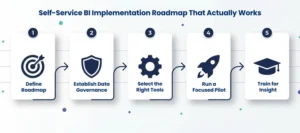
Building a Self-Service BI Implementation Roadmap That Actually Works
Many companies buy a BI tool and do a pilot; that’s a self-service BI initiative. Six months later, it’s not being used, and the program is stalled. The common issue is that there is no BI implementation roadmap in place.
Here’s a step-by-step guide to self-service BI implementation to build for the long haul.
Phase 1: Define Your Business Intelligence Roadmap and Goals
Start with the outputs, not the inputs. Your company needs to answer the questions: What decisions are slow? Which areas lack access to data? Which parts of the business will self-service BI help in the next six months?
This discovery phase should include key players from finance, operations, marketing, and sales – not just IT. The idea is to create a business intelligence plan that is driven by business issues, rather than technical features.
Key activities in this phase:
- Review existing reporting processes and pain points
- Identify data sources to be integrated
- Establish key performance indicators (reporting time, take-up, decision-making time)
- Identify a sponsor – without support from the C-suite, self-service BI programs don’t last
Phase 2: Establish Data Governance Before You Scale
This is where most companies fail – and where they run into trouble. Un-governed self-service BI results in “report sprawl” – hundreds of dashboards with conflicting metrics, no one version of the truth.
Governance in the context of self-service BI is not a matter of locking down access. It means clarity: data definitions and metrics, security and role-based access, and a process for vetting new data sources before they are made available to users.
Governance is the underpinning for a reliable self-service business intelligence platform.
Phase 3: Select the Right Tools for Your Modern BI Implementation
Select the tools after planning, not before. However, the tools that take the market for mature self-service BI environments share similar attributes: they are easy to use, have built-in connectors to existing data sources, are secure, and scalable.
Commonly used platforms in modern BI implementation projects include Power BI, Tableau, Qlik Sense, Looker, and Domo. They each have their own strengths based on your existing tech environment, the number of users, and data complexity.
Questions to ask during tool evaluation:
- Will it allow non-technical users to create reports without weeks of training?
- What are the rates of data refresh for self-service analytics?
- What support and training is available from the vendor?
- Will it work with your data warehouse or cloud platform?
Phase 4: Run a Focused Pilot, Then Scale Thoughtfully
One of the top mistakes made in self-service BI implementation is going “all-out” across the organization. Doing a pilot in a few departments with demonstrable use cases allows your team to iron out integration problems, fine-tune training, and get some quick wins to generate enthusiasm.
Select a department that is most painfully reporting. Have them work with the software for 60-90 days with coaching. Capture what worked, what didn’t, and what had to be changed in the BI strategy and implementation steps before moving on.
Phase 5: Train for Insight, Not Just for Tool Usage
Without training in interpretation skills, users who can execute a report are a governance and an investment risk. Self-service BI training should not be about button pressing. It should cover:
- How to formulate a business question before using the tool
- How to select the appropriate chart for the appropriate data
- How to identify outliers, exceptions, and misleading visualizations
- When to ask a data analyst, versus when to act on your own insights
The companies that foster true data cultures with self-service BI are those that promote data education in addition to access.
Common Challenges in Self-Service BI Strategy (And How to Address Them)
While creating a self-service BI strategy can beneficial, there are common problems that may arise. Here are the places teams typically get stuck and tips for overcoming them.
Data Silos and Integration Complexity
Data silos arise due to geographical and departmental divisions, and a lack of a coordinated data strategy, leading to inconsistent data that requires time and effort to reconcile. Integration of data from different systems is required before self-service BI can take place. This usually means a data engineering project up front, either using ETL, a cloud data warehouse, or a data lakehouse approach, to ensure users are looking at a unified, “clean” data source.
Shadow IT and Conflicting Metrics
With multiple teams building reports with their own logic, you get three versions of “revenue”. This leads to distrust in metrics and political battles. The answer is a semantic layer – a place where important metrics are defined and standardized and then made available to self-service analytics.
Low User Adoption
Just because they have the tool doesn’t necessarily mean they will use it. Low User Adoption in self-service BI deployments is a change management problem. Users will go back to spreadsheets if they are not confident in the tool, do not know how to use it effectively, or have not been shown how to save time. Regular enablement, executive example, and early wins, promoted throughout the business, also help.
Data Quality Issues
You get out what you put in. If the data, you’re using to fuel your self-service business intelligence (BI) system is not consistent, complete, or timely, you won’t draw the right conclusions, no matter how advanced the tool is. Validations and checks on data quality should be incorporated right from the start of a modern BI implementation project.
How AI Is Reshaping Self-Service BI in 2025 and Beyond
The use of AI in self-service BI is no longer a prediction – it is a reality, and it is empowering non-technical users to do more with data.
A key innovation is natural language querying. Users can simply type a question in English – “Which regions had the highest activity last quarter?” – and the system will automatically create visualization. In early 2025, Qlik introduced an AI-powered analytics capability that allows users to discover insights in large data sets with natural language queries and AI-powered visualizations, allowing organizations to automate data preparation, predictive analytics, and trend analysis.
Beyond search, AI is also being integrated into self-service BI tools for anomaly detection, auto-generated insights, and predictive analytics, features previously only accessible to data scientists. This democratises self-service analytics to a wider audience in the organisation.
For businesses looking to pair their self-service BI strategy with deeper AI capabilities — predictive models, machine learning pipelines, generative AI for data exploration — specialized AI development services bridge that gap between standard BI tools and truly intelligent analytics infrastructure.
Choosing the Right Business Intelligence Consulting Services Partner
For many companies, the difference between developing a BI implementation plan and actually putting it into action is expertise. Business intelligence consulting services bring the experience and expertise in architecture, change management, and technical expertise that many internal teams lack, particularly in the early stages.
When looking for a business intelligence services provider, ask if they have:
- Experience with self-service BI across the industries your company operates in
- Areas of expertise in data engineering, governance planning, and platform setup – not just software licensing
- An approach to user training and adoption, not just installation
- Ongoing support after the launch, as self-service BI is an ever-evolving process
Your partner isn’t just delivering a platform. They help you develop in-house skills to maintain and develop your self-service BI environment.
Conclusion
Self-service BI is more than a reporting revolution – it is a decision-making revolution. With the right strategy, governance, and training, it will transform data from an IT function to an everyday team resource. The strategy is simple: set the objectives first, govern before scaling up, select tools that match users’ needs and capabilities, and focus on data literacy as well as access to the tool. If your organization is ready to move from reactive reporting to proactive, data-led decision-making, AnavClouds Analytics.ai brings the AI expertise, data engineering depth, and implementation experience to help you get there — and stay there.
FAQs
What is self-service BI, and how is it different from traditional BI?
Traditional BI is when IT or data professionals create reports and perform analysis for business users. Self-service BI allows the business user to do this themselves – giving them the tools to look at data, create dashboards, and draw their own conclusions.
What are the key steps in a self-service BI implementation roadmap?
The BI implementation roadmap consists of five steps: identify business objectives and use cases, create a data governance framework and a single layer of data, choose the right product for your environment, pilot the product before rolling out across the organisation, and ensure training and adoption support for ongoing success.
What are the biggest challenges in implementing self-service BI?
The challenges include siloed data, lack of adoption, inconsistent metrics, and data quality problems in the underlying systems. An effective self-service BI strategy tackles these issues before, not after, deployment.
How is AI changing self-service analytics?
AI is making self-service analytics much more accessible through natural language search, automatic insight discovery, anomaly detection, and forecasting without the need for technical expertise.