
The world is talking to us, but it’s hard to hear. The difference between data and taking action on it to make better, faster decisions is what separates high performers from the rest. That’s why business intelligence transformation has evolved from “something we’d like to do” to “something we need to do”. Where businesses are now asking questions, such as, “What did we do last quarter?” they are also asking, “What do we do next, and why?” And that means changing the way your company works with information – the tools, processes, and culture. In this blog, we’ll explore how this transition happens, what typically goes wrong in most enterprises, and how to develop a winning BI strategy.
Why Business Intelligence Transformation Is No Longer Optional
The business intelligence software market was worth around $41.74 billion in 2024 and is expected to grow to $151.26 billion by 2034, with a CAGR of 13.74%. This growth isn’t for nothing – it’s a reflection of how much companies across the board are investing in BI modernization.
Historically, companies used BI as a reporting tool. You extracted data from a database, plugged it into a spreadsheet or a dashboard, and that was that. This was fine back when markets were stable, and there was not a lot of data to process. Neither is the case today.
Business intelligence transformation is changing the business model from reactive to proactive – to “action before reaction”. It’s not simply a software upgrade. It’s about who gets access to data, how fast they can get it, and how they can use that data to make their work more efficient and effective.
Traditional vs. Modern BI: What’s Actually Changed
Understanding traditional vs modern BI is the first step to appreciating why transformation is necessary — and urgent.
Traditional BI systems were built for a different era. They relied heavily on IT teams to pull reports, often took days or weeks to deliver insights, and were primarily backward-looking. If you wanted to know why sales dropped last month, traditional BI could eventually tell you. If you wanted to prevent it from happening next month, you were mostly on your own.
Modern business intelligence flips that model. Here’s how the two compare:
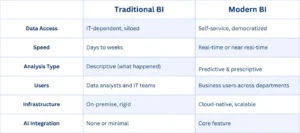
The shift from BI reporting vs analytics is a useful way to frame this. Reporting tells you the score. Analytics helps you understand the game and adjust your strategy mid-match.
Breaking Down a Solid BI Transformation Strategy
A BI transformation strategy doesn’t always work. In fact, many companies spend a lot of money on tools, and yet their data culture doesn’t change. It’s not the BI tools that are at fault, but the strategy.
Here’s what a sound BI implementation strategy actually looks like in practice:
1. Start With a Data Audit, Not a Tool Selection
Know your data prior to looking for a tool: what you’ve got, where it resides, the quality, and who owns it. Without this, companies end up paying for fancy BI tools on top of dirty data, and are surprised their dashboards don’t make sense.
Key questions to answer:
- What data sources are combined, and which are still isolated?
- Are there any data quality problems that would affect reporting?
- Do different parts of the business use different definitions for the same metrics?
2. Define What “Transformation” Means for Your Business
There’s no one definition of business intelligence transformation. A retailer embarking on a BI transformation may focus on real-time stock management and forecasting. A bank might be more interested in risk management and compliance reporting. Set your own metrics for success when you start transforming business intelligence systems.
3. Build a BI Strategy for Enterprises Around Use Cases, Not Features
Vendor demos are designed to impress. Your BI strategy for enterprises should be built to help your business. Determine three to five top priorities – the decisions that take too long or are based too often on intuition – and focus on solving those with your BI strategy.
4. Invest in Data Governance Early
A major pitfall of data analytics transformation is the failure to give data governance the attention it deserves. Without data ownership, security, and data definitions, the most advanced BI solution will only generate inconsistent results and a lack of confidence.
5. Prioritize Change Management Alongside Technology
Enterprise BI solutions are useless without the training and awareness in your teams, and an understanding of why it is important. Develop education programs, appoint data champions across business units, and link BI usage to business outcomes.
Turn raw data into real decisions with AI-powered BI built for the way modern enterprises actually work.
BI Reporting vs Analytics: Understanding the Real Difference
This is a critical consideration when embarking on a business intelligence transformation.
BI Reporting is structured and predefined. It answers: “What happened?” It’s critical for regulatory compliance, key performance indicator reporting, and executive reporting. But it’s passive by nature.
Analytics – especially predictive and prescriptive analytics – asks: “What is likely to happen, and what should we do about it?” This is where modern business intelligence can deliver a competitive edge.
Companies that view BI reporting vs analytics as one or the other are mistaken. A BI modernization project that is sophisticated leverages reporting and adds analytics. Reporting is your starting point – where you are. Analytics will tell you where you’re headed and how to get there.
It’s also important for resource allocation. An organisation that doesn’t invest much in analytics is likely doing so because they’re mothballing its reporting investments. A key element of any business intelligence transformation is to reduce maintenance, freeing resources to focus on the future.
How AI Is Reshaping Business Intelligence Transformation
The most disruptive influence in the field of business intelligence transformation today is artificial intelligence (AI). It’s affecting everything – from data preparation through to the way insights are presented and consumed.
AI-Powered Business Intelligence: What It Enables
There are many ways in which AI-powered business intelligence makes a difference:
- Automated data preparation: AI can cleanse, standardize, and merge data from multiple sources automatically, dramatically reducing the time analysts spend on data wrangling.
- Natural language querying: Business users can ask questions in plain language — “What were our top-performing products last quarter in Southeast Asia?” — and receive instant, visualized answers without writing a single line of SQL.
- Predictive analytics: Machine learning models surface patterns and forecast outcomes that human analysts would take far longer to identify.
- Anomaly detection: AI flags unusual patterns in real-time, enabling faster responses to operational issues, fraud, or shifting customer behavior.
- Proactive insight delivery: Rather than waiting for someone to build a report, AI surfaces insights proactively based on what’s changing in the data.
These are no fantasies. They’re already changing the way enterprise BI solutions are developed and used. Companies that incorporate AI-augmented analytics now see a dramatic reduction in the time-to-insight compared to those using traditional methods.
The Role of Business Intelligence Solutions Services
Developing these capabilities in-house isn’t simple. This is where AI development services can help. Businesses that want to embed machine learning, NLP, predictive analytics, or other AI capabilities into their BI solutions often require external support to speed up development, minimise risk, and ensure AI functions are built into their specific data ecosystem (not just added on to a generic platform).
Choosing the Right Enterprise BI Solutions
The enterprise BI solutions market is jam-packed, and the best choice is often dependent on your infrastructure, use case, and maturity. Here are some considerations to bear in mind:
Scalability: Is it capable of managing your current and future data loads? Cloud-based services are more scalable than on-premises.
Integration: Your BI solution needs to integrate with your systems – CRM, ERP, marketing platforms, and so on. Look for integration quality rather than quantity (as listed on the product page).
Self-service: Check for self-service platforms that genuinely put the power of business intelligence in the hands of business users. Evaluate how easy it is to use with real end users.
AI-readiness: If you’re an enterprise that is on a journey of business intelligence transformation, then look for how much of the platform is built with AI and machine learning, rather than bolt-ons.
Security and governance: Particularly for BI strategy for enterprises, governance features (role-based access, audit logs, data lineage) are essential.
Common Pitfalls in Business Intelligence Transformation
Even well-funded enterprises succumb to some common pitfalls in business intelligence transformation. Here are the most common:
- Looking at BI transformation as a technology project: It’s a business change project. It’s not a technology project.
- Data first, dashboards later: If you don’t clean up your data first, you will lose credibility with your teams quickly.
- Overlooking the human factor: Adoption is the key challenge for BI modernization. Don’t underestimate the change management effort.
- Boiling the ocean: If you try to boil the ocean, you get a lot of delays, cost blowouts, and people burn out. Think small, achieve quick wins, then scale.
- Thinking of BI as a project: Business intelligence transformation is ongoing. Business needs, data sources, and technologies are all in a state of flux.
Conclusion
The journey towards business intelligence transformation might not be a straight line, nor is it necessarily straightforward – but those companies that invest get something that can’t be easily replicated: the capacity to make better decisions, faster and with greater certainty. Whether it’s reimagining your BI strategy and selecting the right enterprise BI tools, incorporating AI, and creating a culture of data-driven decision-making, every step in this process is important. If you’re looking for a partner who can help you with the technical and strategic challenges of a data analytics transformation, look no further than AnavClouds Analytics.ai – we have the expertise, experience, and outcome-focused methodology to help you move from where you are today to where your data should lead you.
FAQs
What is business intelligence transformation, and why does it matter?
Business intelligence transformation is the upgrade of the way an enterprise gathers, manages, and leverages data for decision-making. It’s not just about new software, but about a new data strategy, architecture, governance, and culture. It matters because companies using legacy BI are less agile, miss opportunities for growth, and may not have access to the latest information in making decisions.
How long does a BI transformation typically take?
The duration of a BI transformation depends on the complexity and size of the organisation, its data maturity, and the extent of the BI transformation. Targeted, use-case-based deployments can return value in 3-6 months. Enterprise BI transformation projects, involving data infrastructure upgrades and change management, can take 12-24 months. Companies with staggered rollouts and early successes are more likely to achieve rapid uptake and long-term success.
What is the difference between BI reporting and analytics?
Business intelligence (BI) reporting is about using historical data in structured reports such as dashboards, scheduled reports, and key performance indicator (KPI) summaries to understand what has happened. Analytics enables deeper insights using statistical models, machine learning, and predictive analytics to explain what occurred and forecast the future. Both are necessary, but analytics is how businesses drive a competitive advantage from data.
Do small and mid-sized businesses need a BI transformation strategy too?
Absolutely – business intelligence transformation isn’t just for big businesses. Thanks to cloud-based BI solutions, SMBs now have access to powerful BI tools without the need for huge IT budgets. Indeed, SMBs that embrace data-driven decision-making early on tend to outpace their peers who are still relying on gut feel and spreadsheets. The trick is to identify the right use cases and build on that.