
Not too long ago, getting a business insight meant submitting a request and waiting. Sometimes days. By the time the report landed, the moment had already passed. Things have shifted — and in 2026, they’ve shifted fast. The business intelligence trends 2026 aren’t just about better dashboards or faster queries. They’re about rethinking who gets to use data, how fast decisions get made, and what role AI plays in all of it. Whether you’re running a mid-size business or an enterprise analytics function, the business intelligence trends 2026 are worth understanding — the gap between organizations acting on them and those that aren’t is already showing.
Why 2026 Is a Turning Point for Business Intelligence
BI has always been about making sense of data — but for a long time, it was slow, siloed, and mostly backward-looking. You’d get a report that told you what happened last week, not what’s happening now, and certainly not what to do next.
That’s the gap 2026 is closing. Enterprise spending on BI and analytics tools hit $28.1 billion in 2025, growing 14.2% year-over-year — and that investment is driven by one expectation: answers, not just reports.
Leaders today want to know why something happened and what to do next. That’s what the business intelligence trends 2026 are built to deliver — a shift from static reporting to continuous, AI-powered intelligence that works in real time.
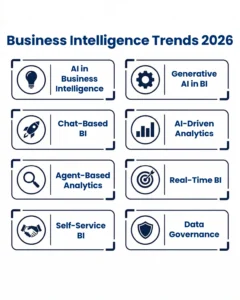
8 Business Intelligence Trends 2026 That Are Reshaping Analytics
1. AI in Business Intelligence Is No Longer Optional
Among all the business intelligence trends 2026, this one carries the most urgency. Most organizations have spent the last two years “exploring” AI in their analytics stack. In 2026, that exploration phase is over. AI in Business Intelligence has moved from pilot projects to core infrastructure, and the companies treating it optional are starting to feel the gap.
What’s different now is depth. AI isn’t just sitting on top of your dashboards generating auto-summaries. It’s embedded inside the pipeline — detecting anomalies before anyone spots them, flagging shifts in customer behavior, and supporting AI decision making at a speed no human team can match alone.
Consider a retailer tracking hundreds of SKUs. Identifying which products are quietly trending downward before they create a margin problem used to take days. With AI in Business Intelligence, that signal surfaces automatically. It’s a small example of why business intelligence trends 2026 keep coming back to AI as the core driver.
What AI is actively handling inside BI systems today:
- Anomaly detection and root cause flagging, automatically
- Predictive scoring for revenue, churn, and demand
- Narrative summaries generated directly from dashboard data
- Continuous data quality monitoring at the pipeline level
- Role-based recommendations surfaced without anyone asking
2. Generative AI in BI: A Core Driver of Business Intelligence Trends 2026
When people ask which of the business intelligence trends 2026 will have the most visible impact, Generative AI in BI consistently tops the list — and for good reason. It fundamentally changes how people interact with data.
Traditional BI required users to know what they were looking for — build a report, set up the filters, and interpret the output yourself. Generative AI in BI flips. Describe what you need in plain language; the system handles the rest.
Here’s what Generative AI in BI is enabling in 2026:
- Auto-generated executive summaries from complex datasets
- Dynamic report creation from natural language prompts
- Scenario modeling — “What happens to our margins if raw material costs rise 15%?”
- Narrative data storytelling that replaces static slide decks
- Personalized insight delivery based on user role and context
For businesses evaluating Generative AI development services or Generative AI solutions, the timing is right. Tracking business intelligence trends 2026 without acting on Gen AI specifically is leaving a significant advantage on the table.
3. Conversational BI: One of the Most Practical Business Intelligence Trends 2026
Here’s a scenario most people in data-heavy teams will recognize: a department head needs a quick answer about last quarter’s numbers, but their analyst is tied up, so they wait two days for a simple figure that could have changed a decision.
Conversational BI exists to eliminate that wait entirely. It lets any user — regardless of technical background — type or speak a question in plain language and get an accurate, data-backed answer within seconds. No query language, no ticket system, no bottleneck.
The adoption of conversational AI development services tied to BI is accelerating — when everyone can access data directly, decisions happen faster at every level.
Where it’s making the most difference right now:
- Sales checking pipeline health without waiting on analysts
- Ops pulling supply chain snapshots directly on mobile
- Finance reviewing budget variance through a chat interface
- Executives asking live follow-ups during board discussions
Among BI trends 2026, Conversational BI pays off fastest after adoption — especially for teams who’ve always been one step removed from the data.
4. AI-Driven Analytics and the Shift Toward Predictive Intelligence
Here’s the truth about most BI setups — and it’s one of the reasons the business intelligence trends 2026 keep putting predictive intelligence front and center. Most tools are great at explaining what went wrong after the fact. You lost a client, a campaign underperformed, and a product line dipped. The report shows it clearly. But by then, the damage is done.
Predictive intelligence shifts that. With AI-driven analytics, the system reads signals continuously, updates models in the background, and surfaces issues before they fully materialize.
Take customer churn prediction. Customers rarely leave overnight — the signals show up weeks earlier in login frequency, support ticket tone, and purchase behavior. AI-driven analytics catches that pattern early and triggers a retention workflow while there’s still time to act.
The same logic scales across functions:
- Finance: Cash flow gaps get flagged before they affect operations
- Supply Chain: Demand shifts show up in forecasts before they hit inventory
- HR: Attrition risk is identified before resignations come in
- Marketing: Campaign performance is modeled before the budget is spent
This shift from reactive to proactive is one of the most valuable outcomes the business intelligence trends 2026 are driving. And it compounds — as models learn from more data, the predictions get sharper and the interventions more timely.
5. Agent-Based Analytics and the Business Intelligence Trends 2026 Shift to Action
Perhaps the boldest shift in business intelligence trends 2026 is agent-based analytics — where AI doesn’t just surface an insight but follows through on it.
Traditional BI flags that inventory is running low. An AI agent built for AI agents for data analysis doesn’t stop at the flag — it checks supplier lead times, evaluates order thresholds, and places the reorder without anyone being in the loop.
It is predicted that 40% of enterprise applications will be integrated with task-specific AI agents by the end of 2026, up from less than 5% in 2025. The business intelligence trends 2026 are no longer just about intelligence — they’re about intelligence that executes without waiting to be told.
What agent-based analytics looks like in practice:
- A revenue agent monitors pipeline health and nudges sales reps on at-risk deals automatically
- A finance agent detects expense anomalies and initiates approval workflows without manual intervention
- A marketing agent reallocates ad spend in real time based on live performance signals
For organizations exploring AI development service capabilities, agent-based analytics is where the strongest ROI case lives in 2026. It’s the most action-oriented of all business intelligence trends 2026.
6. Real-Time BI and the Death of the Weekly Report
By the time a weekly report lands in your inbox, a good chunk of it is already stale. Among business intelligence trends 2026, real-time BI directly addresses this — closing the gap between when data is generated and when it’s acted on. Data gets ingested, processed, and surfaced as it flows — not in batches at the end of the day. A flash sale goes live — conversion rates are visible by the hour. A supplier runs short — the forecast reflects it before fulfillment is affected.
What’s making this practical at scale in 2026:
- Streaming architectures processing events as they happen
- In-memory compute handling millions of rows without lag
- Continuous syncing between source systems and analytics layers
- Embedded AI-driven analytics pushing alerts into dashboards live
Organizations evaluating Business Intelligence services are treating real-time capability as table stakes now. Among business intelligence trends 2026, real-time BI is the one that makes every other trend more impactful — because AI is only as good as the freshness of data it acts on.
7. Data Democratization and Self-Service BI
The data bottleneck — where business teams wait days for a number, the data team hasn’t had time to pull — is one of the oldest frustrations in analytics. Self-service BI solves it, and within business intelligence trends 2026, it’s one of the most practically impactful. Natural language querying and AI-guided analysis mean a marketing manager or ops lead can explore data without writing a single line of SQL. Gartner notes 69% of large enterprises have active data democratization initiatives — and BI trends 2026 are accelerating that shift.
Practically, self-service BI in 2026 looks like:
- Non-technical users building their own reports without IT involvement
- Role-appropriate data access baked into existing tools — CRM, ERP, HRIS
- AI suggesting the right visualization for the question being asked
- Automated metric definitions so everyone works from the same numbers
When data access stops being a privilege of the analytics team, every function moves faster. Self-service BI is one of the most practically impactful business intelligence trends 2026 for any mid-to-large enterprise.
8. BI Meets Data Governance: Accuracy You Can Trust
Governance rarely makes headlines, but it underpins every other item on this list. None of the business intelligence trends 2026 deliver real value if the data feeding them is unreliable — and organizations investing heavily in AI while neglecting data quality tend to find that out the hard way.
As AI in Business Intelligence takes on more autonomous decision-making, data quality becomes even more critical. An AI model acting on inaccurate inventory figures, duplicate customer records, or misaligned definitions across systems doesn’t just generate bad reports — it makes bad decisions at scale.
Any good AI consultancy partner will tell you governance isn’t the exciting part — but it’s where most of the ROI gets protected.
What governance looks like in a mature 2026 BI environment:
- Continuous data quality monitoring with automated anomaly alerts
- Data lineage tracking so every number has a clear origin
- Access controls aligned with GDPR, HIPAA, and relevant regulations
- Shared metric definitions across finance, marketing, and ops
What Industry Leaders Are Saying About Business Intelligence Trends 2026
Gartner’s read on 2026 is that the line between human judgment and machine intelligence is getting harder to draw — and they’re framing that as the new normal for the business intelligence trends 2026 era, not a warning sign. AI systems are increasingly in the loop on decisions that used to sit entirely with people.
BI isn’t just a reporting layer anymore — and that’s exactly what the business intelligence trends 2026 are reflecting. It’s becoming part of how organizations think — connecting data, context, and action in ways that simply weren’t practical two years ago.
Organizations putting resources into Generative AI solutions, conversational AI development services, and AI agents for data analysis aren’t chasing hype — they’re building for where the business intelligence trends 2026are clearly heading.
Conclusion
The companies pulling ahead in 2026 aren’t necessarily the ones with more data. They’re the ones doing more with it — and the business intelligence trends 2026 have made that gap more visible than it’s ever been. The business intelligence trends 2026 have made that gap more visible than ever. Generative AI, real-time pipelines, autonomous agents, self-service access — these aren’t future investments anymore. They’re present-tense differentiators. If your analytics stack still feels like a reporting tool rather than a decision engine, that’s the gap worth closing. AnavClouds Analytics.ai works with businesses to build AI-powered analytics that move decisions forward — not just dashboards that look good in a quarterly review. The question is where your organization stands.
Frequently Asked Questions
What are the biggest Business Intelligence trends in 2026?
Generative AI is changing how reports get built. Conversational BI gives non-technical teams direct data access. Agent-based analytics is acting on insights, not just surfacing them. These are the business intelligence trends 2026 showing up in real budgets.
How is AI changing Business Intelligence in 2026?
The biggest shift — and one that runs through all the business intelligence trends 2026 — is that AI in Business Intelligence stopped being a feature and became the engine. It catches anomalies, handles customer churn prediction, and supports AI decision making without anyone filing a report request.
What is Conversational BI and why does it matter?
Think of it like asking a colleague a question — except the colleague is your data. No query language, no waiting. Conversational BI matters because most people in a business never touch BI tools, and that’s the exact gap it closes.
How do AI agents improve data analysis in 2026?
Most BI tools surface a problem and stop there. Someone still must decide what to do next. AI agents for data analysis close to that gap — they spot the issue and handle the follow-through, whether that means flagging a risk, adjusting a forecast, or starting a workflow.