
For most businesses, data is getting out of hand. They are collecting more data than ever from their customers, from the IoT, from other systems, and from their own applications, and it’s becoming more important than ever to know where to store it and how to effectively harness it. The core of this problem is two different approaches: data lakehouse vs data warehouse. They both have their uses but are built for different worlds. Figuring out which is best for your business is not only a technical decision, but it also impacts how your team can best use the data to gain insights and take action. This blog has you covered.
Why the Data Architecture Conversation Has Changed
A few years back, the data warehouse was the cornerstone of enterprise data analytics. Here, you could rely on reliable data formats for business intelligence. But it falls short with new data and the demand for AI use cases.
The data lakehouse was created to address this. The global data lakehouse market is projected to grow to USD 11.9 billion in 2024 and register a compound annual growth rate (CAGR) of 25% from 2025 to 2034, according to Global Market Insights, which means that businesses are indeed during a data revolution.
Today, the data lakehouse vs data warehouse debate is not about which is “better”. It’s about which one or which combination of data will help your business grow in the future.
Still running a legacy warehouse while your competitors scale AI? It’s time to rethink.
What Is a Data Warehouse?
A data warehouse is a repository for storing pre-processed data that has been organised for a specific purpose. It’s schema-on-write, meaning data is structured before it’s stored.
Data Warehouse Architecture
A data warehouse architecture includes:
- Source systems – ERP, CRM, transactional systems, feeds
- ETL process – Extract, transform, load (ETL) into the warehouse
- Centralized repository – Structured for reporting
- Business intelligence layer – Power BI, Tableau, or Looker for BI
This architecture makes data warehouses great for one thing: getting answers to business questions quickly, consistently, and reliably.
Data Warehouse Benefits
- Fast querying of relational data
- ACID transactions for data accuracy
- Powerful governance features including role-based security and audit trails
- History of success for financial reporting, compliance, and analytics
- Easy integration with business intelligence as-a-service and reporting platforms
When Does a Data Warehouse Fall Short?
Despite the strengths of the data warehouse, it was never designed for the age of AI. It struggles with:
- Unstructured and semi-structured data (pictures, logs, audio, JSON) that it doesn’t support properly
- Machine learning algorithms that need diverse and raw data
- The cost of storage at a large scale, particularly in the cloud
- Schemas that limit experimentation and exploration
This is where the data lakehouse concept came about – and why the data lakehouse vs data warehouse debate is so much in play for data engineering services teams today.
What Is a Data Lakehouse?
A data lakehouse is a new, integrated data platform that combines the cost-effective, scalable nature of a data lake with the organization, governance, and speed of a data warehouse. It supports structured, semi-structured, and unstructured data – and is all in one place.
This is where things tend to change when organisations explore the data lakehouse vs data warehouse question – because the lakehouse was designed to fill the gaps left by the data warehouse. Developed primarily by Databricks, but now embraced by AWS SageMaker Lakehouse, Microsoft Fabric, and Google BigLake, the lakehouse has quickly gained traction.
Data Lakehouse Architecture
The data lakehouse architecture typically includes:
- Ingestion layer – Ingests raw data from various sources – streaming and batch
- Open-format storage layer – Stores the data in open formats such as Apache Iceberg, Delta Lake, or Apache Hudi on object storage (e.g., Amazon S3 or Azure Data Lake Storage)
- Metadata and governance layer – Enforces schema, catalogs, and manages permissions
- Query and compute layer – Supports SQL analytics, machine learning (ML) applications, and real-time data processing
- BI and AI layer – Enables integration with business intelligence services, AI development services, and data analytics services apps
This system removes the need for two systems to support analytics and AI, making it much more cost-effective.
Data Lakehouse Benefits
The data lakehouse benefits are more than just the combination of two systems. Here’s why it’s special:
- A single store for structured, semi-structured, and unstructured data
- Schema-on-read for ad hoc analytics and data science
- ACID transactions with Delta Lake and Iceberg – overcoming one of the main drawbacks of data lakes
- Machine learning and AI workloads are natively supported without data movement
- Reduced costs via open format object storage
- Low-latency ingestion and real-time processing
- Fewer data silos, making data quality for AI simpler to manage
- Open and interoperable – no lock-in with proprietary formats
The data lakehouse is especially attractive for data engineering services, data pipelines and scaling AI development services.
Data Lakehouse vs Data Warehouse: Head-to-Head Comparison
Here is a structured look at the key differences that define the data lakehouse vs data warehouse debate:
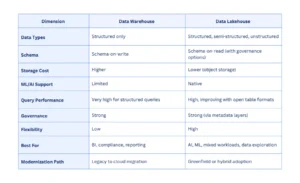
This comparison makes it clear that data lakehouse vs data warehouse is not a binary choice — it is a spectrum of trade-offs that depends entirely on your use case and data maturity.
Pros and Cons of Data Warehouses vs. Data Lakehouses
Understanding the pros and cons of data warehouses vs data lakehouses helps teams make architecture decisions with confidence rather than guesswork.
Pros and Cons of Data Warehouses
Pros:
- Optimized for structured queries and complex SQL joins
- Mature ecosystem with well-understood operational patterns
- Strong ACID guarantees for mission-critical workloads
- Excellent fit for business intelligence transformation initiatives
- Deep support for regulatory compliance (HIPAA, SOX, GDPR)
Cons:
- Cannot store or process unstructured data natively
- High total cost of ownership at a large scale
- Schema rigidity slows down data experimentation
- Poor fit for machine learning solutions and AI pipelines
- Data movement creates latency and introduces data quality risks for AI
Pros and Cons of Data Lakehouses
Pros:
- Handles all data types in a single platform
- Eliminates redundant storage across separate lake and warehouse systems
- Directly supports AI development services and ML workflows
- Open formats prevent vendor lock-in
- Scales more cost-effectively
Cons:
- More complex initial setup and governance design
- Requires experienced data engineering services teams to implement well
- SQL performance, while improving, can lag behind purpose-built warehouses for some workloads
- Newer technology means fewer battle-tested case studies in regulated industries
The pros and cons of data lakehouse vs data warehouse essentially come down to complexity vs capability. If your workloads are predictable and structured, a warehouse may serve you better. If your needs are evolving and AI-centric, the lakehouse is the more future-proof choice.
Data Warehouse Modernization: The Bridge Between Old and New
Many enterprises do not need to abandon their existing data warehouse investments. What they need is a thoughtful data warehouse modernization strategy — one that incrementally adopts lakehouse principles without disrupting what already works.
For companies facing the data lakehouse vs data warehouse decision in the midst of a transformation, modernization is an alternative. It typically involves:
- Moving to cloud-native data platforms like Snowflake, BigQuery, or Azure Synapse
- Adding open table formats, such as Delta Lake, to the existing warehouse
- Introducing a lakehouse layer for unstructured data and machine learning without disrupting the warehouse
- Providing governance across both systems for data quality for AI and regulatory compliance
- Supporting real-time data ingestion to support business intelligence transformation from batch to streaming data sources
Rather than a data lakehouse vs data warehouse decision, many large firms take the view that it’s data lakehouse and data warehouse – with the latter system optimised for its specific workloads, and the two systems integrated through a robust governance and cataloging layer.
Choosing Between Data Lakehouse vs Data Warehouse: A Decision Framework
The decision between data lakehouse vs data warehouse is not an “all or nothing”. Let’s consider this:
Choose a Data Warehouse if:
- You are focusing on structured reporting, dashboards, and compliance
- Your analysts work primarily in SQL and are not scaling AI/ML
- You require ACID compliance for regulatory or financial data
- You are early in the process of establishing business intelligence services
Choose a Data Lakehouse if:
- You are developing or expanding your machine learning and AI services
- You have log, image, clickstream, or other unstructured data
- You want to integrate your data engineering services pipeline
- You are on a business intelligence transformation journey to real-time and predictive analytics
- You are concerned about data quality for AI and want to build governance into the system
Consider a Hybrid Approach if:
- You have substantial investments in data warehouse technologies
- You wish to support existing BI and emerging AI use cases
- You are on a data warehouse modernization journey, and in a state of transition
Viewing the data lakehouse vs data warehouse decision through the above lens will help prevent over-engineering and ensure that your data architecture aligns with where your company is in its journey – not where you aspire to be.
Key Considerations Before Making the Switch
Regardless of whether you’re considering a lakehouse or a warehouse, here are a couple of considerations that should inform the data lakehouse vs data warehouse decision:
Data Volume and Variety
If you are dealing with clean and structured data from a few sources, a warehouse will suffice. As soon as you start working with unstructured or semi-structured data at scale, the cost of the data lakehouse vs data warehouse battles in favour of the lakehouse.
Team Readiness
A data lakehouse demands data engineering skills – especially as they relate to open table formats, metadata, and distributed computing. If you’re an SQL-heavy team with limited engineering capability, it may be better to start a warehouse.
AI and ML Ambitions
If you have a medium- to long-term plan to build machine learning solutions and leverage AI development services, you will likely have to retrofit your architecture to a data lakehouse. The data lakehouse vs data warehouse decision has long-term consequences for AI readiness.
Governance Maturity
Data quality for AI is not just a technical concern – it is an organisational concern. Data lakehouses can deliver advanced governance, but it needs to be designed in. Organisations that delay governance until later in the game often pay a much greater price in retrofitting than they would upfront.
Cost Structure
There are differences in the cost of ownership for a data lakehouse vs data warehouse. Data warehouses generally have higher compute and storage costs for large workloads, but data lakehouses are more cost-effective with object storage and can have higher engineering costs when being set up.
Conclusion
The data lakehouse vs data warehouse decision is one of the most important architecture choices a data-driven company is making today. Each has its own merits, and the answer lies in your business objectives, data readiness and workloads – or workloads you plan to run. Whether you are embarking on a data warehouse modernization adventure, developing AI development services capabilities, or scaling your data analytics services platform, getting the foundation right is critical. At AnavClouds Analytics.ai, we work with enterprises to put in place data architectures that are built to support today’s use cases, but also tomorrow’s scale – marrying expertise in data engineering services, machine learning solutions and business intelligence transformation, delivering solutions that make a difference.
FAQs
What is the main difference between a data lakehouse and a data warehouse?
A data warehouse is structured data for reporting via SQL. A data lakehouse stores all types of data, supports both governed analytics and AI workloads, and brings together both in a unified platform.
Is a data lakehouse replacing the data warehouse?
Not entirely. Many companies operate both data warehouses for structured reporting and data lakehouses for AI and ML. Upgrading data warehouse systems often involves a gradual migration to a lakehouse.
Which is more cost-effective: a data lakehouse or a data warehouse?
Data lakehouses are typically more cost-effective for large volumes of data due to low-cost storage. Data warehouses provide better query speeds, but are more expensive for large data sets.
Can a data lakehouse support business intelligence tools like Tableau or Power BI?
Yes. The latest lakehouse solutions provide SQL-compatible engines and built-in support for Tableau, Power BI, and Looker – enabling complete BI capabilities and out-of-the-box support for AI and ML.