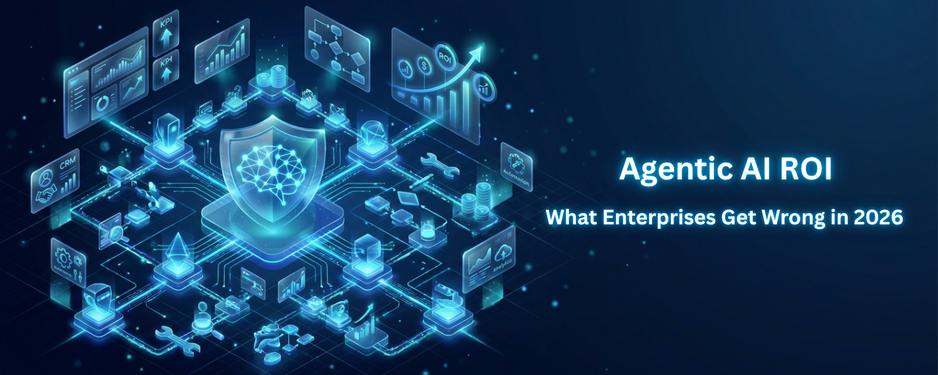

Every CFO wants a straight answer to one question: what’s the actual return on this AI investment? That question gets harder to dodge as agentic AI moves out of pilot mode and into production budgets. Agentic AI ROI is no longer an abstract metric buried in an innovation team’s slide deck — it’s the number that decides whether a program scales or gets shut down. Yet most organizations still struggle to prove it. 25% of AI initiatives have yielded expected results, and only 16% have been scaled enterprise wide. This blog explains the concept of agentic AI ROI, how to measure agentic AI ROI, and the agentic AI ROI framework enterprises use to transform from pilot to profit.
What Is Agentic AI ROI and Why Does It Matter Now?
Agentic AI ROI is calculating the financial and operational benefits of AI-powered agents over building, deploying, and maintaining them. An AI agent can perform multi-step tasks, make decisions with guardrails, fetch data from a variety of systems, and take action without waiting for manual “approve” at each stage—whereas a script with rules cannot. It’s this autonomy which makes agentic AI ROI tricky to track. No longer are you saving the hours; now you are saving the decisions, the errors, and the revenue.
The need has increased as boards have finished funding experiments just for the sake of experiments. The purpose of budget cycles is shrinking, and finance leaders want a line item they’ll be able to defend. Programs that do not demonstrate measurable return in two or three quarters are good candidates for the chopping block! This is forcing companies to adopt and institutionalize a rigorous process for planning, deploying, and reporting on their AI agent programs.
Another problem lurking under the budget argument is the scale. One good agent on one workflow is a bit more defensible – it’s a simple calculation, and the return on the investment is easily visible in weeks. Deploying dozens of agents throughout departments is another matter altogether. Each one has a set of baseline, integration cost, and risk characteristics. Finance teams lose visibility rapidly, and without a consistent approach to measuring AI ROI, trust in the program erodes deployment by deployment.
How to Measure Agentic AI ROI: A Step-by-Step Approach
Knowing how to measure agentic AI ROI starts long before an agent goes live. It begins with a baseline.
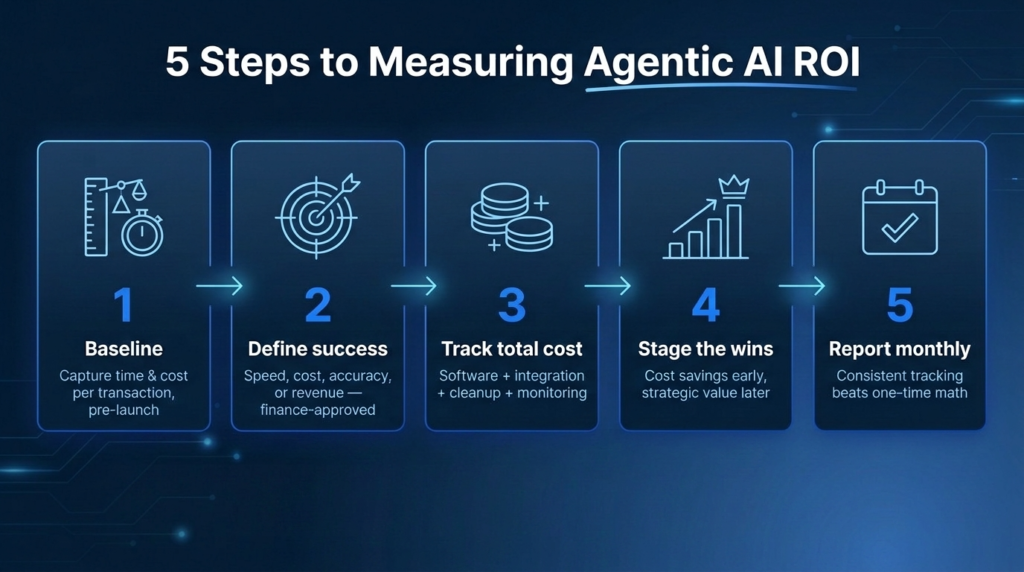
- Document the current state. How long does the process take today, and what does it cost per transaction or per decision? Without this number, any post-deployment claim is guesswork.
- Define success metrics before launch. Decide whether you’re optimizing for speed, cost, accuracy, or revenue, and get finance to sign off on the definition.
- Track total investment, not just software cost. Include integration, data cleanup, change management, and ongoing monitoring — this is where the true ownership cost starts adding up.
- Measure in stages. Early wins usually show up as measurable cost reductions; strategic value tends to surface months later.
- Report against the baseline, consistently. Monthly tracking beats a single retrospective calculation nine times out of ten.
This staged approach to how you measure agentic AI ROI is what separates programs that can defend their budget from ones that get quietly defended after the first hard quarter. Assigning ownership early also matters — someone on the business side, not just IT, should be accountable for the baseline and the reporting cadence, so results are reported in language finance trusts.
What Does Agentic AI Business Impact Actually Look Like?
Numbers matter, but agentic AI business impact is easiest to understand through real scenarios. A financial services firm might deploy agentic AI in banking to handle fraud investigation triage, cutting case resolution time from days to hours. A retail brand might use agents to manage inventory reallocation in real time, reducing stockouts without adding headcounts. A healthcare provider might automate prior-authorization workflows, freeing clinical staff from paperwork.
None of these examples lead with “productivity.” They lead with an outcome finance can trace directly to a dollar figure: fewer charge backs, fewer lost sales, faster claims turnaround. That’s the shift happening across enterprises right now — conversations are moving away from “hours saved” and toward agentic AI business impact tied directly to the P&L.
There’s a second layer that often gets overlooked: what employees do with the time an agent frees up. If a claims adjuster gets four hours back each week but spends it on the same low-value tasks, the impact stalls. The enterprises seeing the strongest returns are deliberate about redirecting that capacity toward higher-value work.
Why Are Enterprise AI Investment Returns Different From Traditional Automation?
Enterprise AI investment returns don’t behave like traditional RPA or software ROI. A licensed tool delivers roughly the same value on day one as it does a year later. An AI agent doesn’t work that way — its performance compounds. An agent deployed in Q1 is typically making better decisions by Q3 simply because it has more data and tighter guardrails.
That compounding effect cuts both ways. It means early returns often understate the long-term payoff, but it also means a poorly scoped agent compounds its mistakes just as fast. Enterprises that treat enterprise AI investment returns as a one-time calculation, done once at launch, consistently underestimate both the risk and the reward.
Comparing returns across departments without context can also be misleading. A customer service agent handling thousands of interactions a month will show measurable returns far faster than an agent supporting a low-volume, high-complexity legal review process. Both can be worthwhile — they just need different timelines attached from the outset.
Where Do AI Agent Cost Savings Come From?
AI agent cost savings typically show up in three places: labor cost per transaction, error-related rework, and speed to resolution.
- Lower cost per interaction. A human-handled support ticket costs several dollars in labor; an agent-handled one can cost a fraction of that once deployed at scale.
- Reduced rework. Well-designed agentic AI for data analytics pulls from a single source of truth, making fewer downstream errors than manual, multi-system handoffs.
- Faster cycle times. Shorter resolution windows mean fewer escalations and less overtime spend during peak demand.
These AI agent cost savings are the easiest part of the ROI story to prove, which is why most enterprises start here before moving into strategic use cases. Cost avoidance rarely shows up as a clean line item — a dispute that never escalated, a customer who didn’t churn — but these are real dollars that require deliberate tracking against a baseline to be visible at all.
What Is the Right Agentic AI ROI Framework for Enterprises?
A dependable agentic AI ROI framework generally works across three tiers, moving from immediate wins to long-term transformation.
Tier 1: Operational Efficiency (Weeks to Months). This tier is the fastest to prove. It covers cost per resolved task, reduced handling time, and the percentage of work an agent completes without human intervention.
Tier 2: Quality and Experience (Months). Here, the focus shifts to first-contact resolution, customer satisfaction, and internal team retention — value most ROI models ignore.
Tier 3: Strategic Transformation (Long-Term). This is where the returns compound into something bigger than cost savings — new revenue streams, market entry through round-the-clock coverage, and capabilities of competitors can’t easily replicate. Few enterprises reach this tier without first proving Tier 1 and Tier 2.
Agentic AI ROI also looks different depending on where an enterprise sits in its adoption curve. A company running its first agent in a single department is still validating the basic case, while a company with a dozen agents live across functions is managing a portfolio, weighing which use cases deserve more investment and which should be sunset. Both stages need clear numbers, but the questions being asked of those numbers are not the same.
How Do You Calculate ROI on AI Agents?
Calculating return on investment AI agents generate follows a familiar formula, but the inputs need discipline: (Total Value Generated – Total Cost of Investment) ÷ Total Cost of Investment × 100.
The tricky part isn’t the formula — it’s populating it honestly. Total value should include hard savings and soft value that can be tied to a number, like retention or faster time-to-market. Total cost should include licensing, integration, data preparation, governance, and internal hours spent managing the rollout — in short, the full AI implementation cost, not just the software line item. Enterprises that calculate return on investment AI agents deliver using only software licensing costs, while ignoring integration and oversight, consistently overstate their agentic AI ROI.
Which AI Agent KPIs for Enterprise Teams Should You Track?
The right AI agent KPIs for enterprise teams depend on the use case, but a few apply almost everywhere:
- Autonomous resolution rate — the share of tasks completed without human escalation
- Cost per resolved task or interaction
- Time to value — how many weeks from deployment to measurable return
- Accuracy and error rate — especially for regulated or high-stakes workflows
- Revenue or retention impact — tied to upsells, churn prevention, or faster conversions
Tracking these AI agent KPIs for enterprise programs consistently, not just at launch, is what turns a pilot into a program finance trusts.
What Is the Total Cost of Ownership AI Agents Bring to the Table?
Understanding the total cost of ownership AI agents carry means looking well beyond the subscription fee. It includes data preparation, integration with existing CRM or ERP systems, ongoing model monitoring, governance overhead, and change management to get teams actually using the agent as intended.
Enterprises that skip this full accounting of total cost of ownership AI agents require almost always overestimate their returns in year one and get an unpleasant surprise in year two when maintenance and scaling costs show up. A realistic TCO view protects the credibility of every ROI number that follows.
Why Partner With AI Development Services for Agentic AI ROI?
Building agentic AI ROI internally from scratch is possible, but it’s slow and expensive to get right without prior experience. Experienced AI development services bring pre-built frameworks for base lining, KPI tracking, and TCO modeling, along with the technical expertise to architect agents that integrate cleanly with existing enterprise systems.
The right partner also brings pattern recognition from having deployed agents across industries, which shortens the path from pilot to measurable, defensible returns.
Conclusion
Establishing the discipline to see agentic AI ROI is not a one-shot; it’s a commitment to base lining, tracking, and reporting it consistently, quarter by quarter. Agents are being scaled with confidence by enterprises that view agentic AI ROI as an iterative process, rather than a single calculation. If you have the baseline, KPIs, and TCO correct, the numbers will take care of themselves. When you’re looking to take your pilot projects to a program with board-proof agentic AI ROI, AnavClouds Analytics.ai can help you develop the framework, build the agents, and get the reporting ready in place to show your ROI at each step.
Frequently Asked Questions
What is a good agentic AI ROI benchmark for enterprises?
There is no one answer as to how long it will take, but most businesses expect to break even between 2 and 6 months in, and returns starting to compound after month 12.
How long does it take to see ROI from AI agents?
Huge savings can be achieved in the early stages within 4-8 weeks. The returns with strategic investment and revenue generation are generally achieved within 6-18 months.
Can small and mid-sized businesses achieve agentic AI ROI?
Yes. Whether you’re a small or large business, or have a limited budget, ROI is easier to measure and scale when you take the approach of starting with one well-defined, high-volume workflow.
What’s the biggest mistake enterprises make when measuring AI agent ROI?
Skipping the baseline. When there is no up-to-the-minute cost, time, and error rate, it is hard to argue or believe any post-deployment ROI case.