
Generative AI vs Agentic AI is the conversation dominating enterprise technology boardrooms in 2026. One system creates on demand; the other acts on its own. Understanding where one ends and the other begins isn’t a theoretical exercise; it shapes your vendor decisions, your automation roadmap, and ultimately how far behind you fall if you get it wrong. This blog covers the core difference between generative AI and agentic AI, how organizations are navigating the stages of AI adoption, and what a practical path looks like as enterprises move from generative AI to agentic AI. If you’re building or rethinking your AI strategy this year, this is where to start.
Just over 60% of organizations plan to use AI agents in the next two years, and only 17% have implemented them to date, making this the highest rate of adoption for an emerging technology that Gartner has ever seen. That gap between intent and execution is exactly what this guide is designed to close.
Generative AI vs Agentic AI: What’s the Core Difference?
Before diving into maturity models and roadmaps, let’s get the definitions straight, because generative AI vs agentic AI is a comparison that gets muddled quickly.
The name generative AI implies that it’s aimed at production. Give it a prompt, and it will return an output, such as a paragraph, an image, a block of code, or a summary. It is reactive and as such. Waits for instructions, responds, and halts. The model doesn’t make plans for future activities, doesn’t compare his/her own work with an actual system, and doesn’t move tasks forward on his/her own.
Agentic AI should be action-oriented. It needs a goal, then it needs a series of steps to achieve that goal, needs to call tools/external systems to implement those steps, and it needs to evaluate the result and adjust the steps if it doesn’t go right. All of these steps without waiting for a human to click “go” between each one. Makes sense of things; makes plans; carries out plans.
That’s the fundamental difference between generative AI and agentic AI is that one is a capable tool that you use, and the other is a capable worker you talk to. The latter is something that most businesses have experienced today. It is rare for anyone to have the latter, in fact.
Generative AI vs Agentic AI: How Does Each System Actually Work?
Understanding the mechanics helps when it’s time to match technology to a use case.
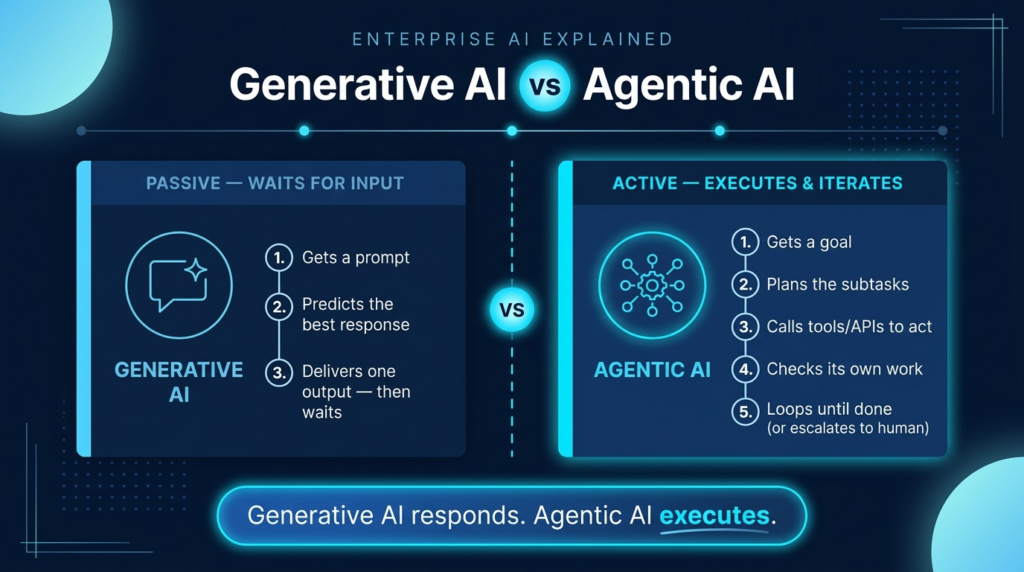
How Generative AI works:
- Receives a prompt or input from a user
- Predicts the most contextually appropriate output based on training
- Returns a single response, then waits for the next prompt
How Agentic AI works:
- Receives a goal or objective (not just a prompt)
- Builds a plan by breaking the goal into executable subtasks
- Selects and calls the right tools, APIs, databases, applications, to complete each step
- Reviews its own outputs and corrects course when results don’t match the goal
- Loops until the objective is met or a human needs to be brought in
This is why generative AI vs agentic AI isn’t just a capability comparison, it’s a fundamentally different operating model. When enterprises talk about autonomous AI vs generative AI, what they’re really asking is: do we want AI that produces, or AI that does?
Why Are Enterprises Accelerating the Shift from Generative AI to Agentic AI?
Three forces are compressing timelines for the move from generative AI to agentic AI faster than most roadmaps anticipated.
Productivity gains from generative AI have plateaued for many teams. The first wave of generative AI development, faster content creation, quicker research, better first drafts, delivered real value. But human effort is still required to review, validate, and execute every output. Agentic AI removes that bottleneck. It doesn’t just write the follow-up email; it sends it, logs the activity in the CRM, and schedules the next touchpoint automatically.
Multi-agent orchestration has become technically viable. Specialized agents, one handling lead qualification, another managing outreach, a third checking compliance, can now coordinate within shared frameworks, passing context between them without losing continuity. That kind of architecture wasn’t production-ready at enterprise scale two years ago.
Competitive pressure is no longer abstract. When a competitor’s support system resolves the majority of tickets without human involvement, organizations still relying purely on generative AI to assist human agents face a tangible efficiency gap. Generative AI vs agentic AI is no longer a future debate, it’s a current performance gap for many industries.
What Are the Stages of AI Adoption Every Enterprise Goes Through?
Sequencing matters more than speed. Most AI adoption maturity levels follow a recognizable progression, and skipping stages is the leading cause of failed deployments.
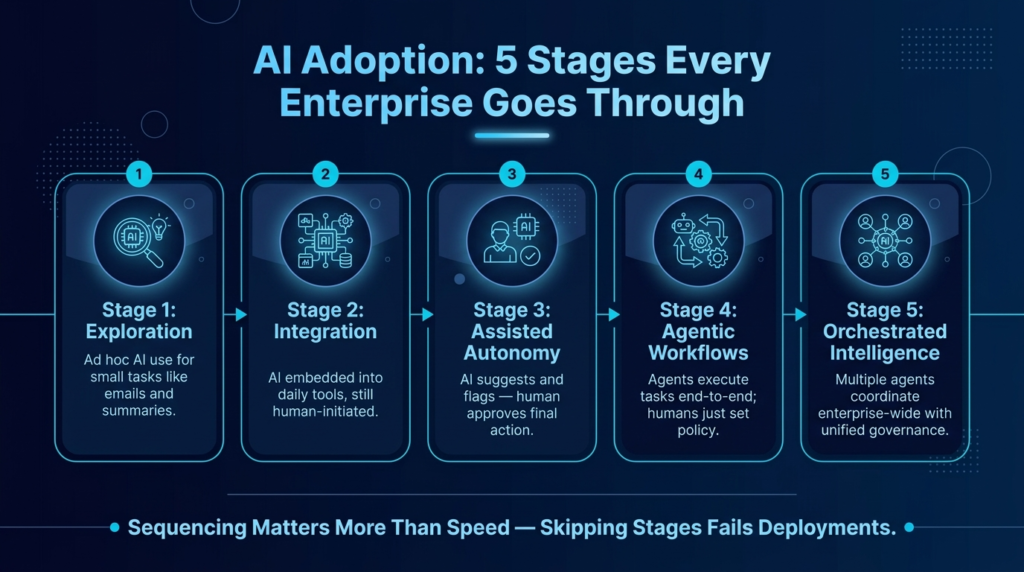
Stage 1: Exploration
Teams experiment with generative AI tools for contained, low-stakes tasks: drafting emails, summarizing documents, generating FAQs. Adoption is ad hoc, not integrated into core systems.
Stage 2: Integration
Generative AI gets embedded into existing software, CRMs, ticketing platforms, BI dashboards. It’s reactive and still dependent on human initiation, but it’s becomes part of the daily AI workflow automation.
Stage 3: Assisted Autonomy
Systems begin taking limited autonomous action within tight guardrails, routing a ticket automatically, flagging an invoice anomaly and suggesting a fix, drafting a full outreach sequence triggered by a CRM event. A human still reviews and approves final actions.
Stage 4: Agentic Workflows
Multi-step agentic processes execute end to end. Humans set policy and review exceptions; agents handle execution. This is where the real generative AI vs agentic AI transition becomes operational.
Stage 5: Orchestrated Intelligence
Multiple agents across functions share context and coordinate toward enterprise-wide objectives, backed by unified data infrastructure and mature governance. Few organizations have reached this stage in 2026, but it’s where the enterprise AI strategy roadmap points.
What Is an Agentic AI Maturity Model, and Why Does Every Enterprise Need One?
An agentic AI maturity model gives leaders a framework to assess where the organization genuinely stands across four dimensions, before committing autonomous deployment.
Data Readiness
Can an agent access the data it needs in real time? Siloed, unstructured, or stale data is the fastest way to undermine an agentic system. Before deployment, the underlying data has to be clean, connected, and reachable. This is where agentic AI for data analytics depends most on real-time access.
Process Definition
Is the workflow documented clearly enough for an agent to follow without ambiguity? Agentic AI amplifies process quality, a well-defined process runs better at scale; a vague one breaks faster.
Governance and Guardrails
What decisions is the agent authorized to make independently? What requires human approval? These boundaries must be defined before deployment, not discovered after something goes wrong.
Tooling and Integration
Can the agent securely call the systems it needs, CRM, ERP, finance tools, communication platforms? Integration depth determines what the agent can actually accomplish versus what it can only partially complete.
Score poorly on any of these dimensions, and the move from generative AI to agentic AI will produce expensive failures. Score well, and the maturity model becomes your deployment confidence signal.
Building an AI Maturity Assessment Framework
An AI maturity assessment framework doesn’t need to be complex. It needs to be honest. Five questions drive most of the clarity:
- What decisions are you ready to let AI make without a human in the loop?
Specificity matters. “Approve refunds under $150” is actionable. “Handle customer service” is not.
- Where does your data live, and is it reachable in real time?
Agentic AI is only as effective as the data it can access when it needs it.
- What’s the error tolerance for this specific process?
A miscategorized support ticket is recoverable. An incorrect financial transaction is not. The answer changes which processes get autonomous authority first.
- Do you have observability in place to catch an agent going off-script?
Monitoring isn’t optional once autonomy increases. It’s the difference between a contained error and a compounding one.
- Who is accountable if the agent gets it wrong?
Accountability must be assigned before deployment. Every agentic workflow needs a named human owner for exception handling.
Running this assessment before every deployment keeps the generative AI vs agentic AI decision grounded in operational reality, not enthusiasm.
What Are the Most Effective Agentic AI Use Cases for Enterprise Right Now?
The best agentic AI use cases for enterprise have in common that they are very specific, have clear boundaries, and clear metrics. The widest dreams are bound to lead to the greatest failures.
Customer Support Automation
Categorize incoming requests, create responses to common ones, and close tickets automatically, only raising issues that fall on the edge. Outcome is quantifiable: resolution rate, handle time, CSAT.
Sales Development
Agents research prospects, customize sequences of follow-ups, schedule meetings, and update CRM records, and eliminate the manual follow-up work that slows sales cycles.
Finance and Invoice Processing
Agents compare the details of an invoice to a purchase order, recognize discrepancies, and forward approvals to the appropriate person for invoice or spend amount thresholds or policy rules.
IT and Software Engineering
Agents prioritize bug reports, execute automated tests, open draft pull requests, and log bugs; until engineers review, none of this will be merged.
Supply Chain Monitoring
Agents monitor inventory signals and trigger replenishment orders as needed when inventory signals are met, and update demand forecasts as they go without the need for a weekly planning cycle.
These all work since you have a clear process boundary, the data is in a structured format, and someone is still at the process boundary to trap exceptions. Generative AI vs agentic AI deployments that succeed at measuring AI ROI versus ones that quietly die stand out in that regard.
How Should You Build an Enterprise AI Strategy Roadmap?
A practical enterprise AI strategy roadmap doesn’t leap from pilot to full autonomy. It sequences across phases.
Phase 1 (Months 1–6):
Audit current generative AI usage. Identify two or three processes that score well on your maturity assessment, data is clean, process is defined, error tolerance is moderate.
Phase 2 (Months 6–12)
Run contained agentic pilots in high-visibility, measurable areas. Customer support and sales development are the most common starting points because outcomes are easy to track and the blast radius of errors is manageable.
Phase 3 (Year 2)
Formalize governance. Expand successful pilots. Begin introducing multi-agent coordination where agents in different functions, sales, support, ops, and share context toward shared objectives.
Phase 4 (Year 2+):
Layer in enterprise-wide observability, cost controls, and continuous improvement loops as the organization’s data infrastructure and governance practices mature.
The goal throughout is not to replace generative AI. It’s to let generative AI keep doing what it’s best at; drafting, summarizing, brainstorming, while agentic AI takes ownership of the multi-step execution work that previously required humans copying outputs from one tool into another.
Generative AI vs Agentic AI: Which One Does Your Organization Actually Need?
That’s the truth: it’s most likely both, each applied at various levels.
Generative AI vs Agentic AI: it’s a sequential decision. Generative AI is for creative brainstorming, ideas, strategy, and drafting content for tasks that involve judgment, exploration, and creativity. Agentic AI is ideal for tasks that require multiple steps, rules, and repetitive execution, such as ticket resolution, lead qualification, invoice processing, and report generation.
The ones to be competitive in 2026 are not those who took sides. It’s the ones that created a clear AI maturity assessment framework, recognized their stages of AI adoption, deployed generative AI when it was right for them, and took a measured approach from generative AI to agentic AI, only when their data quality and governance were truly ready.
Conclusion
Generative AI vs Agentic AI isn’t a debate about which technology wins, it’s a roadmap question about what comes next for your organization. Generative AI laid the foundation. Agentic AI is what enterprise teams build on top of it when they’re ready to move from content creation to autonomous execution. Getting that sequence right requires honest assessment, deliberate governance, and a clear view of where your data and processes stand. At AnavClouds Analytics.ai, we help enterprises navigate exactly this journey, from building your AI maturity framework to deploying governed agentic systems that deliver outcomes, not just outputs.
Frequently Asked Questions
Is agentic AI just a smarter version of generative AI?
No, Generative AI is used to generate content from prompts. Agentic AI is the ability to reason and self-manage a multi-step process. They address various issues and require specific infrastructure to operate properly.
Do I need generative AI before I can adopt agentic AI?
While not always necessary, the general trend with generative AI adoption is that the data readiness, data governance practices, and familiarity with AI within the organization make the implementation of agentic AI much easier and less risky.
What causes most agentic AI projects to fail?
The analysts always state there are three reasons: using agents on unstructured or siloed data, not putting any governance framework in place before launching, and choosing processes that are too subjectively defined for an agent to be able to execute reliably.
How long does the move from generative AI to agentic AI typically take?
It takes most enterprises 12 to 24 months to move their generative AI experiments into regulated, agentic workflows, which primarily relies on the maturity of the data and the robustness of the processes.