
Data is no longer the problem. Most businesses today are sitting on massive volumes of it. The real challenge is doing something meaningful with it — fast enough to matter.
This is exactly where agentic analytics enters the picture.
At its core, it is the next evolution of business intelligence. It combines AI agents, large language models (LLMs), and autonomous decision-making to move beyond dashboards and static reports — into a world where AI doesn’t just surface insights, it acts on them.
Traditional BI tools tell you what happened. Agentic analytics figures out what to do about it — without waiting for a human to ask. By 2028, 60% of self-service analytics users will use general-purpose LLMs for ad hoc and exploratory analysis — a clear signal that agentic AI is shifting from emerging trend to enterprise standard.
From Augmented Analytics to Agentic AI Evolution: How We Got Here
If you’ve been in the data space for a while, you’ve watched analytics go through a few different phases — and each one felt like a big deal at the time.
First came traditional BI. Reports, dashboards, scheduled queries. It worked, but someone always had to ask the right question first. The data sat there, waiting to be poked.
Then came augmented analytics, which brought AI into the analyst’s workflow — natural language queries, auto-generated insights, smarter visualizations. A real step forward, but still a tool that responded to humans rather than one that worked alongside them.
Agentic analytics is different in a way that’s hard to explain until you see it. The AI isn’t waiting for instructions. It’s monitoring, reasoning, flagging issues, and taking action on its own. That shift — from reactive tool to proactive agent — is what the agentic AI evolution is really about. For businesses that get it right, it changes what’s possible with data entirely.
How Agentic Analytics Works: The AI Agents in Analytics Explained
People often ask what actually makes agentic analytics different from the AI tools they’re already using. The honest answer is that most AI tools are still waiting for you to do something. Agentic analytics isn’t.
At the center of it all is the AI agent — not a chatbot, not a dashboard, but an autonomous system built to pursue a business goal from start to finish. Here’s how that actually plays out, step by step.
Step 1: Perception — Continuous Monitoring Across Your Data Ecosystem
Your analyst checks the dashboard at 9 am. Maybe again after lunch. The agentic agent never clocks out. It’s pulling in data from transaction logs, CRM systems, IoT feeds, and web events all at once — not on a schedule, just constantly. By the time your team sits down in the morning, AI agents in analytics have already been watching for hours. That alone is a fundamentally different starting point for any business.
Step 2: Reasoning — Turning Raw Data into Contextual Intelligence
Watching data isn’t the same as understanding it. This is where most traditional systems hit a wall — they can tell you something changed, but not why it matters. Agentic analytics uses LLMs and machine learning models to actually interpret what’s going on. A dip in conversions might look alarming in isolation. But in context — paired with a shipping delay, a competitor’s flash sale, and last year’s seasonal pattern — it tells a very different story. That’s AI-driven data intelligence doing what raw data never could on its own.
Step 3: Planning — Autonomous Goal-Directed AI Decision Making
Once the agent knows what’s happening and why, it figures out what to do — without anyone needing to tell it. It’s weighing options against real constraints: budget limits, stock levels, and compliance boundaries. And it’s not doing this for one problem in isolation. In environments running multiple agents, each one is sharing context with the others, so the pricing agent knows what the logistics agent has already flagged. That coordination is what makes AI decision-making in agentic analytics genuinely useful at an enterprise scale.
Step 4: Action — Executing Decisions Across Systems in Real Time
This is where agentic analytics earns its name. The agent doesn’t hand off a recommendation and wait — it acts. Pricing rules are updated. Alert sent. Workflow triggered. If the situation genuinely needs a human call, it escalates with full context already written up, so no one starts from scratch. Most AI-powered analytics tools stop well before this point. Agentic analytics closes the loop, and it does it across thousands of decisions simultaneously without anyone having to babysit the process.
Step 5: Learning — Self-Improvement That Makes Agentic Analytics a Compounding Asset
Most tools don’t get better unless someone makes them better. Agentic analytics is different — after every decision cycle, the agent looks back at what happened and adjusts. Did the inventory reorder prevent the stockout? Did the churn flag lead to a successful save? It’s not reviewing outcomes out of curiosity. It’s using them to quietly recalibrate, so the next decision is sharper than the last. That feedback loop is what separates agentic AI from static data intelligence platforms — and what makes it more valuable the longer it runs.
Key Capabilities of Intelligent Data Analytics Platforms
AI-Driven Data Intelligence at the Core
AI-driven data intelligence is what powers the always-on nature of agentic analytics. Rather than generating insights on demand, intelligent data analytics systems continuously ingest, contextualize, and generate intelligence in the background — surfacing what matters, when it matters, to whoever needs it.
Predictive Analytics That Evolves Without Manual Retraining
Unlike static predictive models that degrade without human intervention, agentic analytics uses self-improving algorithms that update continuously based on real outcomes. This makes predictive analytics genuinely actionable — not just a forecast sitting in a report, but a live input to autonomous decision-making.
Augmented Analytics Elevated to Full Autonomy
Augmented analytics traditionally helped analysts work faster. Agentic analytics goes further — removing analysts from repetitive decision loops entirely and allowing teams to focus exclusively on strategic, high-judgment work that truly requires human thinking.
LLM Use Cases That Make Analytics Universally Accessible
LLM use cases within agentic analytics platforms range from natural language querying and automated narrative generation to context-aware anomaly detection and cross-source synthesis. LLMs give agentic analytics systems the ability to reason with nuance — and to communicate insights in plain language, making data intelligence accessible far beyond the data team.
AI Decision Making That Scales Human Judgment
AI decision making in an agentic framework isn’t about replacing human judgment. It’s about scaling it. Agentic analytics handle thousands of micro-decisions — pricing adjustments, inventory triggers, fraud flags — autonomously and in real time, freeing people for the decisions that genuinely require human wisdom.
Agentic Analytics vs. Traditional Analytics: A Clear Comparison
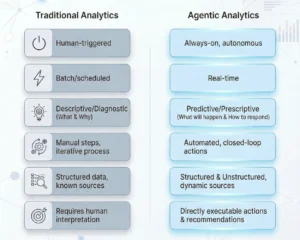
The shift from the left column to the right is what enterprises across industries are navigating right now — and the businesses moving fastest are building structural, compounding advantages.
Real-World Applications of Agentic Analytics Across Industries
It’s easy to talk about agentic analytics in theory. Where it gets interesting is when you look at what it actually does inside real businesses, in industries dealing with real pressure.
Retail & E-commerce
Retailers don’t have the luxury of waiting for a weekly report when demand shifts happen overnight. With agentic AI, pricing adjustments, inventory rebalancing, and demand signals are handled in real time — automatically. If a product starts trending unexpectedly in one region, the agent picks it up before a stockout happens, not after.
Banking & Financial Services
Fraud patterns don’t follow a schedule, and neither do the AI agents build to catch them. In financial services, agentic analytics monitors transaction behavior around the clock, adapting to new threat patterns as they emerge. Compliance monitoring gets the same treatment — continuously updated, not reviewed quarterly.
Healthcare
In healthcare, a few hours can make a clinical difference. Agents tracking patient data can flag early warning signs that might not trigger a formal alert yet — giving care teams a head start. On the operational side, resource allocation becomes far less reactive when intelligent data analytics is running in the background.
Manufacturing
For manufacturers, unexpected downtime is one of the most expensive things that can happen. Agentic analytics change the equation by monitoring equipment sensor data continuously — spotting the early signatures of failure and scheduling maintenance before the breakdown, not after.
Telecom & Oil and Gas
In telecom, network issues rarely announce themselves in advance. AI agents pick up on degradation patterns early, enabling proactive fixes before customers notice. In oil and gas, the same principle applies to field equipment — agents monitoring sensor data in real time can flag anomalies before they turn into incidents.
The Role of Data Intelligence Platforms in Enabling Agentic Analytics
Here’s something that often gets skipped over in conversations about agentic analytics: the agents themselves are only as good as the foundation they sit on.
Think of data intelligence platforms as the infrastructure that makes everything else possible. Without a solid layer handling data ingestion, governance, and real-time processing, even the smartest AI agent is working with incomplete or unreliable information — and that’s a problem.
The platforms that support agentic analytics well are the ones built for real-time streaming, not just batch processing. They have semantic layers that help agents understand what data means, not just what it says. They connect AI/ML pipelines with continuous feedback loops so the system keeps improving. And critically, they have governance guardrails baked in — so autonomous decisions happen within boundaries that the business has approved.
Choosing the right data intelligence platform isn’t a technical afterthought. It’s one of the most consequential decisions you’ll make when building toward agentic analytics — and getting it right early saves a lot of pain later.
How to Get Started with Agentic Analytics as Your AI Consultancy Partner
Most businesses we speak to aren’t short on ambition when it comes to agentic analytics. What they’re short on is a clear starting point — and confidence that the investment will actually land the way it’s supposed to.
That’s a legitimate concern. Agentic analytics isn’t something you bolt onto an existing stack and hope for the best. It requires a clear picture of your data environment, honest prioritization of where AI agents can deliver the most value early, and a rollout plan that doesn’t turn into a multi-year project with nothing to show at the six-month mark.
At AnavClouds Analytics.ai, this is exactly the kind of work our team does. With 50+ certified AI experts across machine learning, generative AI, NLP, data engineering, and business intelligence, we’ve helped enterprises across 12+ countries move from “we want to use AI” to “this is actually working.” We’re not interested in building pilots that never reach production. We build agentic analytics systems that are designed from day one around your specific data, your specific goals, and your specific constraints.
If you’re just starting to explore agentic analytics or looking to evolve an existing analytics stack into something that actually acts on its own — let’s have a practical conversation about where to begin.
Final Thoughts
Agentic analytics isn’t a future concept — it’s being deployed today, and the gap between organizations that adopt it early and those that wait is widening fast.
The businesses winning on data right now aren’t the ones with the most dashboards. They’re the ones whose data works for them — autonomously, continuously, and intelligently.
If you’re ready to explore what agentic analytics can look like inside your organization, AnavClouds Analytics.ai is here to help you build it right.
Frequently Asked Questions
What is agentic analytics, and how is it different from traditional BI?
Traditional BI gives you a report. You open it, interpret it, and decide what to do next. Agentic analytics skips the middle steps — AI agents monitor data continuously and take action on their own, without waiting to be asked.
What are the main use cases of AI agents in analytics?
It varies a lot by industry, but some of the most common ones are fraud detection, demand forecasting, predictive maintenance, and automated anomaly alerts. Basically anything where waiting for a human to notice a pattern first is too slow or too costly.
Which industries benefit most from agentic analytics?
Retail, banking, healthcare, manufacturing, telecom, and oil and gas are seeing the strongest early results — mostly because these are industries where delayed decisions are expensive and data volumes are too high for manual review to keep up.
How do I get started with agentic analytics for my business?
Honestly, the best starting point is getting clarity on your data infrastructure first — what you have, what state it’s in, and where the biggest decision bottlenecks are. From there, picking one or two use cases with a clear ROI makes the rollout much more manageable than trying to do everything at once.