
Most enterprise conversations around LLMs started with curiosity — a few pilots here, a chatbot there. But somewhere between 2024 and today, the dynamic shifted. LLM use cases stopped being experiments and became expectations. Decision-makers are no longer asking “should we explore this?” They’re asking, “Why haven’t we scaled this yet?” And that’s a meaningful distinction. This blog breaks down the LLM use cases that are delivering real, measurable outcomes for enterprises right now — not theoretical ones that sound good in a boardroom deck. If you’re mapping out your AI roadmap for 2026, this is where you start.
Why LLM Adoption in Enterprises Looks So Different Today
A few years ago, LLM adoption in enterprises was patchy at best. Most organizations were testing the waters — a summarization tool for one team, a content assistant for another. There was no cohesion, no strategy, and honestly, not much to show for the investment.
That has changed significantly; a study has shown that more than 80% of enterprises are expected to have deployed generative AI applications or APIs by 2026, up from less than 5% in 2023. The speed of that shift tells you everything about where enterprise priorities now sit.
What’s driving this isn’t just the technology getting better — though it has. It’s that enterprises have started pairing LLM use cases with actual business problems instead of chasing novelty. The companies seeing ROI are the ones who asked: where in our operations does language intelligence remove friction, reduce cost, or create a competitive edge? That’s the question this blog is built around.
The LLM Use Cases Enterprises Are Prioritizing in 2026
1. Intelligent Document Processing and Knowledge Extraction
One of the most immediately valuable LLM use cases for any large organization is making sense of the documents it already has. Contracts, compliance reports, financial filings, internal policies, meeting notes — enterprises generate enormous volumes of unstructured text that mostly sit idle.
LLMs change this. They can read, extract, summarize, and cross-reference documents in seconds, turning static archives into queryable intelligence. A legal team can surface relevant clauses across hundreds of contracts. A finance team can pull risk indicators from quarterly filings without reading each one manually.
This isn’t a future capability — it’s one of the most widely deployed LLM use cases today, particularly in banking, insurance, and healthcare, where documentation is both heavy and high-stakes.
2. Customer Support Augmentation and Intelligent Routing
Ask any support to lead what their biggest headache is, and you’ll probably hear the same thing: volume. Tickets pile up, response times stretch, and agents end up answering questions they’ve handled a hundred times before — leaving less energy for the cases that actually need human attention.
LLM use cases in customer support don’t just automate responses. They make the whole support function sharper. When a customer writes in, the model reads the message, pulls out relevant account history, figures out what the issue is, and either resolves it or routes it to the right person — with a full context summary already prepared. That handoff piece is underrated. Agents who walk into a conversation knowing the background close issues faster, and customers feel the difference.
For enterprises running across multiple geographies, this also removes the localization headache. One LLM layer handles multiple languages without separate workflows or inconsistent service quality across regions.
3. Internal Copilots for Knowledge Workers
Here’s something worth sitting with a large chunk of what knowledge workers do every day isn’t really thinking. It’s finding, formatting, summarizing, and sending. Search through shared drives for a document that may or may not be up to date. Drafting the same type of email for the fifth time this week. Pulling together a report that three different systems need to contribute to.
LLM use cases built around internal copilot chips away at exactly this. Not by replacing anyone, but by handling the mechanical side of knowledge to work so the person behind the screen can spend their time on things that need a human brain. That means faster turnaround on deliverables, fewer dropped details, and less context-switching throughout the day.
Where these tools get genuinely powerful is when they’re connected to real enterprise data through RAG pipelines. Instead of generic answers, employees get responses grounded in the company’s own documentation, policies, and past decisions — which is the difference between a helpful tool and one person trusts and use.
4. Code Generation and Developer Productivity
Developers were some of the earliest adopters of LLM use cases — and for good reason. Writing code is one of those tasks where even small efficiency gains add up quickly across a large team.
In practice, what this looks like is a developer asking the model to generate a function, write unit tests for existing code, explain what a legacy block does, or flag potential issues in a pull request before it goes to review. None of this replaces engineering judgment — but it cuts the time spent on the parts of development that are more mechanical than creative.
The real business case, though, isn’t about individual developer speed. It’s about what faster, more consistent code output means for product timelines. Enterprises with large engineering teams that have leaned into LLM use cases around development are shipping faster and spending less time in review cycles, which compounds into a meaningful competitive advantage over time. New engineers also ramp up faster when they can ask questions about the codebase in plain language and get useful answers immediately.
5. Marketing Content and Personalization at Scale
Content teams have been using generative AI tools for a while, but the more sophisticated LLM use cases in marketing go beyond drafting blog posts. Enterprises are now using LLMs to personalize content at a segment level — generating product descriptions, email sequences, and ad copy that adapts based on customer profile, behavior, and purchase history.
This is one of the LLM use cases where the combination of scale and specificity creates a genuine advantage. A human content team can produce great content but can’t produce 10,000 variations of a product description tailored to different audience segments. LLMs can — with guardrails and human reviews built into the workflow.
For e-commerce and retail enterprises in particular, gen AI use cases in content and personalization are directly connected to conversion rate improvements and customer lifetime value.
6. AI Decision Making and Predictive Intelligence
This one tends to surprise people because it doesn’t fit the typical image of what LLMs do. Most people associate them with text — writing, summarizing, and answering questions. But some of the more impactful LLM use cases right now sit at the intersection of language and data.
Here’s a simple example: an operations manager wants to know why delivery times in a particular region have been slipping over the last three weeks. Traditionally, that question goes to an analyst, who runs queries, compiles a report, and gets back to the manager — maybe by the end of the day, maybe tomorrow. With LLM use cases built around AI decision making, that same manager can ask the question directly and get a structured, sourced answer in under a minute.
The technology isn’t magic — it’s pulling from real data pipelines and machine learning tools that are already doing the analytical heavy lifting. But the LLM acts as the interface that makes those insights accessible to people who don’t know how to write SQL or navigate to a BI dashboard. When you remove that barrier, better decisions happen faster, at every level of the organization.
7. Compliance Monitoring and Risk Summarization
Compliance work is one of those functions where the consequences of getting it wrong are severe, but the day-to-day reality is mostly just exhausting volume. Reading regulatory updates. Reviewing internal communications. Preparing documentation before an audit. Most of it is necessary, very little of it scales well with human effort alone.
LLM use cases in this space aren’t designed to remove compliance officers from the equation — they’re designed to make sure nothing slips past them. A model can scan thousands of communications for language that triggers a policy of concern. It can track regulatory changes across multiple jurisdictions and flag what applies to your organization specifically. It can draft the summary document that your compliance team would otherwise spend two days writing from scratch.
The ROI here isn’t always obvious from the outside because you’re measuring things that didn’t happen — missed filings, regulatory penalties, audit failures. But for enterprises operating in banking, healthcare, pharma, or energy, LLM use cases in compliance to carry some of the highest risk-adjusted value of any AI investment on the table.
What Separates Successful LLM Deployment Strategies from Stalled Ones
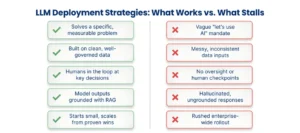
A lot of enterprise AI projects don’t fail because technology failed. They stall because someone greenlit a project without a clear answer to a basic question: what problem, exactly, are we solving, and how will we know when we’ve solved it?
The LLM use cases that actually deliver tend to have a few things in common. They start with a specific operational pain point — not a vague mandate to “use AI.” They’re connected to data that’s clean enough to be useful, because no model performs well on a mess of inconsistent inputs. And they keep humans in the loop at the moments where the stakes are high enough to warrant it.
What often gets underestimated is the infrastructure side. Enterprises that are seeing real returns from their generative AI solutions have usually invested in more than just the model itself — they’ve built the RAG pipelines that keep outputs grounded in real company data, the evaluation layers that catch quality issues before they reach users, and the feedback mechanisms that let the system get better over time.
If you’re figuring out where to begin, a practical approach is to find the LLM use cases where you already have the data, the process is clearly defined, and a wrong answer has a low enough cost that you can learn from it. Start there, prove it out, and use that momentum to move into higher-stakes territory with more confidence.
Conclusion
LLM use cases have matured past the pilot stage. What’s being built now — across industries, functions, and geographies — is a real enterprise infrastructure powered by language intelligence. The organizations moving forward with clarity, the right data foundations, and well-chosen use cases are already seeing compounding returns. If you’re at the stage where you know you need to act but aren’t sure where to start, working with a team that has deep experience in AI development services and generative AI solutions makes a real difference. AnavClouds Analytics.ai brings that expertise — helping enterprises identify, build, and scale LLM use cases that are built for outcomes, not experimentation.
Frequently Asked Questions
What are LLM use cases in business?
LLM use cases in business range from processing documents and handling customer queries to generating content, supporting developers, and flagging compliance risks — helping teams move faster with fewer manual steps.
Which industries benefit most from LLM use cases?
Finance, healthcare, retail, and legal are seeing the strongest returns. These sectors deal with high document volume, strict compliance needs, and customer interaction at scale — exactly where LLM use cases add the most value.
How are enterprises using LLMs in 2026?
Most enterprises have moved past pilots. Today, LLM use cases are embedded in support workflows, internal tools, analytics layers, and developer environments — functioning as operational infrastructure, not standalone experiments.
What is the ROI of implementing LLM use cases for enterprises?
ROI typically shows up as lower processing costs, faster turnaround times, reduced support overhead, and better decision speed — most organizations see measurable impact within the first few months of deployment.