
The financial market is changing at a significant pace of time because smart technologies transform the ways investors process data and implement strategies. One of these innovations is AI trading, which has become a formidable force in making wiser and quicker decisions in the market. Traders are moving towards using AI for trading, which is becoming more popular to analyze large financial volumes, detect patterns, and determine possible market movements. In contrast to conventional ways of trading, artificial intelligence for trading facilitates automatic insights, enhanced predictability of performance, and enhanced speed of performance. The use of AI trading platforms has been increasing among hedge funds, institutional investors, and others. With the trend towards data-driven, competitive markets, AI in trading is emerging as the cornerstone of creating intelligent, scalable, and high-performing investment strategies.
Understanding AI for Trading in Modern Finance
AI for trading refers to the use of artificial intelligence models and machine learning algorithms to analyze financial markets and execute trading strategies. These systems manipulate huge amounts of historical and real-time market data to determine viable opportunities.
Traditional trading is a very heavy, manual analysis and human judgment-dependent trading. Nevertheless, artificial intelligence for trading can be used to analyze thousands of market signals at once and in a computer-assisted manner. These indicators comprise price dynamics, economic indicators, market moods, and trading volumes.
Modern AI systems for stock trading platforms constantly learn based on past trends and become more accurate at their predictions as time goes on. This learning ability enables merchants to develop smarter and more adaptive plans.
Financial institutions are now using artificial intelligence and stock trading technologies to achieve a competitive advantage in the high-volatility markets. The tools enable traders to identify hidden opportunities before they are detected by conventional analysis tools.
Turn complex market data into profitable opportunities with intelligent AI-powered trading solutions.
Why AI in the Stock Market Is Growing Rapidly
The use of AI in the Stock Market has been growing faster because of various technological and economic reasons. The volume of data that financial markets are producing is enormous, and analyzing it manually is becoming harder.
AI for trading can help investors to process such information effectively and turn it into practical conclusions. Machine learning algorithms can identify the relationships between financial variables that human analysts sometimes fail to recognize.
The AI in trading is employed more by institutional investors to acquire insights into the market faster. Such systems assist them in responding fast to changes in prices, news, and macroeconomic forces.
Advanced data analytics are also used to enhance portfolio optimization and risk management policies. The investors can discover the assets that do not perform well and minimize the risk of investing in unstable assets.
The use of AI for trading is picking up pace today. According to recent industry research, 62% of hedge funds currently employ AI in investment decision-making, indicating the increasing use of AI trading technology in market analysis and strategy development.
Advanced Technologies Powering AI for Trading in Modern Financial Markets
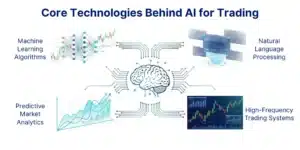
The high pace at which financial technology is changing has improved the use of AI for trading. The contemporary AI trading technology is based on effective computational models that analyze huge financial data in real-time. Such technologies make it possible to analyze and recognize patterns and execute intelligent strategies automatically. AI trading platforms combine machine learning and predictive analytics with real-time data processing, enabling investors to become aware of opportunities more quickly. With the increasing complexity in the market, artificial intelligence for trading keeps transforming the way institutions use data, risk management, and build scalable trading solutions. Moreover, streamlining the process AI development services can be of great help.
Machine Learning Algorithms
AI for trading systems are based on machine learning algorithms. Such models examine the historical trends in prices, the volume of trade, and trading-technical indicators to extrapolate predictive signals. With time, machine learning models keep getting better in their accuracy based on past market outcomes. This is an adaptive ability that enables AI trading platforms to optimize trading strategies and adapt to evolving market circumstances. Machine learning enhances artificial intelligence and stock trading with the help of advanced data analytics, which allows quicker insights and more precise market forecasts.
Natural Language Processing
Natural language processing is vital in facilitating AI in trading systems to process financial news and market sentiment. Earnings announcements, economic reports, and global events are immediate reactions to the financial markets. NLP enables AI for trading stocks to read thousands of news articles, analyst reports, and social media discussions in real time. The ability to convert unstructured data into useful signals. Consequently, AI trading platforms enhance AI in decision-making by enabling traders to respond promptly to the market moving situations.
Predictive Analytics
The modern artificial intelligence stock trading software is built on predictive analytics. These systems consider historical market trends, technical indicators, and economic signals to predict possible price movements. Predictive systems can predict trends that human analysts frequently overlook with the help of machine learning models and statistical algorithms. This will make AI trading more effective in trading strategies in the financial markets. A vast number of institutions utilize predictive models as part of an AI system for stock trading to make precise predictions and enhance investment decision-making.
High-Frequency Trading Algorithms
One of the newest uses of AI trading technology is high-frequency trading algorithms. The systems are capable of making thousands of trades in a few milliseconds by processing live market data. These algorithms are used by the financial institutions to identify short-run price inefficiencies across the exchanges. The current AI trading systems are based on high-frequency algorithmic trading combined with sophisticated data analytics to track markets. Such integration enables AI for trading solutions to increase the speed of execution, liquidity, and react in real time to quick changes in the market.
How AI Trading Platforms Improve Market Decision Making
The capability of enhancing financial decisions is one of the largest opportunities that AI for trading offers. The AI systems take into account several pieces of data at a time and produce the correct trading signals.
The AI technology applied by the financial institutions in the decision-making process will help in analyzing the risk level, performance of the portfolio, and asset allocation techniques. Such systems deliver practical insights rather than unprocessed data to traders.
As an illustration, traders can be alerted by AI trading systems to any abnormal price movements that could give them opportunities. These notifications enable investors to react promptly to the changes in the market.
Moreover, emotional decision-making is eradicated by the AI system for stock trading tools. When the market is volatile, human traders tend to act without thinking. The AI algorithms adhere to the predefined strategies and have the discipline of dealing under trading.
Consequently, AI for trading stocks focuses tremendously on trading accuracy and long-term investment returns.
Building High-Performing Trading Strategies with AI
The design of profitable strategies is only possible with correct market forecasting and sound models of risk management. This is where AI for trading comes in with a high price tag.
Understanding how to build high-performing trading strategies with AI begins with high-quality financial data. The AI models are used to examine the historical price patterns, technical indicators, and macroeconomic indicators.
These systems recognize the concealed trends that are hardly noticed by human traders. After the training, the AI models will create automated trading strategies for trading on the basis of statistical probabilities.
The development teams of numerous AI-based trading platforms incorporate algorithms of reinforcement learning in trading models. Thousands of strategies are tested with these systems on simulated environments before they are implemented in live markets.
Another vital element of artificial intelligence for trading strategies is backtesting. The AI platforms test the strategies based on historical market data to quantify possible profitability.
The strategy assists traders in maximizing strategies and minimizing risk exposure prior to actual capital entering the market.
The Role of Advanced Data Analytics in AI Trading
In the present-day financial markets, massive quantities of structured and unstructured data are produced. Advanced data analytics allows AI for trading platforms to process this information effectively.
AI trading technology relies on data sources such as financial statements, stock prices, volume of trading, social media trends, and economic indicators in the world economy.
Other AI trading services go so far as to use other data sources like satellite images, trade history, and data on consumer behavior. Such datasets enhance market understanding and prediction.
Through the application of both sophisticated data analytics and machine learning solutions, traders can have a deeper understanding of the market. The strategy enables investors to discover opportunities that have not been found using conventional methods of analysis.
Key Advantages of Artificial Intelligence Stock Trading Software in Modern Markets
The introduction of artificial intelligence software in stock trading is changing the way modern traders are tackling investment and financial institutions. Through AI for trading, organizations will be able to analyze large volumes of market data, make decisions automatically, and optimize trading decisions. State-of-the-art AI trading tools integrate machine learning and sophisticated data analytics to identify trends, anticipate the future, and maximize the strategy. With the ongoing developments in AI in trading, these smart systems present increased efficiency, accuracy, and scale to traders in competitive financial markets.
Faster Market Analysis
The first benefit of AI for trading is that it can analyze large amounts of financial data in real-time. Recent AI trading technology interprets market signals, price patterns, and economic indicators in just a few seconds. This has enabled traders to react with greater speed to market dynamics as well as enhance the accuracy of decision-making on AI trading settings.
Improved Accuracy
Another significant advantage of artificial intelligence and stock trading systems is accuracy. AI for trading models runs on historical data and other complex data to find concealed patterns in the market. Such insights minimize human error and enhance the accuracy of forecasts, enabling traders to design more trustworthy strategies with the help of sophisticated data analytics.
Automated Trading Execution
A key component of the current AI trading platforms is automation. Through AI for trading, algorithms are implemented so that, upon receiving an order to buy and sell, automated systems are used to place the buy and sell orders. This process removes the human factor in the process and enhances efficiency and consistency. Consequently, AI trading technology assists traders in making strategies more reliable and quicker in their execution.
Enhanced Risk Management
An AI system for stock trading makes risk management more efficient. These smart systems will keep track of the performance of a portfolio, market volatility, and exposure to risks. With the adoption of AI in decision-making, traders will be alerted to things in real-time, which will assist in protecting and holding a balanced portfolio.
Scalable Investment Strategies
The significant benefit of AI trading platforms employed by large financial institutions is scalability. AI for trading stocks permits organisations to manage a number of stock portfolios and strategies at the same time. With the help of modern data analytics, institutions can grow their operations optimally, and their trading performance across the global marketplace can remain the same.
Key Challenges and Risks of AI for Trading in Modern Financial Markets
Although AI for trading has been found to have strong benefits, it also presents numerous operational and strategic difficulties. Contemporary AI trading technology is based on the quality of the data, the structure of the algorithms, and regulatory compliance. The risks that financial institutions have to cope with as they move towards AI trading platforms include automation risk, market risk, and system risk. Knowledge of these issues can help organizations use artificial intelligence more responsibly in terms of trading and maintain the stability of the markets and efficient AI in decision-making within financial ecosystems.
Algorithmic Market Volatility
Among the major difficulties linked to AI for trading context is the possible acceleration of volatility in the market. By having several AI trading platforms responding to the same signals at any given time, there can be sudden changes in prices. These fast algorithmic reactions can magnify short-term variations, particularly in the high-frequency setup that is propelled by improved AI trading algorithms.
Data Dependency
High-quality and correct data is also essential to the success of AI for trading. Artificial intelligence stock trading software is a type of software that analyzes large amounts of data to produce insights and predictions. Nevertheless, unfinished or incorrect information may give false signals. Even advanced AI systems of stock trading models without a trusted higher level of data analytics can provide flaws in trading decision-making.
Regulatory and Compliance Challenges
The growing adoption of AI trading technologies has put the financial regulators of the world on alert. Governments pay close attention to AI in trading systems to bar market manipulation and unfair benefits of trading. Consequently, AI trading platforms that are utilized by financial institutions are required to comply with strict compliance frameworks, although they are expected to be transparent and responsible in their algorithmic actions.
Over-Reliance on Automation
Overreliance on AI for trading stocks may decrease human control in important financial decision-making. Even though AI in decision-making enhances efficiency, entirely automated systems might not consider strange activities in the market. The traders who are successfully engaged in business usually mix intelligence and artificial intelligence with stock trading instruments and human judgment to ensure that the investment strategies are balanced and informed.
Conclusion
The emergence of AI trading is also changing the financial landscape, as it allows for making more analyses faster, making predictions smarter, and implementing various strategies automatically. Through the integration of sophisticated data analysis, machine learning, and smart algorithms, contemporary AI trading systems can assist organizations with a more in-depth understanding and enhanced trading activity. But to make it work, one needs high-quality data, effective administration, and appropriate technological skills. A strong competitive advantage will be enjoyed by the businesses that invest in artificial intelligence trading technology as financial markets keep on changing. We work with companies at AnavClouds Analytics.ai and power AI-driven solutions that can empower smarter trading systems and analytics, and data-driven financial decision-making in future-ready markets.