
Data warehouse migration cost is the complete amount of money that must be spent to move data, schemas, pipelines, and workloads from a legacy system to a more modern cloud-based system, like Snowflake, Databricks, or Microsoft Fabric. The cost is generally in the range of $20,000 (for small data sets) to well more than $1 million (for enterprise environments with complex data, compliance requirements, and downtime tolerances). Estimating data warehouse migration cost is more important than the migration itself, as research shows 83% of data migration projects fail or go over budget and schedule before they are even finished. This guide provides a breakdown of real 2026 prices for the big platforms.
Why This Number Is So Hard to Pin Down
Get five data warehouse migration cost estimates from different vendors, and you’re likely to receive five different estimates. This is not vendors being coy; it’s because the cost of migration is not one line item. It’s a combination of compute costs, data size, engineering time, test cycles, and the condition of your data. And if you haven’t settled on a target architecture yet, the data lakehouse vs data warehouse decision itself will shift these numbers before migration even starts.
What Factors Actually Drive Data Warehouse Migration Cost?
To manage the data warehouse migration cost, you must first be aware of what forces are moving the migration up or down. The following groups are the ones to look out for:
- Data volume and complexity – Terabytes cost just as much to move as they do to store; Petabytes of semi-structured, nested data cost a lot more.
- Downtime tolerance – Migrations that require near-zero downtime require parallel running environments, thus temporarily doubling infrastructure costs.
- Compliance needs – Healthcare, finance, and government workloads require encryption, audit trails, and access controls from the get-go.
- The tool – Automated ETL/ELT tools reduce engineering hours; manual scripts increase engineering hours.
- Expertise of the teams – If the in-house teams lack experience with cloud-native, they can triple the time and budget.
- Post-migration optimization – Query tuning, indexing, and workload distribution through proper data engineering services are not something that can be ignored – it’s where the bulk of the cost is really going.
- Cloud provider choice – switching between AWS, Azure, and GCP mid-project is often costly, as is the cost of compute and egress for each of these providers.
- Data residency and sovereignty regulations – Multi-region businesses may require duplicate storage footprints for mere compliance – and that costs more on the bill.
They all tend to be underestimated by most teams, and that’s what a project that starts for $150,000 becomes a $220,000 project when it hits go-live.
How Much Does a Data Warehouse Migration Typically Cost in 2026?
Before most organizations will even put their foot in the water, they want a number. So here’s a realistic estimate of how much data warehouse migration cost by scale:
- Small business (under 5TB, single source system): $20,000–$60,000
- Mid-market (5- 50 TB, multiple sources, moderate transformation): $75,000 – $250,000
- Enterprise (50TB+, complex dependencies, regulatory scope): $300,000–$1,000,000+
These figures refer to the migration work alone. These pricing models begin to play a big role in Snowflake, Databricks, and Fabric.
There’s more to industry than most estimates recognize. These are usually at the top of the ranges because of additional HIPAA, PCI-DSS, or SOX compliance tasks that are placed on top of the technical migration. Retail/e-commerce migrations are typically towards the middle, attributed primarily to high volumes of data in peak seasons. The most variable are manufacturing and logistics migrations, as volumes of IoT data or sensor data can turn a mid-market project into an enterprise-level project with a single day of changes.
Snowflake vs. Fabric Cost: Which Platform Wins on Budget?
The Snowflake vs. Fabric cost debate comes up in nearly every migration planning session, and the honest answer is: and the truth is, it depends on your current usage. Microsoft Fabric is offering a single capacity model for Power BI, OneLake storage, and compute, putting the combined cost at 25-40% less for enterprise workloads than Snowflake, primarily due to Snowflake customers paying for a BI tool such as Tableau separately on top of compute. Several 2026 analyses have estimated the savings at about 25-40%.
Snowflake, by contrast, charges per second and automatically suspends the compute when not in use, making it easier for organizations with bursty, unpredictable workloads and extended idle time to save money, compared to Fabric’s reserved capacity. With your team already in Power BI and Azure, Fabric is likely to reduce the data warehouse migration cost. Snowflake’s elasticity can be the right formula for multi-cloud environments or for more ad hoc queries if you need them.
Databricks vs Snowflake Pricing: How Do the Numbers Compare for Migration Projects?
The pricing comparison between Databricks vs Snowflake pricing is a completely different comparison, as both platforms are geared towards different tasks. If you’re still deciding between the two platforms outright rather than just budgeting for the move, our full Snowflake vs Databricks breakdown covers the architectural differences in depth.
Snowflake typically provides query response times 15–30% faster for typical BI and analytics workloads. At scale, Databricks is generally 20–40% more economical than for heavy ETL, streaming, and machine learning pipelines.
This is relevant directly in your overall migration spending. Snowflake’s predictability can be the determining factor if you’re mostly on the dashboard and reporting side of things. While migrating pipelines with a great deal of transformation logic might require more engineering work in the initial stages, Databricks’ job-compute pricing can significantly cut down on the cost of the pipeline over time.
How Is AI Changing These Numbers in 2026?
AI-assisted tooling is starting to shift the economics on both sides of this comparison. Automated schema mapping and code conversion tools now handle a meaningful share of the transformation logic that used to require weeks of manual scripting, regardless of which platform you land on. That doesn’t eliminate the pricing gap between Snowflake and Databricks, but it does shrink the engineering-hours portion of your total migration spend, which for complex projects can be a larger line item than compute itself.
How Do You Build a Snowflake Credit Cost Estimate Before You Migrate?
One of the steps that many people overlook in their migration planning is the Snowflake credit cost estimate. Without it, budgets slowly creep up on you. Snowflake bills are based on the number of credits used per second, with a minimum bill of 60 credits per 60-second period when the warehouse is on. The pricing is typically in the $2-$4 per credit range per edition per cloud provider, with the storage costing about $23-$40 per terabyte per month.
To build an accurate Snowflake credit cost estimate, plan for your warehouse sizes, the hours that you expect them to run, and the number of warehouses you will need at peak load. Auto suspend helps, but if it isn’t properly set up in your team’s environment, idle warehouses that are left running are one of the quickest ways to exceed your projected data warehouse migration cost.
What Does Legacy Data Warehouse Modernization Cost Look Like Versus a Fresh Cloud Build?
Legacy data warehouse modernization cost is usually higher than people expect, because it’s rarely a clean lift-and-shift. Old on-premises systems — think aging Teradata, Oracle, or SAP environments — often carry undocumented dependencies, custom stored procedures, and data quality issues that only surface mid-migration.
Modernizing a legacy warehouse typically adds 20–30% to the baseline data warehouse migration cost compared to standing up a greenfield cloud environment, purely because of the discovery, cleansing, and validation work required. Organizations that skip a proper assessment phase are the ones who end up in that 83% failure-or-overrun statistic mentioned earlier. A structured audit before migration consistently pays for itself.
How Should You Run a Cloud Data Platform TCO Comparison?
A cloud data platform TCO comparison looks beyond the sticker price of compute and storage to capture the full financial picture. Run this comparison before committing to a platform, because it directly shapes your final data warehouse migration cost:
- Compute and storage – List pricing across your top two or three platform candidates.
- BI and visualization licensing – Bundled versus standalone tools change the math significantly.
- Engineering and training time – New platforms require ramp-up, even for experienced teams.
- Data transfer and egress fees – Often ignored until the first invoice arrives.
- Scaling costs at 2x and 5x current volume – Model growth, not just today’s numbers.
A proper cloud data platform TCO comparison, done before migration, is the single biggest lever for keeping your total migration budget predictable over a three-year horizon.
How Can an AI Development Company Help Control Data Warehouse Migration Cost?
An experienced AI development company brings something spreadsheets can’t: pattern recognition from dozens of prior migrations. Instead of estimating data warehouse migration cost from generic benchmarks, a specialized partner can profile your actual data, flag hidden dependencies early, and recommend the platform mix — Snowflake, Databricks, Fabric, or a hybrid — that fits your workload rather than the vendor’s sales pitch.
This is where AnavClouds Analytics.ai typically gets involved: assessing data estates before a single record moves, building automated validation into the pipeline, and using AI-assisted schema mapping to cut the manual engineering hours that usually drive data warehouse migration cost past its original estimate.
What Hidden Costs Push Data Warehouse Migration Cost Higher Than Expected?
Even well-planned projects get surprised by costs that don’t show up in the initial quote. These are rarely dramatic on their own, but stacked together, they explain most of the budget overruns that Gartner’s research points to:
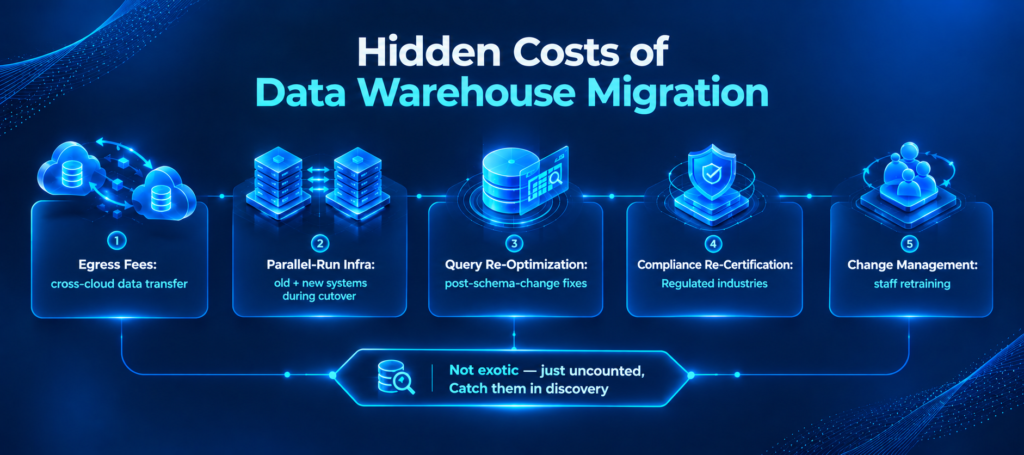
- Data transfer and egress charges between cloud regions or providers
- Parallel-run infrastructure during cutover windows
- Query re-optimization after the schema changes
- Compliance re-certification for regulated industries
- Change management and staff retraining
None of these are exotic. They’re predictable line items that a thorough discovery phase should catch before they inflate your project’s final price tag.
How Can You Keep Data Warehouse Migration Cost Under Control?
Some practices stand out as the ones that succeed in making on-budget migrations stick, while the other 83% fail to make it work.
- Conduct a complete data audit and dependency map before creating a migration plan.
- Request a Snowflake credit cost estimate (or equivalent) based on the workload, rather than a basic tier.
- To test the migration using a representative, smaller sample of data before swapping out all the data.
- Include a contingency allowance of 15-20% for issues that are not identified in the discovery process.
- Get a team that has done this playbook in the past instead of picking up on your production data.
Don’t consider data warehouse migration cost as a one-and-done calculation – it will continuously be refined along the way, and you don’t want to set it on day one and pray for it to stay that way.
Final Thoughts
Data warehouse migration cost is not a static figure; it’s influenced by the complexity of your data, the platform you select, and how much planning happens before the first record moves. Whether you are comparing Snowflake vs. Fabric cost, a precise estimate of costs is essential—and not optional—for organizations that budget effectively. The 17% that successfully complete the project on budget vs. the 83% that don’t is the difference between a realistic cloud data platform TCO comparison upfront and not after invoices are received. AnavClouds Analytics.ai applies the same workflow to teams as it does yourself, from data evaluation to optimization after migration; your platform choice is based on your work, not a vendor’s pricing page.
Frequently Asked Questions
What is the average data warehouse migration cost for a mid-sized company?
The cost of most mid-market migrations is between $75,000 and $250,000 and depends on such factors as the amount of data, the complexity of the source system, and the amount of transformation work required before go-live.
Is Snowflake or Microsoft Fabric cheaper for a cloud data warehouse?
With the need for built-in BI, Fabric can be as much as 25-40% less expensive for teams that are more Microsoft-centric. Bursty, multi-cloud, and highly variable compute workloads can cost less on Snowflake.
How long does a typical data warehouse migration take?
The time required for timelines to be developed varies from weeks to months depending on how small and straightforward the migration is, or even up to 12–18 months for complex enterprise migrations where compliance and dependency mapping requirements are greater.
Can data warehouse migration cost be reduced with automation tools?
Yes. Schema mapping, ETL code generation, and validation tools can help to reduce engineering hours by anywhere from 20-30%, and in some cases even more, than manual methods, especially since the total cost of the project can be 20-30% higher.