

Businesses handle massive customer interactions each day, and this volume keeps increasing. Modern teams now expect faster processes, quicker insights, and smarter automation. These expectations make traditional systems feel slow and disconnected. Companies now need tools that simplify customer communication and help teams act faster.
This is where AI Chatbot Integration with CRM becomes a powerful advantage. When you connect an intelligent chatbot with your CRM, everything feels more unified. Your sales, service, and support teams understand customer needs sooner. Workflows become smoother, and conversations stay consistent across channels.
In this blog, we explore how CRM AI chatbot integration supports business growth. You will learn how AI chatbots connect with CRM, ERP, and other enterprise systems to deliver efficient workflows. We also discuss the benefits, required steps, technical considerations, integration approaches, and factors affecting the AI Chatbot Development Cost.
Why AI Chatbot Integration With CRM Is a Game-Changer
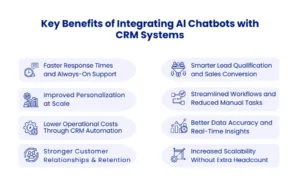
Combining an AI chatbot and CRM makes a connected and smart ecosystem that enhances customer interaction and internal performance. The integration of CRM tools and automated assistants allows companies to gain access to quicker operations, more valuable insights, and simplified processes. That is why the integration of CRM AI chatbots is a strategic investment for contemporary companies.
Unified Data and Reduced Silos
An intelligent AI chatbot integration with CRM systems has all conversations with customers centralized. All the chats, messages, and support requests are immediately registered in CRM. This minimizes the amount of manual work and avoids any data gaps, so that there is a single source of truth between teams.
Faster, 24/7 Customer Support
An integrated chat robot provides 24-hour services to every channel. It takes care of frequently asked questions and product inquiries as well as simple troubleshooting. This is the one that enhances the response speed and instills confidence, and thus, the integration of an AI chatbot with CRM is a necessity in businesses that require considerable support.
Better Lead Capture and Qualification
Each time there is an interaction, the chatbot gathers organized information and forwards it straight into the CRM. The scoring or categorization of leads is automatic, and the sales teams can prioritize leads in a short time. This enhances conversions and showcases the actual Chatbot CRM integration benefits.
Personalized Conversations at Scale
The chatbot also provides individual responses to previous interactions since it has direct access to CRM data. It stores user preferences, past problems, as well as purchase history. Such personalisation leads to a higher level of interest and customer loyalty.
Automated Workflows and Follow-Ups
AI chatbot integration with CRM can book appointments, remind, log cases, or assign without human intervention. Such automated operations save on labor and maintain consistency of processes. Custom AI chatbot development services are helpful in providing businesses with reliable execution.
Lower Operating Costs and Higher Efficiency
Automation saves the massive support team and decreases redundant work. Quick operations, precise information, and a reduced number of human errors reduce the total costs. This is the reason why businesses collaborate with an AI development company to develop scalable systems of integration.
How AI Chatbot Integration With CRM and Enterprise Systems Works
In order to learn about the AI chatbot integration and the CRM, consider a smart assistant that will be able to talk to your internal systems. It reads and processes data and updates records automatically. This smooth interaction becomes the basis of the successful integration of the CRM AI chatbot.
Reads and Understands Customer Data
CRM data, including contact details, order history, support tickets, and preferences, is immediately available to the chatbot. The AI chatbot integration with CRM systems uses this information to provide appropriate and customized answers.
Accepts Inputs from Multiple Channels
It collects the questions and messages on websites, mobile applications, or social media. These data assist the chatbot in enhancing interactions and enhancing the overall AI integration services ecosystem.
Interprets Queries and Generates Intelligent Responses
The chatbot determines the intent of the user and gives appropriate responses through AI and NLP. It can seek further information where necessary. This decision-making skill indicates the worth of custom AI chatbot development services.
Updates CRM and ERP Systems Automatically
The chatbot automatically feeds new information into CRM or ERP platforms. It can make or revise leads, cases, or orders where necessary. This eliminates the manual labor and demonstrates good AI Chatbot Integration with CRM.
Triggers Automated Tasks and Workflows
Demos can happen with the help of integrated bots, reminders can be sent, tickets can be created, or human agents can be notified. Such interventions illustrate major Chatbot CRM integration benefits for expanding teams.
A Connected System That Works as One
By having secure APIs or ready-to-use connectors, the chatbot will be a natural extension of the enterprise system. It is not used as an independent tool anymore. Rather, it acts as a smart veneer that is driven by a seasoned AI chatbot development company.
How to Streamline AI chatbot integration with CRM, ERP, and Existing Systems
1. Audit Current Systems & Define Objectives
The first step to a successful AI Chatbot Integration with CRM is to understand your existing systems and workflows with customers. See the way your CRM, ERP, or support tools store the data and find the gaps that can be filled by an AI chatbot. This makes sure that your integration objectives are aligned with actual business requirements and that they assist both the sales and service units.
- Review CRM and ERP structure for AI Chatbot Integration with CRM
- Map customer touchpoints suited for AI chatbot for CRM systems
- Identify automation opportunities using AI integration services
- Define chatbot roles: lead qualification, support, or workflow automation
2. Choose the Right Chatbot Platform or Development Approach
The platform you select determines flexibility, the degree of automation, and scalability. Companies usually choose to use ready-made tools or hire developers to build AI chatbots. A bespoke solution includes more CRM AI chatbot integration and workflow customization, but comes at a higher cost of AI Chatbot Development.
- Select low-code or custom AI chatbot development services
- Ensure the platform supports scalable AI chatbot integration with CRM
- Validate NLP quality and language support
- Compare pricing to estimate AI Chatbot Development Cost
3. Design Conversation Flows & Integration Logic
This stage defines how customers will engage with your bot and how the bot will interact with internal systems. Effective AI chatbot integration with CRM requires structured workflows that handle questions, escalate issues, and update CRM data without delays.
- Map user journeys for sales, marketing, and support
- Create workflows aligned with Chatbot CRM integration benefits
- Define data read/write logic between the chatbot and CRM
- Set clear rules for escalation and ticket creation
4. Build the Solution & Connect It with CRM / ERP
Once the logic is ready, developers configure APIs, connectors, and middleware to ensure seamless system communication. Proper API mapping allows the bot to read and update CRM data instantly, enabling a smooth AI Chatbot Integration with CRM.
- Connect systems with APIs or certified connectors
- Implement security and authentication protocols
- Configure real-time syncing for CRM AI chatbot integration
- Add error-handling and fallback routing
5. Test Your AI Chatbot Across All Channels
Testing ensures that your AI chatbot for CRM systems behaves reliably across every platform. It includes checking flows, CRM updates, ticket creation, lead capture, and failover mechanisms. Testing reduces errors and improves customer satisfaction from day one.
- Test chatbot across web, mobile, and social channels
- Validate CRM updates and real-time data sync
- Ensure smooth workflows and response accuracy
- Check escalation paths and fallback responses
6. Train Internal Teams & Monitor Performance
Even the best chatbot needs well-informed teams to support adoption. Train your staff on what the bot can handle and monitor core metrics to assess its effectiveness. Strong monitoring helps you maximize Chatbot CRM integration benefits.
- Train sales and support teams on AI workflows
- Monitor KPIs affected by AI chatbot integration with CRM
- Track response speed and resolution improvements
- Use analytics to refine experience
7. Continuously Optimize After Deployment
After launch, optimization becomes a continuous process. Analyze real interactions, refine language models, and adjust workflows to improve accuracy. This helps your business make the most of AI integration services and scale automation across departments.
- Review chat logs and update NLP rules
- Improve flows for better customer experiences
- Expand automation with AI chatbot development services
- Maintain compatibility with evolving CRM or ERP systems
How AI Chatbots Work Across Enterprise Systems
This protracted design transforms the chatbot into a hub. Every system is connected by it, eliminating manual handoffs and enhancing the accuracy of data within the ecosystem.
Order Management & Inventory Systems
AI chatbot integration with CRM can be linked to an ERP to verify the presence of the product and track orders and deliveries. This facilitates the sales and service departments as it provides real-time information without having to search databases.
Billing & Finance Platforms
Invoices may be retrieved and payment information distributed, and reminders generated through AI chatbots and CRM. This automation saves the work of the finance team and enhances transparency for customers.
HR & Internal Systems
Internal workflows are also assisted by AI integration services. Automated conversational flows allow employees to request leave and access onboarding information, as well as make internal support requests.
Marketing & Analytics Tools
The conversations with chatbots can provide useful information to the marketing teams. The user intent creates one-to-one follow-ups, personalized offers, and audience segmentation, and it is fueled by insights into the interactions of individual users.
Common Challenges & How to Overcome Them
The strong developments of AI chatbots avoid the pitfalls. The sooner AI Chatbot Integration with CRM is aware of the threats, the easier the implementation process, and the long-term results will be more successful.
Complex System Compatibility
The legacy systems might not be able to support easy API based integrations. Audit technical capabilities preceding CRM AI chatbot integration. Implement middleware to build stable connections in situations where they are not necessarily compatible.
Poor Data Quality
In case the data of CRM data is outdated, the chatbot can provide wrong answers. CRM data should then be cleaned, validated, and standardized, and then allowed to integrate AI chatbot integration with CRM to provide reliable responses and automation.
Security & Compliance Concerns
The data about customers must be highly secured. Implement secure APIs, encryption, and compliance best practices when implementing AI integration services to minimize threats to privacy and system exposure.
Employee Adoption Resistance
Staff might be insecure about automation. They should be trained at an early age, told all the advantages of chatbots, and shown how the system can facilitate, not eliminate, their work.
Maintenance & Continuous Updates
Systems change, trends in conversation change, and business requirements change. The chatbot is reliable and scalable with continuous monitoring, optimization, and updates provided by a reputable AI development firm.
Conclusion
AI chatbots are changing the way business is conducted in terms of communication, data management, and customer experience. Selecting AI Chatbot Integration with CRM, you establish an integrated environment in which each team will operate based on the correct information and expedited insights. This is integrated in such a way that sales, service, and marketing teams can work confidently. You also streamline manual processes and enhance the response rates at all channels.
AI chatbot integration with CRM would put you on the path to becoming a business that is aligned with modern automation levels. The chatbot becomes smarter and more efficient when it is attached to CRM, ERP, and other systems.
A trusted partner and one having solid experience in enterprise AI is required in order to make this work. AnavClouds Analytics.ai. This is a chatbot integration service provider of any type that is secure, scalable, and custom-built to work with businesses. Our team aids in simplifying your operations and creating smart systems that will enable you to grow in the long term.