

The use of AI has transcended its experimental phase and is now a tool that impacts customer interactions, hiring processes, and financial results, and its adoption is quickly outstripping regulation in most other areas. By the end of 2026, 40% of enterprise applications will be connected to task-specific AI agents, up from less than 5% today, representing an eightfold increase in just a year. That’s where an AI governance framework comes in to save the day. That’s where an AI governance framework comes in to save the day. It provides the framework of policies, roles, and controls that specify who is responsible for AI, how risk is measured, and what to do when it goes wrong. If there isn’t one, it’s not progress in scaling AI – it’s exposure. This guide explains the elements of a modern AI governance framework, why it’s more important than ever this year, and how to create a framework that can stand up to scrutiny by regulators.
What Does an AI Governance Framework Actually Mean?
An AI governance framework is not just a compliance document in a folder. An AI governance framework isn’t merely a compliance document stored in a folder. It’s an operating system for the approval, monitoring, and retirement of AI within an organization. Imagine that you don’t have fire extinguishers around a building, but you have a fire safety plan that assigns owners, sets out escalation routes and regularly tests the plan.
In essence, a working AI governance framework responds to the following four questions for each AI system in use:
- Who are the owners of this model and who is responsible if it doesn’t work?
- What is it fed with and what’s its source of data?
- What are the potential hazards? How are potential hazards measured?
- How is its behavior monitored, assessed, and modified over time?
If an organization is unable to answer these questions today, then it’s the best sign that an AI governance framework is no longer an option; it’s a necessity.
Why Is AI Governance Suddenly Non-Negotiable?
The truth is that the divide between the use of AI tools and AI regulation has grown so wide that it cannot be ignored. This year, several studies are corroborating this trend from various perspectives. While most of the organizations say they have governance frameworks, fewer have fully realized the necessary controls to address bias, transparency, and security issues.
It’s in that mismatch that all the problems start! Agentic systems perform actions on their own, such as approving transactions, triaging support tickets, creating queries of customer records, and so forth, without a human having to click “confirm” every time. All of those actions must have an audit trail, a boundary, and a rollback plan. Traditional bits of IT supervision were not intended to be for software that takes care of itself. AI risk management needs to be designed to deal with it, and not forced upon it.
That’s another key reason why responsible AI is no longer a mere side discussion among the ethics teams but is now a board-level discussion. If it is possible to authorize a refund without the person’s review, to mark a loan application for a positive response or negative response, or to reroute a shipment without human oversight, an organization must have assurance that the principles of responsibility were baked in at the beginning, not as an afterthought in response to a customer complaint.
What Are the Core Pillars of an Effective AI Governance Framework?
While the terminology might vary from one organization to another, the general outline of most mature AI governance structures is comparable. It’s usually in this shape.
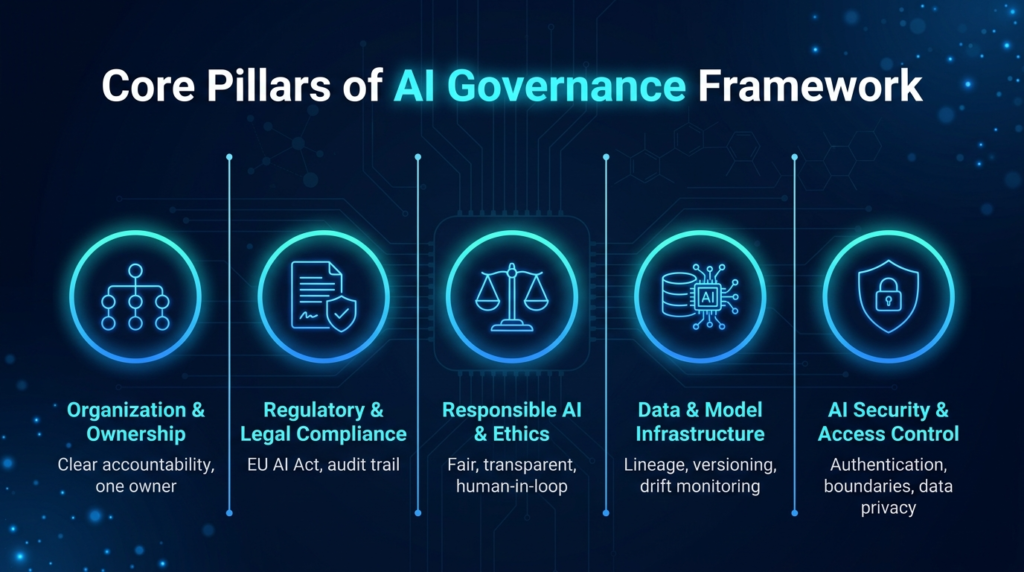
1. AI Organization and Ownership
This is where it is answerable. The AI inventory is owned by someone (typically a Chief AI Officer, a governance lead, or a cross-functional steering committee), oversees the review of AI risks, and reports to leadership. If there isn’t an AI governance structure with designated ownership, it is everyone’s responsibility, and it is no one’s.
2. Regulatory and Legal Compliance
This pillar aligns and connects AI systems to relevant laws, including those specific to certain sectors as well as international-level regulations such as compliance with the EU AI Act. It also includes details of the way the organization will record the decisions if regulators call, and that’s what an AI audit trail does.
3. Responsible AI and Ethics
Here are the principles of fairness, transparency, and human oversight. Responsible AI is not a marketing buzzword; it’s a field of testing to ensure that models are not biased, remain explainable to humans, and allow for human intervention when the output appears incorrect.
4. Data, Model, and AI Ops Infrastructure
This is the backbone that operates: data lineage, model governance, model versioning, and monitoring pipelines that detect drift before it’s a customer problem. What makes a model framework work in production and a framework on paper is good model governance.
5. AI Security and Access Control
The more tools that begin to work with AI, the more a surface space of attack becomes unmanaged. This pillar is about authentication, the boundaries of what AI systems can access, and how to ensure that data privacy in AI is protected and safeguards to prevent sensitive information from being leaked through a poorly scoped integration.
How Does EU AI Act Compliance Fit Into an AI Governance Framework?
The EU AI Act is the most impactful global regulatory guardrails for businesses, and has made meaningful progress this year. In June 2026, the Council of the EU adopted a “Digital Omnibus” streamlining package, further delaying the compliance date of the high-risk AI systems under Annex III from August 2026 to December 2027, and the one for the Annex I product embedded systems now being delayed to August 2028. Transparency requirements for AI-generated content and watermarking of AI-generated content are also scheduled to go into effect in December 2026.
This extension will give time, but not decrease what is needed. Conformity Assessment, registered documentation, human control systems, and ongoing monitoring are essential for all high-risk systems. The key takeaway is that by establishing an AI governance framework now, and not waiting for the upcoming compliance with the EU AI Act, you can have the same controls work for NIST AI RMF and ISO 42001 alignment. A wide range of good governance activities do not remain regional; they are used in all markets in which the business is involved as reusable infrastructure.
It is in this area too that AI policy comes into play. A cross-functional approved AI policy provides a guide for both legal and compliance teams and for business teams, rather than having unique views on what’s and isn’t “compliant AI use.
What Belongs on an AI Compliance Checklist?
Organizations developing or reviewing AI governance policies may find this checklist useful as a working guide to AI compliance, aligned with the pillars listed above, to ensure compliance is not considered a checklist item at a time.
- Model inventory: An up-to-date catalogue of all the AI systems in use, who owns them, and which data they interact with.
- AI policy: documented and cross-functionally approved policy on acceptable use, escalation path and banned uses.
- Risk classification: all systems tagged by the same AI risk management methodology across the tier of risk.
- Data privacy in AI safeguards: clear guidelines for what personal or sensitive information can power or feed an AI system, and how consent and retention are managed.
- Model inventory: versioning, testing, and Approval gates prior to the model going into production.
- AI audit trail: documents that record decisions made by the AI model, particularly for high-stakes or regulated applications, that can be generated when needed.
- Human oversight triggers: thresholds where a human has to review or override an automated decision.
- Model inventory: scheduled reviews for drift, bias, and policy compliance, not just a one-time sign-off
Use this AI compliance checklist as a living document. A governance programme which does not keep evolving in the face of changing regulations and new governance models is no use in a few quarters.
What Does a Data Quality Checklist for AI Look Like?
The failure of governance frameworks to work is not necessarily due to lack of policy, but rather, lack of underlying data governance. A practical data quality checklist for AI should confirm the following:
- Sources of data are documented and traceable to origin.
- The training data is unbiased and tested for bias.
- Data lineage is captured at the ingestion point up to model output
- Access to sensitive datasets is controlled, monitored, and documented.
- Data freshness is tracked, and old or duplicate data is not used for model training.
- Consent and regulatory basis of use are documented, particularly for personal data.
One of the more frequent reasons for governance programs to stall during an audit is that this step is skipped. The policy is on paper, but there is no one who can demonstrate the underlying data actually meet the policy. You can’t have a robust framework without a solid data quality checklist.
How Should an Enterprise Start Building an AI Governance Framework?
Attempting to control too much, too soon, is the quickest method to stall a program before it begins. A staged approach is more effective.
- Inventory first: Identify all existing AI systems, including those deployed in shadow IT projects without central oversight.
- Classify by risk: Focus governance efforts on systems that impact regulated data, financial decisions, or customer-facing results.
- Assign ownership: Decide on a governance lead and a committee before you start writing one policy.
- Create the AI audit trail in advance: It’s much easier to bake in logging than it is to add it on after an incident.
- Automate what scales: When enterprise-wide manual review is no longer feasible, with hundreds or thousands of AI agents working, manual reviews don’t come to a grinding halt.
- Check regularly: Governance is not a ‘launch checklist’, it requires review every quarter as models, regulations, and use cases evolve.
Companies which follow this as a one-off project are likely to have structures that appear full on the slide but which are missing when the auditor, regulatory body, or board member comes along to ask for proof. The ones that see it as an operating discipline will be the only ones who will remain standing when the next wave of AI regulation comes.
Where Do Most AI Governance Frameworks Break Down in Practice?
AI governance frameworks have the same few pitfalls, typically because they were written about the usage of AI a year ago, not today. Ownership is no longer shared between business, technical, legal, and security teams and falls apart when people move on or priorities change. Data quality becomes a problem for somebody else, and the governance effort becomes focused on models based upon data with which nobody can be associated. However, monitoring is only done once at the initial launch and then not looked at again, meaning that drift, bias, and new risks remain unnoticed until something breaks in front of a customer or a regulator.
These are not traps that can be overcome only with a larger team or larger budget. It takes a governance approach of treating governance as an infrastructure rather than a document to be filed after passing the initial audit.
Final Thoughts
The companies that can prove at any given time that their AI systems are accountable, auditable, and compliant will be the ones that will be able to scale AI in the coming years. An AI governance framework does not limit innovation; it is what makes sustained innovation possible without any setback on the way of innovation or risk to the reputation. The first step does not matter whether it’s about EU AI Act compliance, strengthening AI risk management, or simply establishing a better governance framework for AI models before the next audit; it all begins with knowing what AI models you’re running and who’s responsible for them. Whether it’s a data quality checklist or comprehensive compliance audit, at AnavClouds, we assist enterprises in developing AI governance frameworks that survive the test of reality and succeed in growing AI as an asset rather than a burden.
FAQs
1. What is an AI governance framework in simple terms?
It is a structure of policies, roles and controls that specify how AI is developed, monitored and held accountable throughout an organization, ensuring the safe and compliant use of AI.
2. Is EU AI Act compliance mandatory for non-EU companies?
Yes, even if the AI system of the company impacts EU users or markets, the EU AI Act will apply, regardless of where the company is based.
3. What’s the difference between AI governance and AI security?
AI governance establishes accountability, policymaking, and decision-making practices, whereas security ensures the protection of the data, models, and infrastructure itself from threats and breaches.
4. What’s the difference between AI governance and AI security?
Most mature programs perform a review of their programs every 3 months, and other ad hoc reviews are performed when new regulations, incidents, and major model changes occur.