
Before you embark on your next AI initiative for your enterprise, there is one question you need to ask yourself honestly: Is your data ready? Failure in AI isn’t necessarily due to poor models or incorrect tools. They all reduce data not ready to be used for AI. The report reveals that industries are underestimating the critical importance of data readiness for AI by stating that 60% of AI projects without AI-ready data will be abandoned. In this blog, we will explore a pragmatic AI-ready data checklist to understand where enterprises stand, identify gaps, and establish the necessary groundwork for enterprise AI solutions to truly provide value.
What Does “AI-Ready Data” Actually Mean?
To begin with, it is critical to have a clear understanding of what is meant by “AI readiness” in a data context, as most teams misunderstand this. Before the AI-ready data checklist, it is important to have a clear understanding of what “AI readiness” means in a data context, as most teams get this wrong.
AI-ready data is not just clean data. It is data that is accurate, available, controlled, well-documented, and structured for a specific AI use case to be reliably consumed. A business can have tons of information scattered across different data systems, such as enterprise resource planning (ERP) and customer relationship management (CRM), and still not pass an AI-ready data checklist because the data is lacking in one or more of the following: context, permissions, freshness, or traceability.
The difference goes with size. In traditional data management, missing data or stale data seldom cause serious problems in the reporting and analytical environment. AI data infrastructure is unique. Models require timely, consistent, and reliable signals. That’s when they’re weak, the model doesn’t just underperform, it gives confident, wrong answers, sometimes a lot.
Why it’s not just a nice-to-have step to take before creating or rolling out any AI system is to go through an AI-ready data checklist. It’s a choice that can make the difference between a pilot being called up to production and quietly disappearing six months later.
Why Is Data Readiness for AI Different from Traditional Data Management?
Data governance for AI introduces requirements that traditional data teams have rarely had to think about systematically. Here is where the gap usually shows up:
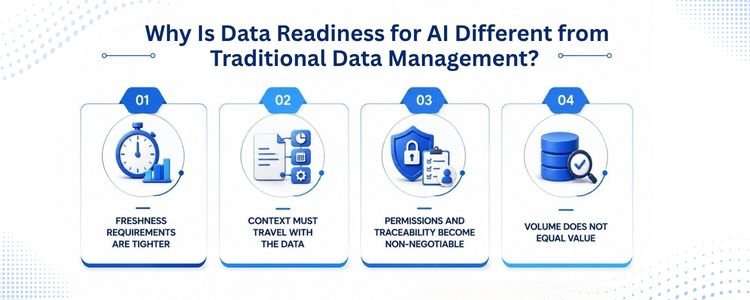
- Freshness requirements are tighter. Traditional reporting runs on a monthly or quarterly cadence. AI models in production often need data quality signals measured in hours. A customer recommendation engine feeding week-old signals is not making real-time decisions — it is making guesses.
- Context must travel with the data. An AI system needs to understand not just what a data point says, but what it means — which metric it belongs to, how it was calculated, when it was last updated, and what business rule governs it. Without this layer of metadata, the AI interprets numbers without understanding them.
- Permissions and traceability become non-negotiable. When an AI system acts on data — making a credit decision, triggering a patient alert, updating a customer record — there must be an auditable trail showing what data informed that action and whether access to that data was authorized. This is where data security compliance becomes inseparable from AI data quality.
- Volume does not equal value. An enterprise that has accumulated ten years of transaction data still needs to validate whether that data is fit for a specific AI use case. The AI-ready data checklist is how you make that distinction systematically rather than finding out after deployment.
The Complete AI-Ready Data Checklist for Enterprises
This AI-ready data checklist is structured across six core dimensions. Each section reflects a genuine gate that data must pass before it can support production AI. Work through each area honestly, and treat every gap as information, not failure.
1. What Does Your Data Inventory and Visibility Look Like?
The first section of any AI-ready data checklist covers whether the enterprise knows what data it has, where it lives, and whether it can be used.
- Do you have a complete inventory of enterprise data sources, including shadow systems and legacy databases?
- Is every critical data asset documented in plain language — not just technically labeled?
- Are the relationships between data sources mapped and maintained?
- Do you know which data assets are actively used versus those that persist out of inertia?
- Can data scientists and engineers access this inventory without going through multiple teams?
Why it matters: Many enterprises discover during an AI data infrastructure review that they operate far more systems — and far more conflicting versions of the same data — than anyone realized. AI pipelines built on undocumented or siloed sources produce outputs that cannot be trusted or explained.
2. How Strong Is Your AI Data Quality?
AI ensuring data quality is not a single, one-time effort. It is a continuous practice that can be monitored, has standards, and is owned. This part of the AI-ready data checklist examines the visibility of your quality signals prior to a model’s contact with your data.
- Does the business have an agreed and documented business dictionary that outlines definitions for business terms (e.g., what constitutes an “active customer” or completed “transaction”)?
- Do duplicate records exist, and are they identified, flagged, and managed?
- Is there continuous monitoring of missing values and data anomalies — not just when a model goes awry?
- Are automatic quality checks built in at data ingest points?
- Should you review data quality at the hour, day, week, or month level?
Why it matters: Silent data problems are the most dangerous kind. An AI system trained on data with consistent gaps or quiet inconsistencies will surface those problems in production outputs — often with high confidence. Data readiness for AI requires quality to be visible, measured, and actively managed.
3. Is Your Data Governance for AI Actually Enforced?
Data governance for AI goes beyond policies in a document. It needs clarity of ownership, strict permissions, and accountability mechanisms that extend beyond teams, systems, and use cases.
- Is there a data owner and data steward defined for each critical asset?
- Do access rights exist? Are they enforced and reviewed regularly?
- Do you have any standards in place for obtaining new data and/or changing current definitions?
- Do some teams report using different numbers for key business metrics, or is there one source of truth?
- Do you have an understanding of what systems and models are impacted by a business rule change?
Why it matters: Without data governance for AI, every team interprets data differently. The AI model inherits that inconsistency. And when the model produces a flawed output, there is no governance trail to explain what happened or who is responsible.
4. What Does Your Data Pipeline Architecture and AI Data Infrastructure Look Like?
Data readiness for AI should involve a comprehensive assessment of technical infrastructure. Enterprise AI solutions rely on pipelines that provide the appropriate data and processing at the appropriate time — every time.
- Do your data pipelines scale up accordingly to the volume and velocity your AI use cases demand?
- Are pipelines clearly distinct for analytics, and for model training and inference?
- Do pipelines have monitoring and alerting, and defined failure behavior?
- Is scaling the infrastructure without full re-architecture possible when introducing a new model?
- Is it possible to use live data feeds with production AI systems, which need real-time inputs?
Why it matters: Legacy data pipeline architecture built for batch reporting cannot support modern enterprise AI solutions. The AI data infrastructure must be capable of continuous delivery, not just scheduled loads. This is where many enterprises discover that their technical debt is deeper than expected.
5. How Is Your Data Traceability and Business Logic Documented?
This component in the AI ready data checklist is often overlooked. Business logic in code, stored procedures, or in the knowledge of people is hidden from AI until it is made explicit.
- Are you able to trace any metric or number in a report or data set?
- Do you have documentation in plain language of data transformations (ETL jobs, calculated fields, aggregation rules)?
- Do you have a record of what, when, and who changed what?
- If a mistake is seen in an output downstream, can you go back and see where it came from?
- Do the rules of calculations for key metrics remain constant, and are they version-controlled?
Why it matters: Traceability is the key that differentiates AI-generated content from content that can be believed and justified. Regulated industries, such as the healthcare sector, need enterprise AI solutions that support every inference with an auditable chain, whether it’s a clinical recommendation, a fraud flag, or a pricing decision.
6. Are Your Data Security Compliance and Organizational Practices Ready?
The last part of the AI-ready data checklist tackles the organizational and compliance aspects that can be left for later, and later often means after the first incident.
- Does sensitive data reside in categories, and is there a clear distinction between what is accessible to the AI and what is not?
- Are you familiar with the regulations that apply to your data in AI applications (GDPR, HIPAA, DPDP, industry-specific regulations)?
- Do prompts, model inputs, and inference outputs get recorded in a manner that meets compliance requirements?
- Has your team checked for AI-specific risk surfaces, such as prompt injection, data leakage, and model overreliance?
- Is readiness for AI considered a prerequisite investment, rather than an option for improvement, by senior leadership?
- Do you have specific funds allocated for data foundations maintenance and evolution when you get more use cases with AI?
Why it matters: It’s important because one of the most frequent risks in enterprise AI deployments is data security compliance, and another is organizational alignment. Even if the model is built properly, however, if data that was used by the model was not controlled, authorized, or documented properly, the enterprise is subject to regulatory and reputational risks that the model’s accuracy cannot help them avoid.
What Happens When You Skip the AI-Ready Data Checklist?
The consequences of skipping data readiness for AI are not theoretical. They tend to follow predictable patterns.
The AI initiative launches well in a controlled pilot environment. Data is curated by hand. The output looks impressive. Stakeholders approve the budget. Then, as the system scales to real users and real data, quality degrades. The model starts producing outputs that developers cannot explain, and business teams cannot defend. Manual interventions multiply. Costs rise. Eventually, the initiative is scaled back or abandoned entirely.
This is not a failure of AI technology. It is a failure of AI data infrastructure that was never built to support production-scale deployment. The AI-ready data checklist exists precisely to surface this gap before it becomes expensive.
Enterprise data management that treats data readiness as a prerequisite — rather than a cleanup task to handle later — is consistently what separates the 5% of enterprises seeing measurable ROI from AI from the 95% still waiting for their pilots to graduate.
How Can an AI Development Company or Data Strategy Consulting Partner Help?
The AI-ready data checklist is useful as a self-assessment of the data. However, the value of external data strategy and AI consulting services becomes real when it comes to translating the findings into a prioritized remediation plan and then implementing it within a complex data ecosystem.
A specialist AI development company can aid enterprises in mapping their data sources and gaps, designing scalable data pipeline architecture, embedding data governance for AI into business and technical processes, constructing the enterprise AI solution’s data metadata, and ensuring data security compliance from the beginning of the journey, not as a retrofit.
Technical depth without business context can be a hindrance here, and the AI-ready data checklist shows that there are gaps beyond just technical. They cover governance, organizational culture, business rules, and infrastructure at the same time. Solving their problem needs engineering skills and strategic advice.
Conclusion
The AI-ready data checklist isn’t a box to check — it’s the most obvious demarcation between AI investments that work and those that fall short. Companies that make data readiness for AI a top priority, rather than an afterthought, are the ones that move from pilot to production without giving up steam. If you are launching new enterprise AI initiatives, scaling existing deployments or just assessing your current situation for the first time, this checklist will help you understand where you’re at. We help enterprises in various industries bridge data readiness gaps and lay the groundwork for the future of AI – from data governance and pipeline design to end-to-end enterprise data management. The hard work that you put in today will be the return on investment you will get tomorrow.
Frequently Asked Questions
What is an AI-ready data checklist?
An AI-ready data checklist is an organized assessment of data to determine if it is accurate, controlled, accessible, and trustworthy enough to be used in production systems.
Why does data readiness for AI matter more than data quality alone?
Data quality is one component. Data readiness for AI doesn’t just include governance, traceability, access controls, documentation, and pipeline architecture — these factors can all affect the scalability of an AI system.
How is data governance for AI different from standard data governance?
AI data governance needs to go beyond traditional governance approaches, as it calls for continuous enforcement, asset-level accountability, real-time access controls, and compliance concerns related to AI outputs.
What is the first step in building AI data infrastructure?
Begin with an inventory of your data, its location, ownership, and documentation. The first step in building an AI data infrastructure is a complete inventory and visibility review.