
Enterprises rushing to deploy AI agents are hitting the same wall: the models work, but the answers don’t. A data quality checklist for AI is the set of checks organizations run before letting agentic AI touch production data — covering completeness, freshness, lineage, access controls, and semantic consistency. Without it, AI agents inherit every gap and inconsistency sitting in the underlying systems. Here’s the number that should concern every data leader: only 16% of AI-generated answers to open-ended enterprise questions meet the accuracy bar required for business decisions. That’s not a model failure — it’s what happens when capable AI runs on data that was never made AI-ready in the first place.
What Is a Data Quality Checklist for AI, and Why Does It Matter Now?
A data quality checklist for AI isn’t a one-time audit. It’s a recurring verification process that confirms your data environment can support autonomous agents making decisions, running queries, and chaining actions without a human checking every step.
The stakes are categorically different from traditional BI. A dashboard with bad data produces a wrong number someone might catch before it reaches a decision-maker. An AI agent with bad data produces a wrong number, acts on it, and triggers downstream automations before anyone notices. By the time a human spots the error, it may already be embedded in a customer email, a financial report, or an operational workflow.
Three shifts are making this more urgent than ever:
- Agentic AI is now acting, not just answering. Agents query, summarize, and increasingly execute — bad data doesn’t just misinform, it misfires.
- Data environments are more fragmented than ever. Cloud warehouses, SaaS platforms, on-prem systems, and unstructured knowledge stores all need to be visible to AI simultaneously and in real time.
- Governance expectations have caught up with AI ambition. Regulators and boards now expect full traceability for AI-driven decisions — which reshapes how enterprises approach a data quality checklist for AI from the ground up.
Enterprises that treat this AI ready data checklist as a formality rather than a discipline tend to repeat the same cycle: an impressive demo, a rushed rollout, and a quiet retreat to manual processes once the agent starts producing unreliable output. The gap between a successful proof-of-concept and a reliable production system is almost always traceable to the data environment — models perform well on curated pilot data but face fragmented sources, schema drift, and documentation-only governance the moment they scale. A rigorous data quality checklist for AI forces teams to verify, before go-live, that the conditions making the pilot look good will hold at scale.
What Should a Data Quality Checklist for AI Actually Cover?
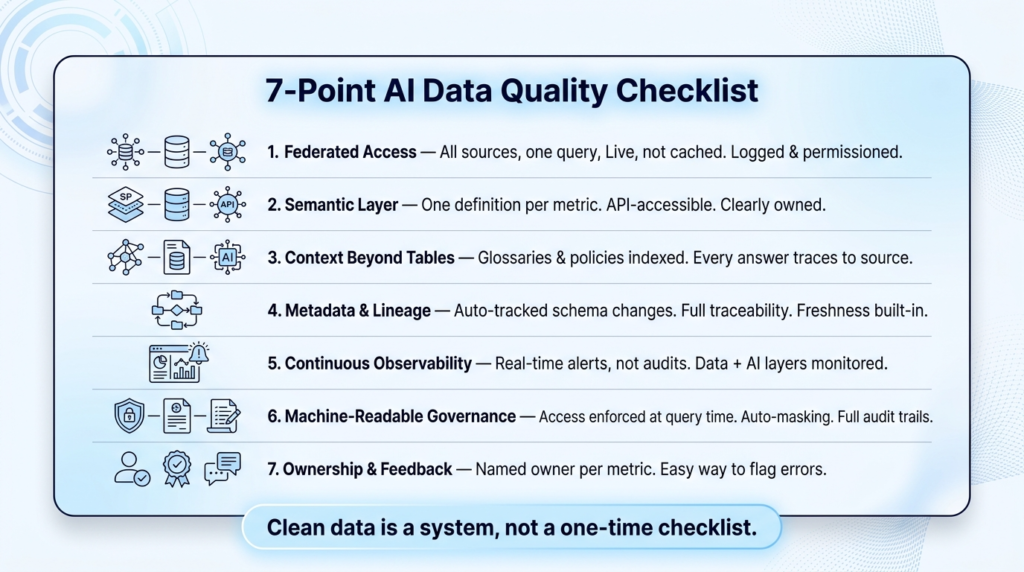
A genuinely useful data quality checklist for AI goes beyond checking for duplicates and nulls. It has to address structure, meaning, freshness, and accountability together — because agentic AI fails in ways traditional analytics never did: quietly, confidently, and at scale. Here is what every AI-ready data checklist needs to include.
1. Federated Access Across Every Relevant Data Source
AI agents can only reason over what they can see. If critical data sits behind a silo the agent can’t query, it will answer as though that silo doesn’t exist — confidently and incorrectly, with no indication to the end user that anything is missing. This is one of the most fundamental AI-ready data requirements, and it’s consistently underestimated.
What to check:
- Agents can query warehouse, CRM, ERP, and document sources in a single operation rather than being confined to one connected system
- No high-value source is quietly excluded from the agent’s view
- Data is pulled live, not from a stale cache that no longer reflects current reality
- Access is logged and permissioned — not an open door that bypasses existing controls
2. A Semantic Layer That Defines What Metrics Actually Mean
Without a shared semantic layer, an AI agent interpreting raw column names will guess what “revenue” or “active customer” means — and at enterprise scale, those guesses stack into inconsistent answers across teams and departments. A strong data quality framework has to include a single, governed definition layer so every agent, dashboard, and analyst works from the same vocabulary, with no room for silent disagreement between business units.
What to check:
- Core metrics have one authoritative definition, not several competing versions scattered across teams
- Definitions are accessible programmatically, not buried in a wiki nobody references
- Ownership is assigned so definitions don’t drift unnoticed as the business evolves
Without this layer, two AI agents pulling from the same data can produce two different answers to the same question — and neither will flag the discrepancy.
3. Context Beyond the Structured Tables
Structured metrics are only half the picture. Contracts, policies, glossaries, and tribal knowledge shape how data should actually be interpreted — and if that context isn’t captured somewhere machine-readable, AI agents operate blind to it, treating every table as equally trustworthy regardless of whether it is current or deprecated.
What to check:
- Business glossaries and certification status are machine-readable, not locked in slide decks
- Unstructured documents — policies, specs, runbooks — are indexed and retrievable in real time
- Every AI answer traces back to a specific grounded source rather than appearing as an unattributed fact
Enterprises that skip this step often find agents confidently citing outdated dashboards simply because nothing told the agent those sources were no longer authoritative. Clean data for agentic AI means context is always part of the picture — not an afterthought layered on later.
4. Active Metadata, Lineage, and Provenance
Schemas drift. Pipelines break. Sources go stale without warning. Any serious data quality checklist for AI has to include continuous, automated tracking of these changes — because a one-time data quality pass becomes obsolete within weeks in a fast-moving data environment.
What to check:
- Schema changes are detected and propagated automatically to every dependent system
- Every answer can be traced to its source tables and transformations, supporting both trust and compliance
- Freshness and quality scores are embedded directly in metadata, not tracked separately
Lineage and provenance are not the same thing, and both matter: lineage shows how data moved and transformed, while provenance shows where it originated and under what governance. AI systems need both to explain their answers credibly.
5. Continuous Observability, Not Periodic Audits
Static, quarterly data quality checks don’t hold up against agentic AI querying data hundreds of times a day. A complete data quality checklist for AI requires observability running continuously across both the data layer and the AI layer — watching for anomalies, drift, and degraded answer quality in real time, not after a business user notices something is wrong.
What to check:
- Alerts trigger on quality degradation before it ever reaches AI outputs
- Model and retrieval performance are monitored continuously, not audited on a fixed schedule
- User feedback feeds directly back into quality remediation rather than sitting in a backlog
Two layers matter here: data observability (volume anomalies, null spikes, schema shifts) and AI observability (query validity, retrieval relevance, hallucination detection). A mature data quality checklist for AI treats both as equally essential.
6. Machine-Readable Governance and Security
Data governance for AI deployment cannot live in a PDF policy document that nobody consults in real time. When agents generate queries and chain actions at machine speed, governance has to be enforced automatically at the point of query — not reviewed after the fact by a human who may never see most of the activity.
What to check:
- Role-based access is enforced at query execution, not just at system login
- Sensitive data is masked automatically based on user role, without manual intervention
- Full audit trails exist for every AI agent action, supporting accountability and regulatory review
- Policies are encoded as executable rules, not static documentation that governs intent but not behavior
This is the requirement most likely to be underestimated, because traditional access controls were simply never designed for autonomous agents acting on their own initiative. Building data governance for AI deployment into the architecture — rather than bolting it on afterward — is what keeps AI-ready data environments compliant at scale.
7. Clear Ownership and Feedback Loops
The most overlooked item on any data quality checklist for AI is organizational, not technical. Semantic layers go stale without an owner. Context libraries rot without maintenance. A checklist that is purely architectural, without accountability attached, will decay within a quarter — no matter how well it was designed on day one.
What to check:
- Every metric, data product, and context component has a named owner accountable for its accuracy
- Business users have a clear channel to flag wrong AI answers, and those reports trigger real remediation
- Domain teams — not just central data teams — own their definitions, since they understand the business context best
Without ownership embedded in the operating model, even the most technically sound data quality framework drifts out of alignment with how the business actually operates.
How Is Clean Data for Agentic AI Different From Traditional Data Quality?
This is where many data teams underestimate the shift. Clean data for agentic AI isn’t just accurate and deduplicated — it has to be structured for autonomous consumption, with consistent semantics, live freshness, and embedded context an agent can act on without a human in the loop to correct mistakes before they reach a decision.
Traditional BI tolerates some staleness and ambiguity because a human analyst applies judgment before reporting a number. Data quality checklist for AI removes that checkpoint entirely. If the underlying data quality framework doesn’t account for that missing human layer, errors propagate faster and further than they ever did in a dashboard-only world — reaching customers, triggering automations, and shaping decisions before anyone reviews them.
This is also why “clean” means something fundamentally different in an AI context. A dataset with no duplicate rows might satisfy a traditional check, but it says nothing about whether an autonomous agent can trust that data’s freshness, ownership, or contextual meaning. Clean data for agentic AI has to answer a harder question: can this data be acted on safely, without a human double-checking first? That standard is exactly what a thorough data quality checklist for AI is designed to meet — and where investing in professional AI development services and data analytics services makes the difference between building this capability once and sustaining it over time.
What Happens When Enterprises Skip the Data Quality Checklist for AI?
The consequences aren’t abstract. Enterprises without AI-ready data management are dropping AI initiatives at scale — not because the technology failed, but because nobody verified the data could support it. Gartner projects that 60% of AI projects lacking AI-ready data management will be abandoned, and that trajectory is playing out exactly as predicted across industries.
This is why a data quality checklist for AI needs to function as a deployment gate, not a guideline. Projects that pass every checkpoint are far more likely to reach production. Projects that skip even two or three items reproduce the same pattern — a promising demo followed by a quiet rollback, often accompanied by internal skepticism that makes the next AI initiative harder to greenlight. Unlike technical debt that can be patched later, gaps in data governance for AI deployment tend to compound the longer they go unaddressed.
Building a repeatable data quality framework, assigning ownership, embedding governance into the architecture, and running continuous observability — these aren’t extras. They are the foundation on which reliable AI is actually built. Teams investing in dedicated AI development services early in the deployment cycle consistently avoid the expensive rebuild that comes from skipping this foundation entirely.
Conclusion
AI agents are only as reliable as the data feeding them, and most enterprises discover this the hard way — after a promising pilot quietly fails at scale. A rigorous data quality checklist for AI, backed by real data governance for AI deployment and a repeatable data quality framework, is what separates AI initiatives that scale from the ones that get quietly shelved. At AnavClouds Analytics.ai, we help enterprises build exactly this foundation — through AI development services and data analytics services designed to make data genuinely AI-ready, not just clean on paper, so every agent you deploy is working with data it can actually trust.
FAQs
What is a data quality checklist for AI?
It’s a structured set of checks — covering access, semantics, governance, and observability — confirming enterprise data is accurate, current, and traceable enough for AI agents to use safely in production.
Why does clean data matter more for agentic AI than traditional software?
Agentic AI acts autonomously without human review at each step, so data errors propagate directly into decisions and automations instead of being caught first by an analyst.
What is data governance for AI deployment?
It’s the machine-enforced set of access controls, audit trails, and policy rules governing what AI agents can see, use, and act on — enforced at query time, not just documented on paper.
How do I know if my data is AI-ready?
Run it against a full AI-ready data checklist covering federated access, semantic consistency, lineage, governance, and ownership — gaps in even two or three areas signal it isn’t production-ready yet.