
The world of Data Analytics has never ceased to evolve. Over the decades, there was a smarter way to work with data, whether it was a spreadsheet, a BI tool, or a predictive model. However, everything is different in 2026. It’s not only an upgrade. It is a basic change in the entity (or entities) that conducts the analysis. Agentic AI for data analytics is revolutionizing the game. An agentic system creates a pipeline or writes a query or identifies an anomaly — continually, independently, and at a scale that no human team could. The pace of change of this landscape is highlighted by Gartner’s prediction that 40 percent of enterprise applications will be connected to task-specific AI agents by the end of 2026, compared with less than 5 percent a year ago.
If you’re still thinking of AI data analytics as a future opportunity, this blog is here to remind you to think differently.
What Is Agentic AI — And Why Is It Different from Regular AI?
Let’s first establish some definitions since there is much confusion in that area.
Present-day AI systems are mostly reactive. You ask them a question, and they answer it. You send data, they compute it! They just do what they’re told — and that’s it. Agentic AI operates uniquely. It sets its own sub-goals and plans a series of steps to accomplish them, then implements those steps in a variety of tools or systems, and monitors the outcome without relying on humans to take any action between each step.
Imagine the same difference between a calculator and a financial analyst. 1 responds to questioning. The other expects, explores, and takes action. This is a significant difference in the field of AI data analytics. Agentic AI analytics isn’t content with just finding insights; it goes hunting for them.
How Agentic AI for Data Analytics Actually Works
The role of power becomes clearer when examining what occurs under the hood of an enterprise setting with Agentic AI for data analytics.
1. Autonomous Goal Decomposition
An agentic system doesn’t require someone to decompose a business goal (such as ‘identify which customer segments are most at risk of churning next quarter’) into actions. It breaks down the goal itself, which data sources are pertinent, and constructs the route to an answer.
2. Multi-Step AI Data Processing
The traditional AI data processing is mostly linear. Agentic systems execute multiple threads, continuously gathering data from multiple sources (CRMs, data warehouses, and third-party sources as well), cleaning it as it is pulled, and executing multiple models to triangulate the information. This leads to more rapid, more intense, and more consistent output.
3. Continuous Learning and Adaptation
AI agents for analytics are not one-size-fits-all. All of the analyses they perform constitute learning inputs. They become more adept over time at identifying patterns, grasping the business landscape and identifying what’s significant for decision makers—rather than what might be considered an “anomaly.”
4. Human-in-the-Loop Design
Despite operating autonomously, well-designed agentic AI analytics systems don’t eliminate human oversight. They escalate decisions that involve judgement, present options with linked reasons, and indicate levels of confidence within outputs. This allows humans to maintain control of the strategy and agents to execute the strategy.
The Role of Data Infrastructure in Agentic AI
Here’s a truth that often gets glossed over in the excitement around agentic AI: the agents are only as good as the data they operate on. If your infrastructure isn’t built for agentic workflows, you won’t get agentic results.
Data Pipeline Architecture Matters More Than Ever
One of the most underestimated dependencies in agentic AI deployments is data pipeline architecture. Agentic systems need reliable, real-time data flows. A pipeline that breaks under load, delivers stale data, or lacks proper transformation logic will cripple an agent’s ability to make sound decisions.
Modern data pipeline architecture for Agentic AI for data analytics typically involves:
- Event-driven ingestion — data flows continuously rather than in scheduled batches
- Automated schema management — agents can adapt when source structures change
- Observability layers — so agents can detect pipeline failures and route around them
- Orchestration tools — connecting upstream sources to downstream models without manual intervention
Organizations investing in agentic AI should treat their pipeline infrastructure as a first-class priority, not an afterthought.
Data Quality for AI Is Non-Negotiable
Garbage in, garbage out — this principle becomes even more consequential with Agentic AI for data analytics. Because AI agents for analytics make decisions autonomously, errors in source data can cascade at machine speed. Data quality for AI needs to be embedded at every stage: ingestion, transformation, storage, and retrieval.
This means:
- Automated data validation checks that run before agents consume any dataset
- Lineage tracking so errors can be traced back to their source
- Anomaly detection on the data itself, not just the outputs it produces
- Governance policies that define which data agents can access and under what conditions
Getting data quality for AI right isn’t glamorous work — but it’s the foundation that makes everything else possible.
Snowflake Intelligence and the Modern Analytics Stack
Platforms like Snowflake are evolving rapidly to support agentic use cases. Snowflake Intelligence — Snowflake’s agentic analytics capability — allows AI agents to query data warehouses in natural language, build and run analytical workflows autonomously, and surface insights directly to business users without requiring an intermediary analyst.
This kind of platform-level agentic capability is a signal of where the industry is heading: toward a world where agentic AI for data analytics is embedded directly into the infrastructure stack, not bolted on as an external tool.
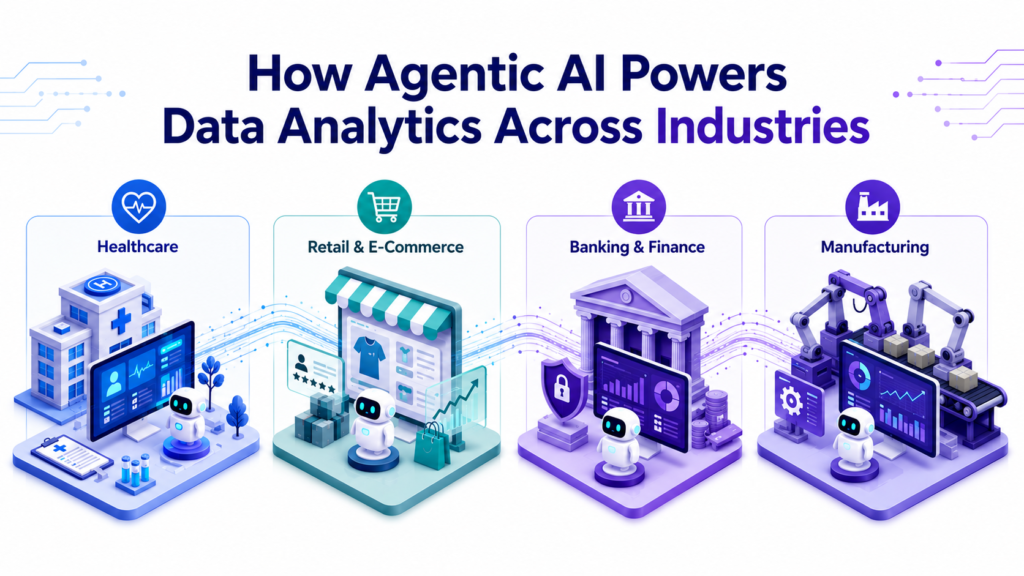
How Applications of Agentic AI for Data Analytics Work Across Industries
Agentic AI for data analytics isn’t abstract. It’s being deployed today across industries in ways that are delivering measurable outcomes.
1. Healthcare
AI agents monitor patient vitals, lab results, and historical records simultaneously. When a combination of signals suggests a risk — early sepsis indicators, for example — the system flags it immediately, without waiting for a physician to review each data point manually. This is AI data analysis working in real time to save lives.
2. Retail and E-Commerce
Agentic systems track inventory, demand signals, competitor pricing, and customer behavior at the same time. When stock for a high-demand SKU drops below a threshold, the agent doesn’t just send an alert — it initiates a reorder, adjusts pricing dynamically, and updates the promotional calendar. That’s end-to-end AI data processing, running autonomously.
3. Banking and Financial Services
AI agents monitor patient vitals, lab results, and historical records simultaneously. When a combination of signals suggests a risk — early sepsis indicators, for example — the system flags it immediately, without waiting for a physician to Gartner’s 2026 prediction on AI agents view each data point manually. This is AI in healthcare analytics working in real time to save lives.
4. Manufacturing
Predictive maintenance powered by agentic AI for data analytics means equipment sensors feed continuously into agents that model wear patterns, predict failure windows, and schedule maintenance proactively. The result is reduced downtime without over-maintenance — a balance that traditional models struggle to achieve.
What’s Driving the Agentic AI Data Analysis Trend in 2026?
The current AI Data Analysis craze isn’t just about the hype. Several structural drivers are driving the uptake.
- Data volumes have outpaced human capacity. Today, most companies produce so much data that it’s more than human beings can handle to analyze in an effective and impactful way. Agentic AI for data analytics is scalable, and BI dashboards cannot begin to handle that scale.
- Decision cycles are compressing. The company that is deciding on a weekly basis is already at a disadvantage compared to the one that is deciding daily. Agentic analytics is about continuously driving decision intelligence, not just reporting.
- AI development services have matured. The tools, frameworks, and platforms for the deployment of agentic AI analytics are much more accessible. This used to take a team of ML engineers and months of custom development to implement, but can now be done in weeks with the right AI Development Services Partner.
- Regulatory and competitive pressure. In areas such as finance and healthcare, the requirement to showcase data-driven decision-making has grown even more significant. Agentic AI offers the analytical depth and audit trail essential for many compliance frameworks these days.
Building an AI Data Strategy for Agentic Readiness
For organizations looking to harness the power of Agentic AI for data analytics, it’s not just a matter of “wanting to” but a need to have a clear AI data strategy. Here are some examples of how it works in practice:
- Start with a data audit:| Prior to deploying any agents, have an understanding of the data you have, where it resides, how it is governed, and how trustworthy it can be. This is a must for data quality to drive AI.
- Define clear agent objectives: Agentic AI for data analytics systems works best with specific and measurable goals. The term “improve revenue” is too ambiguous. The statement “Identify cross-sell opportunities in existing customers and flag top 500 weekly” is actionable.
- Invest in data pipeline architecture: Develop or upgrade infrastructure for your agents. This encompasses capabilities for real-time ingestion, transformation, and monitoring.
- Build governance into the design: Establish independent, human-dependent, and logged decision-making for agents. It’s not about limits; it’s about responsible deployment.
- Choose the right AI development services partner: Rarely does any organization develop agentic AI capabilities from scratch. By leveraging the expertise of seasoned AI development service providers, deployment can be faster, risk can be minimized, and the technical implementation of Agentic AI for data analytics can align with business outcomes.
The Future of Agentic AI Analytics
In the future, the use of Agentic AI for data analytics is set to gain momentum. Agents will be more competent, more specialized, and more integrated into enterprise workflows. The emergence of multi-agent systems in which multiple AI agents work together to address complex problems is an existing frontier capability.
At the same time, the discussion is evolving from the question of whether agentic AI analytics is possible to how to govern it well. Accountability, transparency, and explainability are increasingly at the heart of the discussion — and those organizations that are ahead of the curve will be more ready to responsibly scale their agentic capabilities.
It’s not a fad.AI data analysis is no fad. The new normal. Agentic AI is like the Internet for communication – it’s a structural shift, and it will eventually impact everything.
Conclusion
This transition towards Agentic AI for data analytics is no spectator sport that companies can afford to sit on the sidelines. The number of companies actively deploying it is increasing compared to those still planning to deploy it, with the gap growing wider by the quarter. This is changing the way enterprises use AI data to operate, from autonomous AI data processing to real-time insight generation, adaptive AI data strategy, and even multi-agent collaboration. AnavClouds Analytics.ai is here to assist organizations in managing this transition, from establishing the data foundation for agentic systems to providing outcome-centric AI development services to transform strategy into tangible outcomes.
Frequently Asked Questions
1) What is agentic AI for data analytics?
Agentic AI for data analytics involves AI agents that can initiate, execute, and evolve multiple-step analytical processes, such as deriving insights, building models, and decision-making without continuous human guidance.
2) How is agentic AI different from traditional AI data analysis?
With traditional AI, the AI takes inputs in response to prompts and guides the process between steps. Agentic AI establishes its own sub-goals, operates across multiple systems, and self-corrects, making it much more powerful to support complex, continuous analytical workflows.
3) What industries benefit most from agentic AI analytics?
Industries with large amounts of data, quick decision-making cycles, or intricate workflows – such as healthcare, finance, retail, manufacturing, and telecom – are among the most active adopters.
4) What do businesses need before deploying agentic AI for data analytics?
A clean data foundation, robust data pipeline architecture, governance policies that are clearly defined, objectives for agents, and ideally an experienced AI development services partner to help put it into place and minimize risk during deployment.