
AI is being invested heavily in the enterprise, yet there’s a troubling number of programs that die before they even get to the pilot phase. It’s not the algorithm; it’s typically something else. It’s the information that’s pushing it. Data quality for AI is the make-or-break element that separates AI investments that return a measurable benefit from those that drain budgets without delivering any value. It is estimated that data quality can cost enterprises an average of $12.9 million per year, with the cost escalating dramatically when AI models compound the error at scale. The first place the conversation needs to be had is this: the foundation that every model relies on, for enterprises seeking to transition from proof-of-concept to production-ready AI.
Why Data Quality for AI Is a Different Challenge Altogether
Most organizations have some form of data quality management in place. They run checks, maintain dashboards, and follow data governance policies. But data quality for AI demands something fundamentally different. Traditional data quality was designed to support reporting and transactional systems. AI changes the stakes entirely.
When a flawed record makes it into a sales report, a human analyst can catch it. When that same flawed record enters an AI training pipeline, it gets learned, replicated, and acted on — across millions of predictions — before anyone realizes something is wrong. A 5% label error rate alone can reduce model accuracy by 30 to 40%, making machine learning data quality one of the most high-leverage areas any enterprise data team can address.
What is actually happening is that a significant proportion of businesses are still not ready to scale AI with the appropriate data management strategies. There are a lot of projects that fail with AI that are not due to the models; they fail because the data that they’re learning from was never designed to be used for that kind of workload. Inconsistencies of pipeline and other standards, and unresolved data silos, quietly undermine promising-looking initiatives.
This is why data readiness for AI can’t be treated as an afterthought. It’s a prerequisite.
What “Good Data” Actually Means for AI Systems
Before building any data quality framework, it helps to understand what dimensions of quality matter for AI — because the bar is higher than most teams expect.
The traditional dimensions of data quality — accuracy, completeness, consistency, timeliness, validity, and uniqueness — are still very relevant. But data quality for AI adds a second layer on top of these:
- Label accuracy — Are the target labels in your training data actually correct? Mislabeled data quietly destroys model performance.
- Representativeness — Does your dataset reflect the real-world population the model will be applied to? Biased sampling creates biased models.
- Noise ratio — How much irrelevant or erroneous signal is buried in your data? High noise degrades generalization.
- Distribution drift — Has the distribution of the data your model was built with changed since it was created?
Data quality for AI reaches beyond structured data, as it becomes essential to ensure that documents are factually up to date, appropriately bounded, and appropriately access-controlled before they’re ingested, especially in the case of enterprises integrating large language models or RAG architectures.
The first step is to understand these dimensions. The real work is in getting them implemented.
The Enterprise Data Quality Framework: What Actually Works
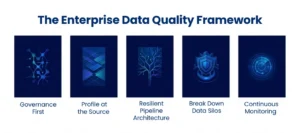
A lot of organizations build frameworks that look solid on paper but break down under the pressure of real data environments. The ones that hold up tend to share a few structural characteristics.
1. Governance Before Everything Else
A data quality framework begins with governance, defining who owns what data sets, how important data elements are being managed, and defining standards for data throughout its lifecycle.
Data quality for AI is not a policy paper game. In terms of AI data management governance, the roles of data stewards, quality standards, and escalation paths are defined, and quality standards are established and enforced once they are exceeded. This is the basis for all downstream work to be firefighting rather than systematic improvement.
2. Profiling and Assessment at the Source
The cost of data quality for AI problems that are caught early is significantly lower than the costs of such problems in production. This is often referred to as the 1-10-100 rule: it costs $1 to verify a record at the point of entry, $10 to clean the record later, and $100 to deal with the consequences if the record is ignored altogether.
Analyzing your data at the source (before it travels anywhere down the pipeline) reveals problems such as schema mismatch, missing data, outliers, and duplicate data. The difference between data quality management that scales and one that plays catch-up is doing it systematically, as opposed to ad hoc.
3. Robust Data Pipeline Architecture
How data moves are just as important as what data you have. A poorly designed data pipeline architecture introduces quality degradation at every transformation step. Joins that introduce nulls, aggregations that obscure errors, and batch processes that load stale data into real-time models — these are infrastructure-level failures with model-level consequences.
Enterprise-grade data quality for AI requires pipelines that are observable, testable, and governed from end to end. This means embedding validation checkpoints at ingestion, transformation, and serving layers — not just at the point of model training.
4. Breaking Down Data Silos and Integration Barriers
Fragmentation is one of the major challenges for enterprise-level data quality for AI. Data silos and integration gaps result in the same data being represented in a different way in each system, and no one is reconciling what systems have with each other.
The impact on AI is devastating downstream. Models built from inconsistent and scattered data have inconsistent and scattered behavior. Solving data silos and integration is not only about technicalities, but it’s also about having stakeholders in different business units align, standardize data, and potentially establish a dedicated integration layer that standardizes data before it reaches any AI workload.
5. Continuous Data Quality Monitoring
Every well-defined data set breaks down. Your pipelines may not keep up with data changes in your business contacts, product catalogs, or market conditions. That is where data quality monitoring serves as a safeguard to prevent it from spreading to model outputs.
Dynamic monitoring of data quality for AI environments exceeds simple rule checks. It monitors schema change, identifies abnormal distributions, and notifies teams if the data they receive doesn’t match the statistical profile on which the model was trained. The intent is not to diagnose, but to detect proactively.
Data Quality vs. Data Integrity: Understanding the Distinction
These two terms are often used interchangeably, but data quality vs data integrity represents a meaningful distinction — especially for AI systems.
Data quality for AI is a measure of the suitability of the data for a specific purpose. It is expressed in terms of aspects such as accuracy, completeness, and timeliness, and it is assessed against a particular purpose.
Data integrity is the soundness of data; that is, whether it follows the relationships, constraints, and referential integrity as it flows among systems. It’s not about the usefulness of the data; it’s about the consistency of the data.
AI is all about both. High integrity is not synonymous with high quality in a dataset for a machine learning use case; if a dataset has high integrity (that is, it is structurally sound with all referential constraints fulfilled), but it is not representative or it is not up to date, it can still be low quality. When it comes to building data quality for AI, both layers must be taken care of.
Enabling Data-Driven Decision Making Through Better Data
The business case for investing in data quality for AI extends well beyond model accuracy metrics. When enterprises get their data foundation right, it enables data-driven decision making at a scale that simply isn’t possible otherwise.
Predictive analytics in BI tools becomes significantly more reliable when the underlying data is clean, consistent, and current. Risk models in finance, demand forecasting in retail, patient outcome predictions in healthcare — all of these depend on the same core asset: trusted data. And trust, in this context, is earned through repeatable, measurable data quality management practices, not through optimism.
Organizations that build this foundation don’t just get better AI models. They get better decisions, faster — which is the real return on investment.
The Role of AI Development Services in Fixing Data Quality
AI is also one of the best tools to enhance data quality for AI, which makes it all more ironic. New AI development services are now available that enable large-scale data remediation that could not ever be done manually.
AI-based data profiling can analyze and categorize data at a rate and volume that surpasses any human team. Unstructured text data can be identified for inconsistencies using NLP tools. Anomaly detection models can identify anomalies in real time. And automated deduplication engines can match entity records from multiple systems — solving data silos and integration issues that have historically required significant time and effort.
This doesn’t eliminate the need for human oversight — it amplifies it. The best implementations of data quality for AI combine automated detection with human-in-the-loop validation, particularly for high-stakes decisions where labeling errors carry real consequences.
Conclusion
Getting AI to actually work in an enterprise context is not primarily a modeling problem — it’s a data problem. The organizations consistently seeing returns on their AI investments are the ones treating data quality for AI as a strategic capability, not a cleanup task. They’ve built the governance structures, the monitoring infrastructure, and the pipeline discipline that make reliable AI possible at scale. AnavClouds Analytics.ai works with enterprises across industries to build exactly that kind of foundation — from data strategy and engineering through to advanced AI implementation — helping teams move from fragile pilots to AI systems that hold up in production. If your AI initiatives are underperforming, the answer likely starts with your data.
Frequently Asked Questions
Q1. What is data quality for AI and why does it matter?
Data quality in the context of AI is the criteria and methodology for ensuring that the information collected, utilized for training, validation, and deployment of AI systems, is accurate, complete, consistent, and representative. Why? Because AI models learn from data, and any mistakes, biases, or gaps in data that are found are reproduced in the model, output, at scale and at speed.
Q2. What are the key dimensions of data quality that AI systems require?
In addition to the classic dimensions of accuracy, completeness, consistency, timeliness, and validity, AI has its own: label accuracy, representativeness, noise ratio, and distribution drift. Each of these dimensions is important and has to be addressed in an overall data quality framework.
Q3. How is data quality different from data integrity?
Data quality is a term that refers to the extent to which the data is suitable for a particular purpose, such as whether it is accurate, complete, or useful in a given use case. Data integrity is the structural validity of the data; that is, if the relationships and constraints are kept in a proper way across all systems. They are both crucial for effective AI use, but they’re supporting different stages of the data environment.
Q4. How can enterprises get started with improving data quality for AI?
First, data governance and ownership should be set, and then enterprises should gradually determine the data characteristics at the source to find out the problems of data quality. The next steps should be building an observable data pipeline architecture, implementing continuous data quality monitoring, and resolving data silos between business units. Developing AI solutions with data quality tooling automation can help to speed up this process.