
Telecom networks are being run on scale, speed, and complexity never. The cloud-native infrastructure, 5G expansion, and edge deployments have added a lot of operational risk. Conventional outage management methods are unable to cope with such changes. Due to this, disruptions in services are increasingly becoming common and difficult to manage.
This problem is accelerating the uptake of Agentic AI in telecom amongst multinational operators. The agentic systems add autonomous intelligence that anticipates failures, averts outages, and makes networks behave optimally at any given time. In 2026, the reliability of telecom will be based on the effectiveness with which organizations can apply agentic capabilities. Agentic AI in telecom is no longer optional for competitive service delivery.
Why Traditional Telecom Outage Management Is Failing
Historical telecom outage management was designed for stable and predictable network conditions. The models use static monitoring tools, pre-defined workflows, and heavy human intervention. With the growing telecom infrastructure in cloud, virtual, and edge environments, these assumptions are no longer true. Outages are now created more quickly and become bigger than the traditional systems can handle.
This widening rift reveals patches of structural vulnerability across AI in telecom industry. Rule-based systems do not possess the level of intelligence needed to understand dynamic network behavior. Real-time complexity cannot be scaled in operations led by humans. Such obstacles are increasing the transition to Agentic AI in telecom to resilient operations.
Static Monitoring Cannot Match Modern Network Behavior
Older monitoring tools have a fixed threshold and base to work with. Such tools find it difficult to detect anomalies across distributed and virtualized telecom environments. Since traffic trends are dynamic, stagnant notifications create noise rather than information. The key problems are not always revealed before the customers are affected.
The operators have to use slow manual analysis without adaptive intelligence. Such latency gives time to outages spread across systems. Agentic AI in telecom addresses this gap by continuously interpreting live network context. Autonomous agents detect early warning signals before failures escalate.
Rule-Based Automation Creates Operational Rigidity
Automation through rules brought about efficiency changes in the initial stages of digital transformation. The systems run programmed actions with the known conditions. But now telecom networks face unpredictable situations daily. Automation fails when situations move beyond what is set out.
The redesigning of rules is manual and always needs updating. This is costly in terms of overhead operation and slow response. Automation on a rule basis cannot be learned from past events and/or modify future behavior. These disadvantages limit the scalability of AI in telecom industry.
Rule-Based Chatbots Fail to Support Customers During Outages
Customer communication systems also suffer from rigid automation constraints. Rule-based chatbots operate using scripted responses without contextual awareness. When there is an outage, they do give generic responses that do not indicate what is actually happening. This restriction elevates frustration among customers and escalates support.
Advanced AI chatbot development services combined with Agentic AI can easily solve these problems. The intelligent agents provide precise updated information according to the live network information. This would enhance transparency, trust, and customer experience in case of disruptions.
How Agentic AI in Telecom Predicts Outages Before They Occur
Outage prediction has become one of the most important needs because telecom networks are becoming more dynamic and distributed. Conventional monitoring solutions have the disadvantage of identifying failures when they have started happening. This is a reactive solution that results in downtime, customer dissatisfaction, and higher operational costs. The agentic AI in telecom does not address the likelihood of an outage but rather starts the process of addressing the issue before it occurs.
The agentic systems can detect risks at an early stage by integrating real-time network data with historical trends and autonomous reasoning. Such AI agents monitor network health and conditions continuously. The feature enables telecom providers to eliminate failure before customers feel inconvenienced. Finally, Agentic AI in telecom is redefining proactive network reliability.
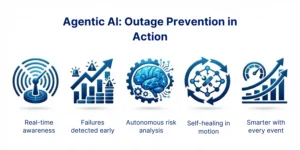
Continuous Network Observation and Contextual Awareness
Agentic AI in telecom keeps all the network levels and domains constantly aware. AI agents consume real-time telemetry information, traffic, and performance measurements. Agents process data based on context and do not use fixed thresholds, as opposed to the static tools used. This intelligence gives the ability to identify early indicators of degradation.
Agents determine the covert dependencies and new risks by comparing signals across systems. These insights enable the operators to respond before small problems grow out of proportion. Predictive outage prevention is based on contextual awareness.
Predictive Intelligence and Failure Pattern Recognition
Advanced predictive models power Agentic AI for telecom outage forecasting. The AI agents process historical events and the current stream of data. They determine repetitive trends in failures and service degradation. This learning-driven approach improves prediction accuracy over time.
The predictive intelligence in agentic AI in telecom in 2026 is one that is adaptive as the networks change. The agents optimize their notions of failure conditions automatically. The ability minimizes false alerts and enhances preventive decision-making.
Autonomous Network Healing With Agentic AI
It should not just be predicted, but also without a prompt correct response. Agentic AI in telecom allows network recovery automatically in case risks are identified. AI agents create an isolation of afflicted objects, route traffic, and configuration changes automatically. These measures are taken in advance before losses to customers.
Self-care minimizes reliance on human reactions in emergencies. Recovery outcomes are validated, and future responses optimized by agents. This closed-loop execution minimizes repeat failures and improves overall network resilience.
Intelligent Traffic and Resource Optimization
Congestion on the roads usually causes service breakdowns and domino-like failures. The use of agentic AI in telecom dynamically controls traffic flows and resource allocation. Agentic AI implementation in telecom anticipates the congestion points and rebalances of loads in advance. This optimization will avert the performance bottlenecks before they are converted to outages.
Through resource management, the telecom providers ensure that there is consistency in the service delivery. This feature is particularly important in peak scenarios and high-demand situations.
Improving Customer Experience During Telecom Outages
Despite the prediction, there are still certain disruptions that cannot be avoided. Agentic AI in telecom enhances customer experience in such events by means of intelligent communication. AI-based systems deliver precise, up-to-date information about the live network conditions. Such transparency saves doubt and aggravation.
High-end AI chatbot solutions that have been incorporated in agentic platforms provide contextual responses. These systems can perceive the scope and progress of resolution of the outage as compared to rule-based chatbots. This will make it more trustworthy and decrease support escalations.
Learning-Driven Optimization for Future Outage Prevention
One of the benefits of Agentic AI in telecom is continuous learning. AI agents use past predictions and interventions. Effective strategies are strengthened, and poor ones are improved or abandoned. This learning cycle enhances reliability in the long run.
Telecom providers leveraging AI agent development services benefit from systems that upgrade according to the complexity of the network. With time, the prediction of the outage will be more accurate and the prevention will be more effective.
The Role of AI Agent Development Services in Telecom Transformation
The adoption needs to be successful with dedicated AI agent development solutions designed to work in telecom settings. These services construct independent agents that are in line with the network objectives and operation policies. The design of the custom agent is compatible and compliant with the existing systems and requirements.
Telecom providers are also collaborating more with AI development services to speed up deployment. These collaborations allow Agentic AI implementation in telecom systems at scale. By leveraging expert development, operators achieve faster ROI and sustainable performance improvements.
Why Agentic AI in Telecom Is a Strategic Priority for 2026
The telecom networks will scale and be more complex than ever before in 2026. There are no ways to overcome the expectations of reliability in the future when using manual operations and automation based on rules. Telecom Agentic AI provides intelligent, adaptable network intelligence and adapts to network needs. This capability directly reduces outages, operational costs, and customer churn.
Telecom leaders who use Agentic AI to transform telecom obtain long-term sustainability and a competitive edge. Autonomous systems guarantee the delivery of services in the same manner in unpredictable conditions. With the development of networks, Agentic AI in telecom becomes an essential part, but not an option.
Final Thoughts
It is now patented that telecom outage prevention needs intelligence that runs more quickly than human intervention. Modern networks cannot be supported with the help of static monitoring, rule-based automation, and manual workflows. These limitations can be eliminated by agentic AI in telecom with autonomous prediction, decision-making, and action. This change makes the outage management more focused on preventing than responding.
With the further development of networks, the Agentic AI of telecom becomes the basis of operational resilience. Organizations investing in AI agent development services and advanced AI chatbot development gain long-term reliability advantages. With knowledge in AI and data-driven solutions, AnavClouds Analytics.ai assists telecom providers in deploying scalable agentic intelligence for outage reduction. In the future of 2026 and later, telecom Agentic AI will determine how service providers uphold trust, performance, and continuity.
FAQs
What is Agentic AI in telecom?
In telecom, agentic AI can be defined as autonomous AI agents that perceive, reason, and take actions on their own. These systems forecast outages, optimize networks, and resolve issues automatically.
How does Agentic AI in telecom reduce outages?
Telecom Agentic AI predicts failures based on real-time data and past trends. AI agents are preventive in nature and take precautionary measures, which lowers the duration of the downtime.
Is Agentic AI better than rule-based automation in telecom?
Yes, Agentic AI in telecom is dynamically adjusted to the evolving conditions. It is able to learn constantly and cope with unpredictable network scenarios as opposed to rule-based automation.
What role do AI agent development services play in telecom?
The development of the AI agent services creates and deploys custom autonomous agents to the telecom networks. These services guarantee agentic AI implementation that is scalable, secure, and effective in the telecom setting.