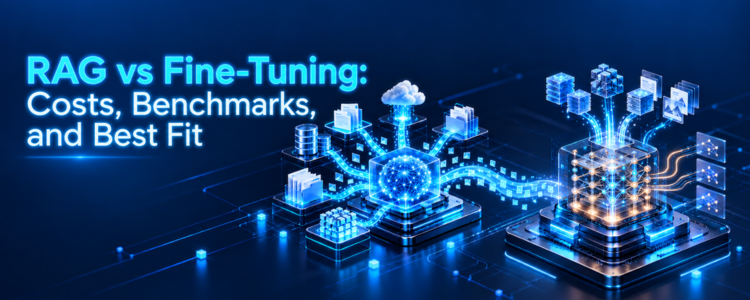

One of the biggest decisions in enterprise AI is choosing between RAG vs fine-tuning. Most teams make the wrong choice by treating it as a binary decision. RAG (retrieval-augmented generation) uses live data with a model to retrieve in-context facts before answering. Fine-tuning retrains the model’s weights to produce a specific behavior or style permanently. The short answer to the RAG vs fine-tuning question is this. RAG is better when knowledge changes constantly. Fine-tuning is better when behavior must be locked in; most production systems in 2026 use both. This article offers a thorough explanation of the distinction between RAG vs fine-tuning, including when to use each, the costs of each, and how to determine which is best applicable.
What Is the Real Difference Between RAG vs Fine-Tuning?
To make a confident decision between RAG vs fine-tuning, it is important to grasp the modifications that each technique introduces into your AI stack. Whether you’re updating the knowledge of a model or its behavior is the essence of the RAG vs fine-tuning comparison.
How RAG Works in the Background
RAG is left as a blank slate. Instead, it accesses the external knowledge base—usually a vector database—to pull in relevant snippets of information to add to the prompt as needed when performing a query. No retraining is needed with the model; it simply infers from the data. This allows you to make changes to a document now, and the model’s answers will change automatically.
How Fine-Tuning Changes Model Behavior
Fine-tuning works differently. It fine-tunes the internal parameters of the model with a carefully selected set of examples, making the new knowledge or behavior a part of the weights themselves. No external lookup step, just a model that learned to react in a certain manner.
Here is the simplest way to explain the RAG vs fine-tuning difference to your team: RAG adds to the model’s knowledge; fine-tuning alters its behavior. It also gives some idea of why there is never a clear winner in the RAG vs fine tuning discussions because they are addressing different problems.
When Should You Fine-Tune an LLM?
Fine-tuning earns its cost when the problem isn’t about knowledge; it’s about consistency.
Signs You Need a Fixed Output Format
Fine-tuning handles structured outputs well. These include JSON responses, medical note formats, and legal brief conventions. The pattern must hold every time.
Signs You Need Domain-Specific Tone or Terminology
If a model must consistently sound like your brand, fine-tuning bakes that in at the weight level. It also makes the model adopt precise clinical, legal, or financial vocabulary.
Signs a Smaller, Cheaper Model Fits Better
Distilling a large frontier model’s behavior into a compact open-weight model can cut inference costs dramatically. This benefits classification or extraction tasks.
Signs Your Data Is Stable Enough to Train On
If the underlying facts rarely change, there’s little risk of the model going stale after training. Knowing when to fine-tune an LLM comes down to one test: does the desired outcome depend on data that changes, or on behavior that shouldn’t? If it’s the latter, fine-tuning is worth the investment. This checkpoint is central to the broader RAG vs fine-tuning decision, and skipping it is how teams end up fine-tuning a model on information that’s outdated within a quarter.
When Does RAG Make More Sense for Enterprise AI?
RAG is the default starting point for most enterprise use cases, and the numbers back this up.
RAG Adoption Numbers Worth Knowing
Generative AI in the Enterprise report states RAG adoption in production environments jumped to 51%, while standalone fine-tuning was used by only 9% of teams. That gap alone explains why most conversations about RAG vs fine-tuning start with RAG by default.
Situations Where RAG Is the Stronger Pick
RAG is the stronger choice when your source data changes frequently, covering pricing, policies, inventory, or product specs. It’s also the better fit when you need answer attribution for compliance, when you want to switch base models without redoing months of training, and when your dataset isn’t clean enough to fine-tune reliably.
This is the crux of the RAG vs fine-tuning question for most businesses. If your knowledge base is a moving target, retraining a model on it every time something changes isn’t sustainable. It’s also why RAG has become the default entry point in almost every enterprise LLM architecture decision made in 2026, even when fine-tuning eventually joins the stack later.
RAG vs Fine-Tuning vs Prompt Engineering: What’s the Real Difference?
It helps to place RAG vs fine-tuning vs prompt engineering on a single spectrum of effort and permanence.
Prompt Engineering: The Lightest Touch
Prompt engineering means writing better instructions or adding a few examples directly into the prompt. It costs nothing to test and can be changed instantly, but it has limits when your context needs are large or your knowledge base is extensive.
RAG: The Middle Ground
RAG is in the middle. It doesn’t modify the model itself, and it depends on infrastructure like embedding, a vector store, and a retrieval pipeline; these are flexible and can be iterated on relatively quickly.
Fine-Tuning: The Most Durable Change
Fine-tuning is at the other end. It requires labeled training data, training runs, and evaluation cycles, but also brings the most lasting modification of model behavior.
Most mature teams combine the three, using prompt engineering for first wins, RAG for keeping answers up to date, and fine-tuning for behavior that prompt and retrieval can’t guarantee. When viewed in this light, RAG vs fine-tuning vs prompt engineering isn’t a competition; it’s a toolkit, and the skill is knowing which tool to use when in a project.
What Do RAG Accuracy Benchmarks Actually Show?
When teams look at RAG accuracy benchmarks, a consistent pattern emerges.
Why Retrieval Quality Determines Benchmark Results
RAG is more likely to improve performance on factual recall tasks. It draws from a trusted source, not from what the model was trained on. Studies that contrast the two methods have consistently shown that Hybrid systems (which retrieve and adjust to fine-tuning tasks lightly) perform better than either retrieval or fine-tuning alone. Another crucial factor in benchmark performance is the quality of retrieval: a high-quality pipeline, which can include a well-tuned retriever with good chunking and ranking, can make RAG substantially more accurate, whereas a poor pipeline can make recall even from a well-fine-tuned model seem inaccurate.
Running Your Own Accuracy Tests
This is why evaluation frameworks that separately measure retrieval precision, context recall, and answer faithfulness have become standard practice for teams comparing RAG vs fine-tuning results on their own data. It’s worth running your own RAG accuracy benchmarks rather than relying purely on published research, since retrieval quality varies enormously based on your document structure, chunking strategy, and ranking setup. A generic RAG vs fine-tuning benchmark from a research paper won’t necessarily reflect how either approach performs on your specific dataset.
Fine-Tuning Cost vs RAG: Which Is Actually Cheaper?
Budget is often the deciding factor in the RAG vs fine-tuning conversation, and the fine-tuning cost vs RAG comparison isn’t as simple as one being universally cheaper. It depends entirely on your timeline.
Fine-Tuning Cost Breakdown
Fine-tuning typically involves a high upfront cost for data preparation, training runs, and evaluation, but relatively low costs to run afterward, especially with smaller distilled models. A fine-tuning run might cost a few thousand to tens of thousands of dollars depending on data volume and model size.
RAG Cost Breakdown
RAG usually has a lower barrier to entry but carries ongoing operational costs: vector database hosting, embedding refreshes, retrieval infrastructure, and the token costs of feeding retrieved context into every prompt. A RAG pipeline’s monthly infrastructure bill can add up to a similar figure over a year.
In practice, fine-tuning can look expensive at first but cheap to operate, while RAG looks cheap to start but accumulates cost as your knowledge base and query volume grow. Any serious fine-tuning cost vs RAG analysis needs to model both the one-time and recurring costs over a 12-month horizon, not just the starting price. This is why the RAG vs fine-tuning cost comparison must be scoped to your actual usage pattern rather than a generic estimate.
How Do You Make the Right Enterprise LLM Architecture Decision?
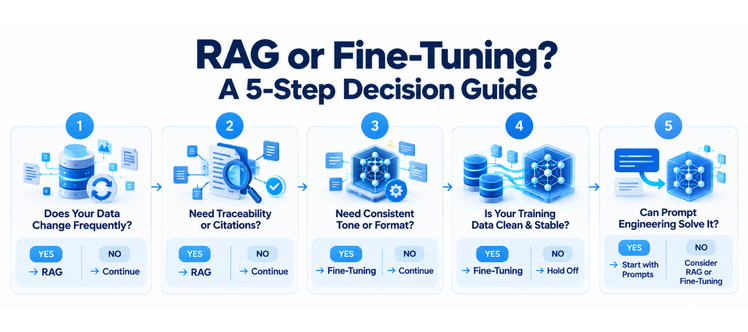
An enterprise LLM architecture decision should never start with technology. It should start with the question you’re trying to answer.
A Five-Step Decision Framework
- Does the answer depend on data that changes? If yes, lean RAG.
- Do you need traceability or citations for compliance? If yes, lean RAG.
- Do you need a fixed tone, structure, or classification behavior? If yes, lean fine-tuning.
- Is your dataset large, clean, and stable enough to train on? If no, don’t fine-tune yet.
- Can prompt engineering alone solve this? If yes, start there before building anything heavier.
Most enterprises land on a hybrid setup once they work through this framework, using RAG to keep answers current and fine-tuning to shape tone, structure, or domain vocabulary. Treating RAG vs fine-tuning as a permanent, binary choice is usually the mistake that leads teams to rebuild their architecture a year later.
Documenting the Decision for Future Teams
Without a written rationale, an LLM architecture decision that is made by an enterprise is difficult to change later when the volume of data grows, compliance mandates change, or a more affordable model emerges. If you wrote down your reasons for choosing RAG vs fine-tuning or hybrid, the next time you do an architecture review, you will know it even quicker.
Why Are Hybrid Models Becoming the Enterprise Standard?
The conversation about whether to use RAG vs fine-tuning has changed from “which” to “how much” of each, and two factors are contributing to this change.
Regulatory Pressure Favors Traceable Architectures
The EU AI Act and other regulatory pressure have driven transparency and explainable to the forefront of the enterprise agenda, and this is in favor of architectures that can lead back to a source of answers.
Smaller Models Make Fine-Tuning Affordable Again
Open-weight versions have become small enough to afford fine-tuning for the narrow, high-volume jobs. RAG is responsible for the knowledge layer, fine-tuning for the behavior layer, and prompt engineering for the connection. Those teams that refuse to move with this change struggle to reach their accuracy, cost, and maintainability limits within a few months of going live. In that respect, it’s not really a question of RAG vs fine-tuning; it’s a question of when to ship first, and when to add something on as you progress through your use case.
How Can AI Development Services Help You Get This Right?
Working through a RAG vs fine-tuning decision internally is possible, but it takes real expertise in vector databases, retrieval pipelines, evaluation frameworks, and model training, skills that are still hard to hire at scale.
What a Good AI Development Partner Actually Does
That’s where AI development services companies can come into play. They have already tested this decision tree with various industries. This can save you months of trial and error. Partner with a capable AI development firm to audit your data. You can determine what you use it for and map it to the decision framework above. Then you can avoid committing to a full architecture before the review. It reduces risk on investment and provides real accuracy and cost numbers, not assumptions, which is the only way to decide between RAG vs fine-tuning based on evidence from the actual systems.
Ongoing Support Most Teams Underestimate
In addition to the initial build, AI development services cover often underappreciated aspects. These include retraining schedules, retrieval pipeline maintenance, evaluation dashboards, and drift monitoring. They monitor drift in either method. That continuous support is frequently the key to a successful POC vs. successful production architecture.
Bottom Line
The RAG vs fine-tuning controversy is far from a simple one to win. RAG ensures you’re always equipped with up-to-date, reliable data. It also helps nail down the tone, structure, and behavior that prompting alone may not achieve. It will depend on how often you change your data, how important compliance is, and your budget over the coming year, not only at launch.
Most companies end up with a hybrid architecture. They do not choose one side or the other of the RAG vs fine-tuning debate. This right architecture selection upfront will save them months of rework. If you’re considering the RAG approach or fine-tuning for your AI roadmap, AnavClouds Analytics.ai can help. It compares and contrasts both methods with your use case. It also helps you design an architecture that grows with your business.
FAQs
RAG vs fine-tuning: which is better for enterprise AI?
RAG is generally better when your data changes often and you need source attribution. Fine-tuning is better for fixed tone, structure, or classification tasks. Most enterprises benefit from combining both approaches.
How much does fine-tuning cost compared to RAG?
Fine-tuning has a higher upfront training cost but lower ongoing costs. RAG has a lower starting cost but recurring expenses for hosting, retrieval, and embedding. Total cost depends on your data volume and query traffic.
Can you use RAG and fine-tuning together instead of choosing one?
Yes, this hybrid approach is now the industry standard for the RAG vs fine-tuning debate. RAG grounds responses in current data while fine-tuning shapes tone, format, and domain-specific behavior.
Do I need fine-tuning if I already use prompt engineering?
Not always. Prompt engineering solves many formatting and tone issues without retraining. Fine-tuning becomes necessary only when prompting can’t reliably hold a required behavior across many varied inputs.