



Modern enterprises deal with complicated workflows that are driven by text, documents, voice, images, and real-time data flows. The old automation tools can only interpret one or the other input, thus making them inefficient and operation silos. The multimodal generative AI will solve this problem and unify the various data into one intelligent system.
Multimodal generative AI facilitates smarter automation in more complex enterprise processes by integrating contextual knowledge with complex thinking. The benefits of organizations working with generative AI services and generative AI consulting include faster execution, higher accuracy, and scalable automation. Multimodal generative AI is needed to develop more intelligent business processes of the future as the level of operational complexity increases.
What Is Multimodal Generative AI?
Multimodal generative AI is a complex AI that can process many different types of inputs at the same time within the same intelligence system. Such inputs are text, images, audio, video, and structured enterprise data created within systems of the business. Multimodal generative AI is not applied to learn individually, but rather learns relationships between different forms of data, thus being able to learn context in a more accurate and consistent way across workflows.
Multi-mod generative AI is based on the combination of contextual intelligence created with all available inputs. The method provides more precise answers, richer knowledge, and intelligent behaviors that are in tandem with actual business situations. Mimicking human-equivalent reasoning with numerous signals, multimodal generative AI allows intelligent automation, which has a high scaling capability across both enterprise functions and contemporary generative AI services.
How Multimodal Generative AI Differs from Traditional Generative AI
Conventional models of generative AI are founded on processing data of one type at a time and, therefore, are less contextual. Text-based models deal with written data alone, whereas the image-based systems consider visuals, and they do not share common sense. This division compels businesses to use a variety of tools, making the working processes more complicated and less efficient.
Multimodal generative AI ties together various data modalities in a single intelligent platform, allowing contextual real-time comprehension across media. By processing text, images, audio, and structured enterprise data, multimodal generative AI produces more detailed outputs and more precise insights. This intelligence cluster enhances decision-making, offers advanced generative AI services, and facilitates scalable development of generative AI across business functions.
The conventional generative AI is usually linear and not very flexible to evolving input. Multimodal generative AI enables interconnected automation that is dynamic and modulates according to real-time signals. Companies that have embraced multimodal generative AI enjoy greater efficiency in operations, less system fragmentation, and better results of the generative AI consulting and AI development services.
Key Features That Define Multimodal Generative AI Systems
The multimodal generative AI is developed on a platform of sophisticated features, which can be used to achieve intelligent, enterprise-grade automation. These characteristics enable organizations to handle various data formats, ensure a sense of context, and produce the right output throughout the workflows. The two constitute the basis of the scalable generative AI services and modern AI chatbot development services.
Multi-Input Understanding Across Data Formats
Multimodal generative AI uses a single system to process text, images, voice, documents, and structured enterprise data. It automatically finds relations between formats without the requirement of different processing pipelines. This universal input knowledge enhances the accuracy of automation and provides systems execution with full operational context in the multifaceted enterprise processes.
Contextual Reasoning and Cross-Modal Intelligence
Multimodal generative AI maintains context between interactions, systems, and data sources. It relates visual cues to text meaning and systematic data to provide accurate and valuable results. Cross-modal intelligence facilitates the process of holistic thinking and, therefore, makes sure that the decisions made are based on the entire picture of the operation and minimizes the occurrence of errors and misinterpretations.
Generative Output Across Multiple Modalities
Multimodal generative AI produces dynamic responses like text responses, summaries, insights, and workflow actions. These outputs are real-time adjusted in case of changing conditions and live operational data. This feature promotes reporting, communication, and task execution, enabling the automation to move to be more proactive instead of reactive.
Continuous Learning and Adaptive Intelligence
Multimodal generative AI is continually enhanced with the help of enterprise comments and engagement data. It makes decisions based on performance, optimizes reaction, and adjusts business procedures to evolving needs. Such adaptive intelligence minimizes long-term maintenance work and enhances the value of the work done by generative AI development projects and generative AI consulting projects.
Why Multimodal Generative AI Is Critical for Operational Automation
The automation of operations is now a necessity because business organizations are dealing with larger volumes of data and volumes of processes. Conventional automation software is unable to comprehend various inputs and dynamic situations. Multimodal generative AI will solve these issues by adding intelligence, context, and flexibility to automated processes.
Handling Complex Operational Data in Real Time
Operational work processes consist of various data streams such as emails, documents, dashboards, and voice communications. Multimodal generative AI evaluates these inputs and generates outputs in one intelligence system at once. The real-time knowledge enhances responsiveness and automation to respond in real time to shifting operational conditions.
Reducing Manual Dependencies and Process Bottlenecks
The manual processes slow down operations, escalate costs, and bring inconsistency between workflows. Multimodal generative AI decreases human reliance through the automation of repetitive and complicated tasks with contextual understanding. Consequently, bottlenecks in the processes are reduced, productivity increases, and teams concentrate on strategic projects.
Improving Accuracy and Decision Consistency
Workflows that are undertaken by human beings tend to give fluctuating results because of disjointed data interpretation. There is also multimodal generative AI, which promises consistent decisions by using established logic with real-time context to support it. There is enhanced accuracy in the departments, the number of errors reduces tremendously, and operational performance is strengthened.
Enabling Scalable and Intelligent Automation
Older forms of automation are not easily scalable as the complexity of operation increases. The multimodal generative AI can scale across functions easily and still deliver the same level of intelligence and performance. This scalable automation enhances the expansion of the business without the corresponding rise in costs, providing extended efficiency due to advanced AI development and AI development companies.
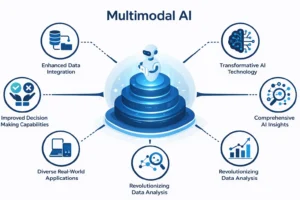
Rethinking Enterprise Workflow Automation with Multimodal Generative AI
Business processes are no longer linear and single source. Organizations deal with documentation, discussions, dashboards, and real-time inputs in systems. Multimodal generative AI allows companies to reconsider the automation of the workflow by integrating intelligence, context, and execution into a single automated platform.
Document-Driven Workflow Automation
Businesses handle contracts, invoices, and documents in the compliance department. Multimodal generative AI can read, interpret, and extract information in such documents with high precision. Workflow triggers automatically run and speed up the approval, validation, and compliance checks without compromising the security of document processing.
Customer Interaction and Support Automation
Customers have the ability to interact via chat, voice, email, and visual throughout the customer experience. Multimodal generative AI interprets customer intent in any format and makes sure that the answer is also correct, consistent, and personal. Multimodal generative AI and multilingual AI Chatbots are efficient in addressing global queries and enhancing customer satisfaction and faster response time.
Internal Operations and Knowledge Automation
The problem with internal knowledge lying in several systems is that employees may find it difficult to access it. The multimodal generative AI integrates into documents, dashboards, and communication devices in a single layer of knowledge. Information search is immediate, internal business processes run more efficiently, and teams are empowered to make informed decisions without having to rely on a manual search.
Decision Support and Real-Time Insights
The management of operations relies on the prompt and precise information that is given by various sources of data. Multimodal generative AI converts unprocessed operational data into operational intelligence in the form of contextual summaries. The time spent on decision-making is reduced; risks are revealed at an early stage, and there is better interdepartmental strategic alignment.
Intelligent Orchestration Using Multimodal Agents
Multimodal agents work independently within defined enterprise workflows and governance boundaries. These agents organize work between systems, data formats, and teams, allowing proactive and adaptive automation. Multimodal agents minimize operation overheads and provide intelligent workflow orchestration at scale by only escalating where needed.
Selecting the Right Partner for Enterprise AI Implementation
The choice of the appropriate partner is key to making AI initiatives transform into apparent business results. The enterprise requires partners that comprehend the complexity of operation, data control, and scalability. The correct partnership makes multimodal generative AI produce actual value instead of being an experiment.
Proven Enterprise Experience and Technical Depth
Seasoned partners offer experience on the basis of enterprise implementations in the real world. Teams that have practical experience with multimodal generative AI know about complex data ecosystems and workflow relationships. This experience helps in mitigating implementation risks and also makes solutions business-oriented.
Capabilities of security, scalability, and compliance are equally crucial. A trusted vendor will then develop AI systems that will be compatible with the current enterprise infrastructure and comply with the governance needs.
End-to-End Ownership Across the AI Lifecycle
The effective AI projects cannot be owned by development only. The capability of strategy, architecture, deployment, and optimization is handled by strong partners in a single delivery model. This will avoid fragmentation and promote accountability in the AI lifecycle.
End-to-end execution enables AI solutions to be dynamic as the business needs to change. The businesses enjoy long-term performance and operations.
Strategic Guidance and Implementation Readiness
The strategic direction is used to make sure that AI efforts are directed to the high-impact cases of business applications. Engagement under consulting assists organizations in evaluating the data preparedness, workflow maturity, and workability. This stage of planning eliminates expensive misalignment in implementation.
There are also clear governance structures and ethical standards that are set at an early stage. It will guarantee responsible implementation and sustainable trust in AIs controlled systems.
Scalable Conversational Automation Capabilities
In contemporary enterprise operations, conversational automation is important. Enhanced chatbot solutions facilitate the use of chatbots in consistent and intelligent interactions on customer and internal processes. Conversations are factual and context sensitive when fuelled by multimodal generative AI.
These solutions are channeled and region-scaled without any loss in personalization. Efficiencies in operations are also enhanced, and user experiences are steady and dependable.
Conclusion
Multimodal generative AI is transforming the way businesses automate and streamline business processes. The ability to process multiple data modalities simultaneously makes it possible to support intelligent decision-making, adaptive automation, and uniform out-of-department results. In contrast to the conventional generative AI, this solution provides contextual awareness on scale.
The long-term efficiency and operational resilience are achieved by organizations that invest in the development of generative AI and AI development services. Under a suitable strategy, consulting, and implementation partner, multimodal generative AI will make automation a competitive edge. Companies that embrace this technology nowadays are set to grow in a scalable manner, with continuous innovation.
Frequently Asked Questions
What is multimodal generative AI?
The next level of artificial intelligence is multimodal generative AI, which simultaneously works with a variety of data. It can interpret text, images, audio, video, and structured information in the same system to provide contextual and smart information.
How does multimodal generative AI work?
Multimodal generative AI is an approach that integrates various data inputs into one intelligence model. It breaks down cross-format connections, retains context, and acts out or responds according to joint knowledge.
What are common use cases of multimodal generative AI?
Multimodal generative AI is usually applied in workflow automation, document processing, decision support, and conversational systems. It is also used in customer service, analytics, and business operations.
Is multimodal generative AI suitable for enterprises?
Yes, multimodal generative AI is suitable for enterprises with complicated data and processes. It contributes to scalable automation, enhances accuracy, and adapts to changing business needs.