



International companies are working with different categories of customers, who like communicating in their own languages. Multi-lingual communication enables firms to establish a stronger level of trust, as well as gain more business conversions. This can be done by using Multilingual AI Chatbots that provide real-time support, personalized responses, and scalability in various markets.
Reading this guide, you will learn to construct Multilingual AI Chatbots, what technologies it is supported by, and why this tool is preferred by businesses that want to gain momentum in foreign markets.
Why Multilingual AI Chatbots Matter for Global Enterprises
The world markets demand that the companies speak their language. Multilingual AI Chatbots make this expectation easier since they can provide contextual communication in various languages without the need to recruit different teams.
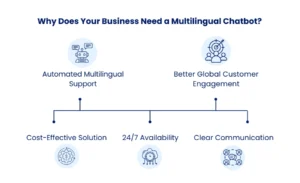
Companies today have digital operations such as websites, mobile applications, support tools, and messengers. Multilingual AI Chatbots make it possible to engage in interactions locally on all of these touchpoints and also provide uniform responses. This enhances interaction, customer satisfaction, and lowers service costs.
The results of customer retention, quicker conversations, and increased customer satisfaction after purchasing have been measurable in companies that invest in multilingual chatbot services.
Scale customer support across regions with multilingual AI chatbots built for accuracy, localization, and growth.
5 Benefits of Using Multilingual AI Chatbots for Global Business
Consistent Customer Support Across Markets
Multilingual AI Chatbots are useful in assisting businesses in providing the same level of service in all regions and languages. Customers who contact in various time zones are properly answered without any delays or misunderstandings as a result of language differences, and this increases customer satisfaction and decreases frustration. Such reliability cultivates trust and remains consistent to support operations in line with international standards, despite the changes in customer volumes. The language-based support teams are also unnecessary in consistency, which is a more stable operation within the organization.
Reduced Operational Costs and Support Overheads
By substituting the multilingual agent teams with multilingual chatbot solutions, companies save the cost of hiring and training the staff and, consequently, the money spent on salary payments. Rather than having different support teams ensure the service of every region, a multilingual AI system is used that processes thousands of conversations in real-time. It minimizes operational overhead and obviates the need to staff up multiple times, either during peak seasons or during global rollouts of products. The price per customer will be dependent on the number of customers, and multilingual chatbot development will be a more cost-effective choice compared to the old model, which will require more personnel to handle support.
Faster Market Expansion and Local Launches
In case of expansion into new countries or markets, an AI chatbot for global business assists teams to communicate with users in local languages in a short period of time. This reduces friction in the onboarding process and avoids wastage of time on translation or regional alignment. New markets can instantly have their own business offers, support, tutorials, and explanations of the products. Consequently, multilingual AI Chatbots speed up the growth of the market and enable organizations to work without hesitation, without having to wait to find the resources needed in the specific region.
Higher Conversions Through Localized Experiences
When the products and policies are presented in their own language, customers make quicker purchases. The AI Chatbots that are multilingual assist in breaking down complicated data and allow the user to perceive the pricing, features, and delivery times in a user-friendly manner. This enhances interaction and experiences significant conversions among diverse buying units. The localized interactions also minimize the user drop-offs to websites, commerce websites, and subscription websites, and global campaigns are more successful.
Personalized Engagement Based on Local Preferences
Multilingual conversational AI can facilitate customized communication in a manner that captures cultural expectations, cultural behavior patterns, as well as geographic differences. Rather than generic scripted responses, the customers are provided with region-specific responses or something that matches their tastes in terms of suggestions or products. Such personalization enhances loyalty and builds better brand relationships. This is beneficial to businesses in the long run because recurrent interaction is enhanced, and users will be satisfied in all markets.
Core Technologies Behind Multilingual AI Chatbots
Multilingual AI Chatbots use intelligent systems that allow businesses to communicate naturally with global customers in real time. These technologies ensure accuracy, cultural relevance, and faster response cycles across multiple languages.
Modern NLP Systems That Understand Multilingual Inputs
Modern NLP systems help Multilingual AI Chatbots interpret user queries, grammar, informal phrases, and sentence patterns accurately. Instead of only translating words, these systems extract underlying intent and meaning across languages. This enables meaningful dialogue and reduces errors when customers use dialects, slang, or region-specific expressions. NLP systems also improve continuously as models receive more localized data from customers.
Machine Translation Models That Ensure Instant Communication
Machine translation models allow multilingual chatbot development teams to process multi-language conversations efficiently. User messages are converted into a standardized processing language before producing an output in the original language. This reduces delays and enables faster interactions. It also improves the ability to respond with accurate product details, support instructions, or policy-based information in the required language.
Contextual Understanding for Smarter Conversations
For global businesses, context accuracy is important because users often return with ongoing queries. Multilingual AI Chatbots use context mapping techniques to remember past messages, previous order history, and selected choices throughout the session. This allows businesses to provide personalized continuity without repeating questions. As a result, customer satisfaction grows significantly during repeat interactions.
Sentiment Recognition for Emotion-Aware Responses
Sentiment recognition helps Multilingual AI Chatbots detect emotional cues such as confusion, dissatisfaction, or urgency. The system adapts tone and messages accordingly and offers more empathetic answers, escalation options, or detailed guidance when needed. Such responses create richer experiences for users who expect sensitivity in customer support conversations.
Enterprise-Grade Architecture Built by Skilled AI Teams
AI development company teams combine these technologies to build structured multilingual chatbot solutions. They establish scalable pipelines, localization layers, and continuous testing systems to maintain accuracy across languages. This creates a stable and intelligent architecture that supports complex multilingual operations and integrates with CRM, support portals, tracking tools, and enterprise applications.
Step-by-Step Process to Build Multilingual AI Chatbots
Below is a simplified and practical lifecycle that businesses follow during multilingual chatbot development.
Step 1: Define Regions and Supported Languages
The initial one is target regions, language variations, dialect patterns, and local communication styles. A multinational company may need Spanish in Mexico, Spanish in Spain, or various Arabic dialects in the Middle East. This makes Multilingual AI Chatbots effective in all locations.
Step 2: Select a Skilled AI Development Company
By selecting the appropriate AI development company, it becomes fast to plan, select the architecture, and map compliance. The teams of experts are focused on security rules, localization systems, and multi-regional deployment, guaranteeing multilingual chatbot solutions on the basis of scaling.
Step 3: Collect High-Quality Multilingual Training Data
Training data contains support documentation, conversational logs, product descriptions, and FAQs. The accuracy depends on the quality of training data, which is more important when businesses build multilingual chatbot systems in different industries.
Step 4: Develop Multilingual Intent Models
The intent model determines the user requirements, like monitoring delivery, making appointments, or seeking product recommendations. Even the Multilingual AI Chatbots can take the language patterns of grammar, and yet they can generate correct intent mapping across variants.
Step 5: Integrate Reliable Translation Engines
Machine translators help speed up the translation process and eliminate the need to use human translators. The immediate translation will provide quicker responses and global coverage at all times, particularly when several groups of customers engage at once.
Step 6: Build Uniform Response Libraries
A formal response library ensures common sense and consistency of messages in the regions. The refund policy, delivery terms, warranty guidelines, or compliance messages are not changed, no matter what language they are displayed in.
Step 7: Add Multilingual Voice Support
Multilingual chatbot development usually incorporates voice-based interactions in areas where users speak rather than type. Voice interfaces enhance usability and provide an easy adoption for older customers or newcomers to the digital realm.
Step 8: Test Localization Accuracy and Output Quality
Testing entails accent identification, dialect differences, situational applicability, and cultural decoding. Companies must introduce controlled pilots with the aim of testing the AI chatbot for global business, with the objective of establishing whether it acts correctly in real life.
Step 9: Deploy Across Channels for Unified Experience
Companies incorporate Multilingual AI Chatbots in their applications, websites, CRM systems, live chat, and support portals. The current platforms allow switching between languages without any extra settings.
Step 10: Monitor Performance and Improve Continuously
Continuous analysis of chat logs, user feedback, and intent gaps is included in AI chatbot development services. This is used to optimize responses, minimize escalations, and improve end-user experiences, to ensure the chatbot improves with customer needs.
6 Important Features to Look for in Multilingual Chatbots
In the case of businesses investing in multilingual chatbot solutions, critical features are to be evaluated to guarantee scalability, accuracy, and customer satisfaction.
Support for multiple languages simultaneously
Multilingual AI Chatbots have to support simultaneous language conversations without influencing the accuracy or the speed of responses.
Real-time translation capabilities
The instant translation enables customers to communicate in their natural way, whereas the messages are translated into the language of processing automatically by the backend systems.
Multi-channel communication support
An effective multilingual chatbot development plan facilitates the use of the chatbot on all websites, mobile applications, CRM portals, live chats, and messaging services.
Automated escalation to human support
When the system detects complex questions, multilingual chatbot services should redirect a user to human support instantly while retaining full conversation history.
Natural tone, regional variations, and dialect recognition
Dialects, regional use of words, culture, and tone should be read to facilitate meaningful conversations between the multilingual conversational AI.
Integration with enterprise systems
An AI chatbot for global business should be interconnected with CRM, ERP, ticketing systems, document libraries, and internal knowledge bases.
Such characteristics are what distinguish higher-level multilingual AI Chatbots and lower-level automated systems and ensure that businesses provide high-quality, localized, and personalized support in different markets.
Final Thoughts
Multilingual AI Chatbots have become the need of every global business due to their enhanced customer experience, decrease in the support workloads, and global consistency of communication. Companies that use multilingual chatbot services would experience foreseeable expansion expected to enhance contact and easier business operations. The second stage of AI chatbot in international business processes will include the correct regional personalization and adaptable language learning. To create enterprise-version chatbots that meet business goals, companies intending to grow at their efficiency level can utilize the skills and experience of AnavClouds Analytics.ai to create multilingual chatbots.