



The modern world is transformed by the need of businesses to interact with customers rapidly, correctly, and smartly, and chatbot performance optimization is more crucial than ever. Badly tuned chatbots confuse users, reduce the level of engagement, and damage the key performance indicators. Using a data-driven chatbot optimization approach, companies can find bottlenecks fast, improve intent recognition, and improve efficiency overall. This guide gives practical steps, critical measures, and functional methods used to streamline the current chatbot services. It includes chatbot analytics for performance tuning, AI chatbot integration with CRM, technical performance, and strategies to enhance AI chatbot performance in 2026, to have your chatbot make a measurable business impact.
Why Focus on Chatbot Performance Optimization?
In the age of instant answers, users would want chatbots to be quick, precise, and situational. Any customer can be frustrated at the causes of delay or error, tasks can be abandoned, and support escalations rise. That is why chatbot performance optimization is critical to businesses based on conversational AI. Using chatbot analytics for performance tuning and optimizing the chatbot on a data basis, companies can find bottlenecks, increase the accuracy of intents, and enhance efficiency. The smart use of chatbots already offered to their users is beneficial not only in terms of improving the satisfaction of users, but also in minimizing operational expenses, high resolution rates, and quantifiable business impact.
Build a Strong Foundation for Chatbot Performance Optimization
1. Start with Clear Goals and KPIs
The first step of chatbot performance optimization is defining clear goals. Identify your measures of success in your bot. The common measures are shorter response time, more conversations done, and better customer satisfaction. Connect every objective to some KPIs, including fallback rate, first contact resolution, CSAT, or containment rate. Having clear objectives enables your team to optimize existing chatbot services and use analytics to concentrate on practical outcomes.
2. Track Essential Chatbot Analytics Metrics and KPIs
Monitoring the right metrics is critical for chatbot analytics for performance tuning. Key metrics include:
- Total interactions: volume and growth trends
- Active users: unique visitors engaging with the chatbot
- Goal completion rate: tasks successfully finished by the bot
- Fallback rate: frequency of bot failures leading to human escalation
- Average response latency: speed of bot replies
- Session length: unusually long sessions may indicate confusion
- CSAT / NPS: direct user satisfaction measurements
- First contact resolution: solved on the first bot interaction
- Intent accuracy: percent of correctly recognized intents
- Escalation reasons: structured reasons for human handovers
Tracking these chatbot analytics metrics and KPIs ensures precise, data-driven insights for tuning your bot.
3. Build an Analytics Pipeline for Continuous Tuning
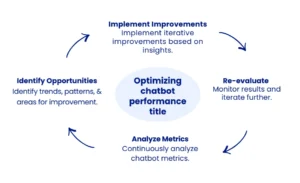
A robust analytics pipeline is essential for data-driven chatbot optimization. Steps include:
- Collect raw data: full transcripts, timestamps, and contextual metadata
- Enrich data: tag intents, sentiment, and session context
- Centralize storage: store in a data warehouse or analytics platform
- Visualize insights: build dashboards for KPIs, trends, and drop-offs
- Set anomaly alerts: detect sudden increases in fallback or latency
This pipeline helps your AI chatbot continuously improve performance while providing actionable insights for AI chatbot performance improvement 2026.
4. Diagnose Problems Using Common Failure Patterns
Analyzing metrics helps identify areas for AI chatbot performance improvement. Common issues include:
- High fallback at specific nodes: refine intents or add clarifying prompts
- Long sessions with low goal completion: simplify conversation flows
- Low intent accuracy: retrain NLU with new examples and edge cases
- Latency spikes: investigate model serving and infrastructure performance
- Repeated escalations: address missing content or complex workflows
Prioritizing these fixes ensures your team can optimize existing chatbot services efficiently and boost overall user satisfaction.
5. Governance, SLAs, and Monitoring
An efficient chatbot performance optimization should be well-regulated and controlled. Establish SLAs on availability, latency, and intent accuracy- 99.5% uptime with specified response limits. Constant model drift, user interactions, and language changes. Have logging, privacy, and access control governance policies. These practices ensure data-driven chatbot optimization, prevent regressions, and maintain trust while allowing your team to optimize existing chatbot services efficiently.
Techniques for Analytics-Driven Chatbot Performance Optimization
Optimizing existing chatbot services requires systematic tuning backed by chatbot analytics for performance tuning. Here are six effective techniques:
1. Intent and Utterance Hygiene
Chatbot performance optimization is based on clean and crisp intents. Eliminate duplicates, combine identical intents, and include utterances of actual user dialogue. Smaller, directional intent sets enhance routing, raise intent recognition accuracy, and provide fallback. It is always important to revise and update intents to keep your bot in touch with changing user language. The introduction of user feedback also enhances comprehension and averts the occurrence of the same misunderstanding.
2. Response and Content Pruning
Overly long or complicated responses frustrate users. Shorten messages and use progressive disclosure to guide users step by step. Keep responses goal-oriented to maximize resolution and improve AI chatbot performance improvement 2026. Streamlined content also improves comprehension for first-time users and reduces conversation drop-offs. Clear, concise responses help maintain engagement and encourage self-service completion.
3. Re-training and Continuous Learning
Frequent retraining makes your chatbot grow as the users behave. Add new labeling of transcripts to increase intent coverage. Ongoing training is essential when it comes to data-driven chatbot optimization and ensuring its high accuracy in the long run. Retrain schedules on a regular basis and use real-world experience to get edge cases. This makes your AI respond to new prompts and remain useful in providing the relevant response.
4. Hybrid Routing and Human-in-the-Loop
Not all the queries are fully automatable. Only route when needed, and handover context and transfer context. This is a hybrid solution that decreases repetitive inquiries, enhances customer satisfaction, and promotes AI Chatbot Integration with CRM. Human-in-the-loop is also useful in collecting insights to make continuous improvements and make intricate queries efficient. Well-structured handovers retain a sense of conversation and avoid user frustration.
5. Latency and Model Optimization
Profile end-to-end latency to identify delays. Cache frequently used answers and optimize model selection. Use lightweight models for routine queries and heavyweight models for complex tasks. This technique enhances response speed and overall chatbot performance optimization. Reducing latency not only improves user experience but also supports higher concurrency for peak traffic. Monitoring system performance ensures consistent and reliable chatbot responses.
6. A/B Testing Conversational Flows
Test alternative prompts, microcopy, and slot questions to determine the most effective flows. Monitor the effect on goal achievement, CSAT, and fallback. Consistent A/B testing is a sure way to ensure that your AI chatbot development company can provide quantifiable, data-driven changes. Experiencing the various conversation paths exposes the preferences of the users and enhances interaction. The constant experimentation will provide the opportunity to use the improvements and prove the efficiency of every chatbot performance optimization.
Integrating Analytics with CRM and Ticketing Systems
AI chatbot integration with CRM bridges the gap between conversations and customer records. Key benefits include:
- Open the CRM records with intent, sentiment, and behavioral information to get the whole picture of customer interactions.
- Automatically create tickets on unsolved problems, eliminating human follow-up, and enhancing support performance.
- Enhance the context of agents during handovers to be able to solve it faster and make customers happier.
- Recycling Feed CRM results in training datasets to improve data-driven chatbot optimisation.
- Increase the lead qualification rate by monitoring the engagement patterns and pinpointing potential high prospects.
- Minimize the average handle time by supplying the agents with chatbot interaction information.
- Assess the business performance of chatbot performance optimization through CRM measurements and analytics dashboard.
- Create individual customer experiences through the integration of conversation data and CRM data to engage customers specifically.
- Enhance workflow automation of sales, support, and service teams with the help of chatbot actions integrated into the CRM process.
The method will guarantee the chatbot performance optimization of current services and provide the operational and customer experience enhancements that can be measured.
Scaling and Advanced Optimizations for 2026
Conversational AI Agents and Agentic Features
The AI platforms that are agentic are becoming more available to SMBs, allowing the multi-step work to be automated and the coordination of the various systems. These are AI agents who can provide services on behalf of users, including more complex operations and ensuring safety and compliance requirements. The use of an AI chatbot development company experience will assist businesses in developing agents that optimize business processes, minimize human intervention, and improve chatbot performance optimization.
Reasoning, RAG, and Retrieval Tuning
To enhance retrieval hygiene and accuracy and minimize hallucinations, retrieval-augmented generation (RAG) is used in combination with strong retrieval hygiene. Make sources of knowledge relevant, labeled, and up to date. The strategy facilitates the optimization of chatbots through data, as it makes their responses reliable and context-sensitive. When properly tuned, chatbots can respond to complex queries, which will make AI chatbots more useful by 2026.
Predictive Routing and Personalization
Use past data of behavior and interaction to direct users to the right flow or agent. Customized reactions enhance interaction, purchase, and customer satisfaction. Chatbot analytics for performance tuning will guarantee the optimization of predictive routing for efficiency and accuracy, hence enhancing the chatbot performance optimization.
Cost-Performance Balance
Scale AI models by deploying the lightweight models when dealing with a large number of simple queries and heavyweight models when dealing with complex, multi-process tasks. Watching both the spending and performance would provide an effective balance between cost and quality. The plan helps to maximize the current chatbot services and provide prompt, reliable, and correct answers to every interaction.
Role of an AI Chatbot Development Company
A qualified AI development company is especially important during chatbot performance optimization through audit of the conversational logs, the establishment of analytics pipelines, and smooth integration of the AI Chatbot with CRM. In choosing a partner, seek companies with:
- Knowledge of NLU and rapid engineering to guarantee the correct recognition of intent and worthwhile conversations.
- Prior positive experience with RAG and ability to access systems with reliable and contextual responses that reduce hallucinations.
- CRM and ticketing integration capabilities to bridge the gap between the interaction of the chatbot and customer records to optimize the chatbot using the data.
- Definite SLAs and quantifiable results to ensure performance, uptime, and quality of response.
- Analytics and dashboard configuration for constant monitoring and chatbot analytics for performance optimization.
- Customizations in workflow automation to integrate chatbots into the business processes and enhance efficiency.
- Continuous training and assistance to sustain and develop chatbot capabilities in the long term.
Collaborating with an experienced AI chatbot development agency will shorten the efficiency optimization of the current chatbot services, promote best practices, and minimize the risks, allowing the companies to reach better outcomes in the short and long term.
Conclusion
Chatbot optimization is not a one-time undertaking; it is a constant, data-driven process that increases user satisfaction and operational efficiency directly. The first step is to define the KPIs clearly, build a trustworthy analytics pipeline, and focus on fixes that influence key metrics. Combining your chatbot with CRM systems will help capture excellent insights to improve the workflow. AnavClouds Analytics.ai is a good solution for businesses that need to optimize existing chatbot services, use chatbot analytics to optimize performance, or introduce AI Chatbot Integration with CRM. Our team assists in auditing logs, creating dashboards, and optimizing bots to ensure maximum chatbot performance optimization for measurable outcomes and long-term evolution.