



One of the ways AI in Healthcare is changing the current state of clinical decision-making is by transforming the analysis, sharing, and use of medical data. The use of AI solutions for healthcare is becoming more popular among healthcare providers to enhance operational efficiency, patient outcomes, and diagnostics. Artificial Intelligence in health care facilitates predictive analytics, personalized treatment planning, and allows a quicker response to medical insights. Nonetheless, such fast adoption has brought severe data privacy and cybersecurity issues. AI works with large amounts of valuable patient data distributed across interconnected systems and platforms. The regulatory stress, patient confidence, and accountability require safe AI implementation. The role of AI in Healthcare also implies the discussion of compliance, risk management, and system security. A moderate solution will guarantee innovation without jeopardizing patient data.
What Is Driving the Rapid Growth of AI in Healthcare?
AI in Healthcare is expanding very fast since healthcare institutions are producing huge amounts of digital data on a daily basis. To enhance diagnostic accuracy, stream data, and help healthcare providers make quicker clinical decisions, the number of healthcare providers using AI solutions for healthcare is increasing. Healthcare Artificial Intelligence can be used to automate clinical, operational, and research settings, increasing effectiveness and patient outcomes.
The AI application in the Healthcare sector currently has an international reach to hospitals, diagnostic laboratories, research centers, and pharmaceutical companies. AI systems analyze intricate medical data that is beyond human capability. Such functionality enhances speed and innovation, but it makes more use of sensitive patient information and sophisticated security measures. Some of the main accelerators in the adoption of AI are listed below.
Growing Adoption of Electronic Health Records and Digital Data
Availability of healthcare data has changed with the prevalence of the use of electronic health records. Artificial intelligence in Healthcare is based on both structured and unstructured clinical data available in electronic repositories. AI solutions can use these records to study the history of patients, their pattern of treatment, and their outcome on a large scale.
Availability of digital data can be used to assist predictive analytics in healthcare and individual treatment planning. Nevertheless, there is also more data access, and this increases privacy and compliance issues. Data safety has been critical to the adoption of AI in a sustainable manner.
Rising Demand for Predictive Analytics in Healthcare
One of the significant sources of AI usage in medical organizations is predictive analytics in healthcare. AI in Healthcare assists in detecting the risk of diseases, forecasting patient outcomes, and optimizing the process of allocating resources. Predictive models are applied when healthcare leaders do not rely on reactive care but implement preventive care.
AI solutions use historical and real-time data to aid in early intervention and cost reduction. Such increased dependence on predictive analytics emphasizes the importance of AI in making decisions in Healthcare.
Advancements in AI Solutions and Cloud-Based Technologies
The improvements in AI solutions have enabled the intelligent systems that have been developed to be accessible and scalable. Cloud computing will help healthcare institutions to implement AI in healthcare without investing in hefty infrastructure. The services of AI development have become favorable to quick implementation and continuous improvement.
The AI platforms based on the cloud provide real-time data processing and cross-departmental collaboration. These innovations make the innovation process much faster, but more and more secure cybersecurity and compliance systems are also required.
How Does AI in Healthcare Depend on Data?
AI in Healthcare operates on pure intelligence based on facts. Health information characterizes algorithms and establishes the reliability of the output. Without quality data, AI solutions for healthcare cannot deliver accurate predictions.
Healthcare organizations receive structured and unstructured data daily. This encompasses records of the patients, imaging records, laboratory reports, and live monitoring records. It is important to safely handle this information to achieve the use of AI in the long term.
Types of Data Used by AI Systems
- Electronic health records and clinical notes
- Medical imaging and diagnostic data
- Wearable device and remote monitoring data
Why Predictive Analytics Requires Large Datasets
Healthcare predictive analytics is based on past trends and live data. Diverse datasets are well modeled by AI. Nevertheless, privacy and security risks are also enhanced with the increase in data usage.
Why Is Data Privacy a Major Concern in AI in Healthcare?
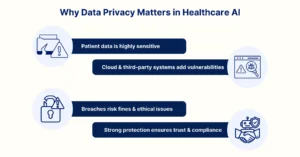
AI in the Healthcare field relies on the constant availability of high healthcare and personal data that may be sensitive. This is patient identifiers, genetic data, diagnostic data, and treatment histories. Regulatory fines, losses, and ethical concerns may result in the case of any abuse or exposure; hence, data privacy is a vital problem for AI solutions for healthcare.
Healthcare AI solutions tend to combine various systems, cloud, and third-party applications. Such complicated data flow exposes more vulnerabilities and restricts concentration. To achieve compliance and trust over time, healthcare organizations need to protect patient data at all levels of AI processing.
Unauthorized Access to Sensitive Patient Records
Healthcare systems that have AI are vulnerable to cyber threats because they hold large amounts of patient data. The loosely implemented access controls or incorrect authentication may result in unauthorized individuals getting access to confidential medical records. Role-based access and identity management are key to ensuring the security of Artificial Intelligence in a healthcare setting.
Weak Data Anonymization and Re-Identification Risks
Numerous AI solutions for healthcare are based on anonymized datasets to be trained and analyzed. Nonetheless, poor anonymization mechanisms may enable patient identities to be re-identified with the help of external datasets. AI in Healthcare should employ sophisticated anonymisation, encryption, and data masking in an attempt to limit privacy concerns.
Lack of Transparency in AI Data Usage
One of the greatest issues of Artificial Intelligence in healthcare is limited transparency. AI systems frequently fail to inform patients about the data collection process, processing, and how their data is used. This ambiguity leads to a decrease in trust and acceptance, and explainable AI and clear data usage policies are necessary.
Patient Trust and Ethical Responsibility in AI Adoption
Trust in the patient forms the basis of successful adoption of AI in the Healthcare sector. Patients desire conscientious, moral, and safe data management. To foster trust and make AI solutions sustainable in the long run, healthcare organizations should align AI development services with ethical governance, transparency, and accountability.
What Regulations Govern AI in Healthcare Data Usage?
AI in Healthcare is used under very stringent legal frameworks that are aimed at ensuring patient information and privacy are safeguarded. Laws like the HIPAA and GDPR regulate the collection, processing, and storage of sensitive medical data with regard to AI in healthcare. Regulatory adherence is a requirement, and it has a direct effect on the design and implementation of AI solutions for healthcare.
These laws demand that medical institutions develop robust data protection measures, transparency, and reduce non-essential data disclosure. Failure to comply may lead to hefty fines, criminal liability, and negative publicity. The development of AI services should meet regulatory expectations in the early phases of the system design.
Patient Consent and Data Minimization Requirements
Patient information used in AI in Healthcare systems has to be gathered through informed and explicit consent. Laws mandate organizations to restrict data gathering to the amount of information necessary for specific clinical intentions. Data minimization helps reduce privacy risks and keep the Artificial Intelligence in healthcare within the ethical and legal limits.
Secure Data Storage and Controlled Access Standards
Regulations ensure that data on patients is stored in a secure manner within AI systems. These should be encrypted, have access controls, and authentication in order to curb unauthorized access. Healthcare AI solutions should be such that authorized users can gain access only to medical information that has been approved during its lifecycle.
Audit Trails and Accountability Measures
Healthcare regulations require detailed audit trails to track data access and usage. AI in Healthcare systems should be implemented in a way that documents the access of patient information by whom and when. These accountability mechanisms assist in adherence to regulations and increase transparency, as well as facilitating rapid investigation of incidents in case of security or privacy concerns.
What Cybersecurity Risks Affect AI in Healthcare Systems?
AI in Healthcare has a profound impact on healthcare by increasing the digital infrastructure based on cloud platforms, medical device connections, and data-driven apps. This growth widens the cybercrime target of the sensitive medical information of cybercriminals. The security requirements among healthcare institutions embracing AI technology in healthcare are greater than those with conventional IT systems.
Cybersecurity breaches are capable of interfering with clinical operations, slowing treatment, and endangering patient safety. Artificial Intelligence in healthcare requires stronger, continuous defenses due to real-time data processing and system interconnectivity. The security of the AI environments is fundamental to the continuance of stability and credibility.
Ransomware Attacks on Hospital and Healthcare Networks
One of the biggest dangers to AI in Healthcare systems is ransomware attacks. Cybercriminals will encrypt important systems and charge to re-encrypt the server. Such attacks can stop AI-powered operations, slow down the process of treating patients, and compel healthcare organizations to make hard decisions amidst severe pressure.
Phishing Attacks and Credential Theft Risks
Phishing is one of the most frequent access points to cybercrimes within healthcare settings. Hackers deceive employees into providing credentials, which open doors to AI systems and patient information. The use of Artificial Intelligence in healthcare systems should be safeguarded by means of strong authentication, personnel training, and controls on access.
Unauthorized Access to AI Platforms and Data Systems
Cyber piracy jeopardizes the privacy of healthcare AI solutions. Inadequate access control can enable internal or external stakeholders to alter the systems or steal sensitive information. The security of AI platforms presupposes role-based access, constant monitoring, and strict verification of identity.
AI-Specific Security Vulnerabilities and Model Exploits
The book, AI in Healthcare, presents unprecedented security threats to conventional systems. Adversarial attacks include AI models with malicious data. Predictive analytics, diagnostics, and treatment recommendations may be distorted with these attacks, and the security of AI models is as important as information protection itself.
How Can Healthcare Organizations Secure AI Solutions Effectively?
AI in Healthcare needs the administrative, technical, and operational discipline as a layered strategy to ensure security. Data, AI models, and workflows should be secured by healthcare organizations at the same time. Effective security systems guarantee adherence, secure patient confidence, and continued clinical functions.
End-to-End Data Encryption
The end-to-end encryption safeguards medical information throughout the storage, transmission, and computation layers of AI. Even when the system is breached, or unauthorized access is made, the encrypted data will be safe. The given practice will guarantee patient confidentiality, regulatory compliance, and, overall, ensure minimal chances of data exposure in AI-driven healthcare settings.
Role-Based Access Management
Role-based access management restricts access to AI systems according to the roles and duties of specific users. The method stops insider threats and unauthorized data manipulation. Access control is enhanced through granular access control, which ensures sensitive healthcare AI systems are only accessible to authorized personnel.
Continuous Threat Monitoring
Threat monitoring allows real-time access to the activity and security events of the AI systems. Complex surveillance devices identify anomalies and suspicious activity, as well as possible attacks, early. Proactive monitoring is one of the methods to allow healthcare organizations to operate swiftly and reduce operational disruption, as well as to protect AI-powered clinical systems.
The Role of an AI Development Company
A competent AI development firm is aware of healthcare security, compliance, and ethical AI needs. The professional AI development services provide scalable and secure AI architectures. The appropriate implementation partner will minimize risks to cybersecurity in the long term, as well as ensure that AI systems comply with the requirements of the healthcare industry.
Conclusion
AI in Healthcare will remain a game-changer in medical innovation, decision-making, and care delivery to patients. AI in Healthcare will rely on safe, compliant, and open data in the future. Healthcare organizations should concern themselves with privacy risks, cybersecurity threats, and regulatory requirements. The value of predictive analytics in healthcare and AI solutions is impossible to overestimate, yet it should not be applied recklessly. Powerful leadership, technical protection, and moral AI models are critical in achieving success in the long-term. The collaboration with a trusted AI development firm will provide a secure AI development service according to healthcare requirements. With the changing trends of AI, companies that put data security first will see trust, compliance, and sustainable growth possibilities through the use of Artificial Intelligence in the healthcare sector.