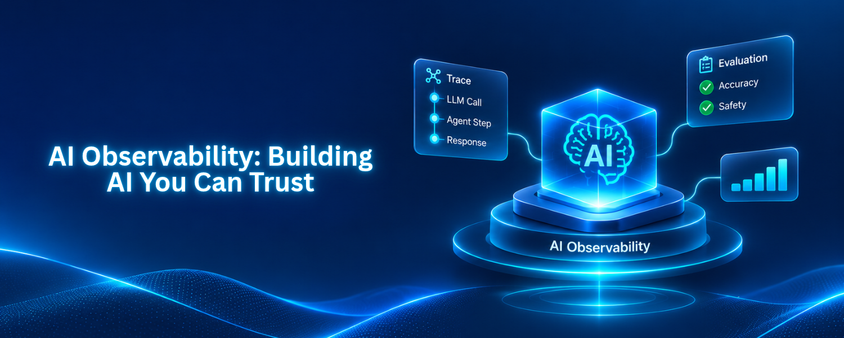

AI observability involves gathering and analyzing traces, metrics, logs, and quality assessments of AI systems to gain insights into the system’s behavior and understand how it performs. It monitors hallucination, drift, bias, token usage, and decision paths, in contrast to traditional monitoring that only monitors uptime. As businesses transition from Chatbots to AI autonomous agents in 2027, AI observability has emerged as the control layer to ensure the accuracy, safety, and affordability of AI. This guide covers the fundamentals, LLM observability, AI agent monitoring, key performance metrics, and the MLOps practices required to be able to rely on AI at scale. Execute models in production – start here.
What Is AI Observability?
With AI observability, teams can have 360-degree visibility of how AI systems function when they’re deployed. It provides a single source of truth for the prompts, context retrieved, tool calls, model responses, and user feedback, so that you can answer the key question: why did the system do that?
By 2028, 40% of organizations implementing AI will be using AI observability tools to track AI model performance, bias, and outputs. That’s the direction in which the market is going. Observability, from engineering ‘nice-to-have’ to production ‘must-have’.
Key Differences from Traditional Monitoring
Traditional monitoring was designed to monitor software that operates in the same manner throughout the life cycle. AI does not. This is where it becomes apparent:
- Non-deterministic outputs: Meaning that the same prompt may be answered in different ways, and it’s important to verify the accuracy of the answer.
- Quality over availability: A “success” message does not necessarily mean that the response is actually false, biased, or unsafe.
- Multi-step behavior: Agents plan, call tools, and loop, which creates long chains that are hard to debug.
- Variable cost: Each token costs a certain amount, and so does spending.
Coverage Across the AI Lifecycle
It covers data quality prior to training, model behavior upon deployment, as well as agent actions at runtime. One perspective – input to outcome.
Why Does AI Observability Matter in 2027?
The vast majority of AI failures are silent. Nothing crashes. The system just begins to provide weaker responses, cough up the money, or do things that it is not expecting. Teams typically discover the value of AI observability when they have a customer complaining about the poor experience or a surprise cloud bill.
Reliability and User Trust
There’s a lesson I learned the hard way about the damage that can be done to trust when a wrong answer is given in a forthright manner. Observability gives you insight into what users don’t report on before it’s too late: drifts, hallucinations, retrieval failures.
Governance and Compliance
Risk, law teams now want to get audit trails – which model, with which data, with which prompt version. Those records are created by traces and logs, and are not manually dug.
Cost Predictability
Agents can loop, retry, and call large models a much greater number of times than originally intended. Service information helps keep spending accountable.
What Are the Core Pillars of AI Observability?
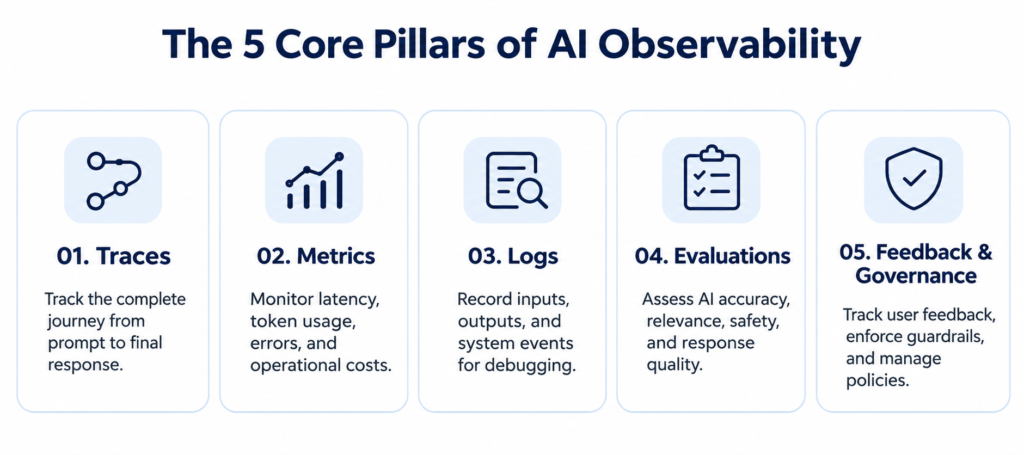
A solid setup rests on five layers. Skipping one leaves a blind spot.
- Traces: The full path of a request, from prompt to retrieval to tool calls to final answer.
- Metrics: These are numbers over time, such as latency, number of tokens, errors per unit time, etc., and costs per request.
- Logs: Raw data of inputs, outputs, and events of the system for debugging and audits.
- Evaluations: Automated and human accuracy, relevance, safety, and tone scoring.
- Feedback and Governance: App user ratings, guardrails, and specific model and prompt version policies.
Teams using them as five seamlessly integrated dashboards can debug faster than teams using five individual dashboards.
What Is LLM Observability and How Does It Work?
LLM observability is a component of AI observability that focuses on the language model component of AI systems. It’s about the interaction between a prompt and a response, the basic building block of most generative AI issues.
Key Data to Capture
- Prompt and answer sets (some system prompts and template versions)
- Information retrieved in pipelines, based on relevance scores noted in RAG documents
- The number of tokens used, latency, and time to the first token.
- The three scores for hallucination, toxicity and groundedness were calculated.
- All injuries to guardrails, refusals, and fallback incidents.
These are set in place; the bad answer is no longer a mystery. You can open the trace to determine if it was caused by the prompt, retrieval step, and/or the model.
How Does AI Agent Observability Work?
Agents plan, select tools, make API calls, and repeat until the goal is achieved. That’s where it gets tricky with AI observability, as one user request can result in many model calls and decisions. AI agent observability is a way to monitor and track the entire process, including the plan, each AI tool call, intermediate reasoning, memory reads, and final results.
AI Agent Monitoring vs. Observability for AI Agents
The two terms overlap, but are not synonymous. Knowing signals monitored by an AI agent, like error rate, latency, and tool failures, will alert you when they are exceeded. Observability for AI agents is more than this. It allows you to explore and experiment by replaying traces and posing new questions, post-facto. You need both: Monitoring is a way to get you the message that something is wrong, and Observability is a way to get you the insight into why it is.
A Trace in Practice
Imagine a situation where a customer is requesting a refund from a support agent. This trace illustrates the planning step, order lookup, policy check, drafting of the reply, and escalation to a human. If the refund is incorrect, you will have the ability to see what was wrong with the refund and what data it made use of in doing the refund.
Common Failures Without It
- Loops in which the agent repeatedly tries the same tool that it fails.
- Choosing an inappropriate tool and getting a plausible but incorrect answer
- Retrieving content and/or user requests and prompt injection.
- Runaway token spend on simple tasks.
- Multi-agent handoffs that drop context
Which AI Agent Performance Metrics Should You Track?
Pick a small set and track it per agent, per model, and per workflow. These AI agent performance metrics are a practical starting point:
| Category | Metric | What It Tells You |
| Quality | Task success rate | Whether the agent actually finished the job |
| Quality | Groundedness or hallucination rate | Whether answers rest on real sources |
| Reliability | Tool-call success rate | How often actions execute correctly |
| Reliability | Loop and retry rate | Whether agents get stuck |
| Speed | End-to-end latency | How long users wait |
| Cost | Cost per completed task | Whether the agent is economical |
| Safety | Guardrail violation rate | How often policies are triggered |
Avoid vanity numbers. Cost per successful task says more than total calls ever will.
How Does AI Agent Evaluation Fit In?
Good AI agent evaluation does not meet the same criteria as monitoring. It’s not “is it running?” but “is it any good? AI observability and assessment is a cycle. Production incidents are identified, and test cases are created that result in regression testing in production before the next release.
Main Evaluation Methods
- Offline evaluation: Test the agent with a curated data set before any changes to the prompt, model, or tool.
- Online evaluation: Score a sample of live traffic continuously.
- LLM-as-judge: Grade at scale using a model, and have human spot checks to ensure it’s honest.
- Human review: Reserve it for high-risk or ambiguous cases.
How Does AI Observability Improve LLM Inference Cost Optimization?
What you don’t see you can’t trim. LLM inference cost optimization starts with determining which prompts, agents, and users are responsible for spend. That’s visible when you have cost data within your AI observability stack.
Where the Waste Usually Hides
Typically in three areas: overly large prompts repeated on each call, high-end models performing very low-level classification, and agents repeating steps they have failed on without end.
Tactics That Cut Spend Without Hurting Quality
- Model routing: Send simple tasks to smaller, cheaper models and keep large models for hard ones.
- Caching: Reuse answers and prompt prefixes for repeated requests.
- Prompt trimming: Cut unused context and bloated system prompts.
- Token budgets: Cap spend per task and flag agents that exceed it.
- Loop detection: Stop retry spirals before they burn through budget.
Measure cost against outcomes, not calls. A cheaper model that fails more often is not cheaper.
Which MLOps Best Practices Support AI Observability?
Observability is best achieved when it becomes a part of the delivery pipeline. That’s achieved using these MLOps best practices:
- Version all of the following: Models, prompts, datasets, and evaluation sets
- Evaluate/regress with gates on CI/CD
- Consider canary or shadow rollout for new models and prompts
- Track drift in data, embeddings, and output quality
- Ensure instrumentation is consistent using OpenTelemetry, so that the trace works between tools.
- Assign clear owners and on-call routines for AI incidents
None of this is exotic. It is the same discipline that made software reliable, applied to systems that are less predictable.
How Do You Build an AI Observability Strategy?
- Inventory your AI systems. List all the models, agents, and pipelines in production, including shadow deployments.
- Define what good looks like. Establish quality, latency, cost, and safety goals for each use case.
- Instrument early. Add tracing + logging at build time – not at runtime.
- Choose tooling that fits your stack. Check for Open Standards, Agent-Level Traces, and Built-in Evaluation.
- Automate alerts and reviews. Route quality drops and cost spikes to the right owner.
- Review and refine monthly. Update metrics and test sets as usage changes.
Conclusion
If you have an AI that does not work in a demo, it will not work at scale. If an AI fails to work in a demo, it will fail at scale. As agents begin to act, and inference bills start to surge, teams need traces, evaluations, and cost visibility from the start. Do a little bit: instrument your most vital agent, monitor a few, and incorporate evaluation in each release. With AnavClouds Analytics.ai, enterprises can easily create and deploy AI and data solutions and monitor and govern them to run reliably. With a team of certified experts in AI, we can assist you in creating a roadmap for observability that aligns with your AI stack. Talk to us to build AI systems you can trust.
Frequently Asked Questions
What Is AI Observability in Simple Terms?
AI observability is the ability to see how AI systems behave in production by tracking prompts, outputs, traces, costs, and quality, so teams can detect, diagnose, and fix problems quickly.
What Is the Difference Between AI Monitoring and AI Observability?
Monitoring is aware of known signals such as latency and errors, and notifies you if thresholds are exceeded. Observability allows you to explore the reasons behind the output of an AI system through the use of traces and evaluations.
Why Is LLM Observability Important?
LLM observability can aid in early detection of hallucinations, regressions, and escalating token costs. Traces unpredictable model behavior, making debugging and auditing of generative AI applications easier.
What Are the Most Important AI Agent Performance Metrics?
Initial measures to use include task success rate, hallucination rate, tool-call success, latency, and cost/finished task. These compoundly demonstrate the accuracy, reliability, production speed, and production economy of an agent.