

The repeated engineering practices that get a model from a notebook to production and then to the right accuracy when it is running in production are MLOps best practices. These include versioned data and code, an automated pipeline for deployment of the ML models, a shared registry, and continual monitoring of model drift. Those teams that follow them use models as products and not experiments. In this guide, you will learn why AI pilots don’t scale, what practices are most important, how to conduct a platform comparison for MLOps, and how to create an AI implementation roadmap so that your first model is in production long after launch day. The same basic rules apply whether you are operating one car or fifty.
What Are MLOps Best Practices, and Why Do They Matter?
MLOps is DevOps with an assignment. A model is modified when the code is modified, when the training data is modified, and sometimes when the world changes and nobody changed anything. All three are kept under control by the implementation of MLOps Best Practices.
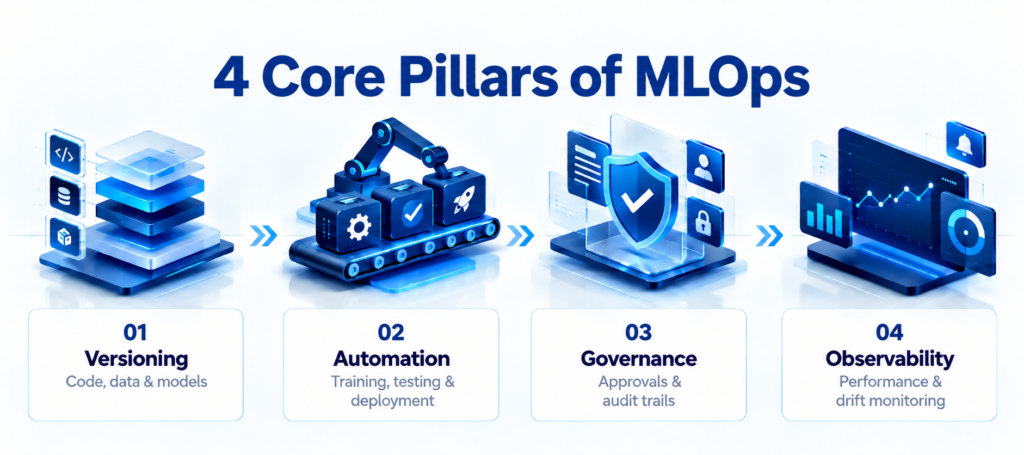
Core Pillars of MLOps Best Practices
- Versioning everything: code, datasets, features, parameters, and model artifacts
- Automation: training, testing, and release steps that run the same way every time
- Governance: approvals, audit trails, and access rules before a model goes live
- Observability: live visibility into data quality, predictions, and business impact
Follow these MLOps best practices and shipping a model feels as routine as shipping a software update.
How MLOps Differs From Traditional DevOps
DevOps ships code. The code, data, and models all go together into an MLOps ship and then are monitored. It’s for this reason that MLOps best practices must also include dataset versioning, reproducible training, and statistical testing, on top of the standard CI/CD.
What Explains Why AI Pilots Fail to Scale?
Most pilots do not fail due to the inferiority of the model. The failures are due to the fact that nothing around the model was built to last! At least 30% of generative AI initiatives will reach the end of proof of concept due to poor data quality, lack of risk controls, rising costs, and unclear business value. Accuracy of the model is not included on that list.
Common Reasons Pilots Stall
These four patterns explain why AI pilots fail to scale:
- Produce work in a notebook bound: the model exists only on one laptop, and there is no path to production.
- Messy data handoffs: training data being different from live data, resulting in lower accuracy after launch.
- No owner after launch: no one is responsible for monitoring, retraining, or incidents
- Fuzzy business goals: Pilot was a success on whether the model was worth funding.
How MLOps Best Practices Close the Gap
Early adoption of MLOps best practices eliminates ad hoc handoffs and installs versioned, tested,d and owned steps. The solution to the problems that AI pilots are not able to scale is not typically the algorithms. Well, it’s a matter of discipline in the operations.
What Does an ML Model Deployment Pipeline Look Like?
A pipeline is a series of stages that are performed in sequence, with an ML model being deployed at each stage and a quality check at each stage. A model can only proceed with the next test if it succeeds on the previous test.
Stages of a Reliable ML Model Deployment Pipeline
- Data validation: check schema, missing values, and unexpected shifts
- Training and tracking: log every run, parameter, and metric
- Evaluation: test against a baseline and compliance thresholds
- Packaging and registration: containerize the model and store it with metadata
- Staged release: use shadow, canary, or A/B patterns, not 100% of traffic at once
- Rollback: keep the previous version one command away
Automation With CI/CD and Continuous Training
This flow is one of the quickest to pay off of all MLOps best practices. Changes in data require continuous training, and changes in code require CI/CD. They eliminate manual handoffs, reduce time to release, and ensure an audit trail. The same goes for a mature ML model deployment pipeline: it works on a Friday evening just as well as it does on a Monday morning. In that regard, a mature ML model deployment pipeline is the same on Friday night as it is on Monday morning, and that’s exactly what the best practices of MLOps promise.
What Does a Model Registry Feature Store Setup Do for Your Team?
Most production setups have two components that have different functions. There is a pairing of a model registry and feature store that allows for consistent versions and inputs both when training and serving models.
Model Registry for Version Control
A model registry is the “one true source” for versions of models. It maintains metadata, metrics, lineage, and approval status so that anyone can find out who approved which model and which model is running in production. One of the key best practices for MLOps is a registry, and there are registries available in MLflow, SageMaker, and Vertex AI.
Feature Store for Consistent Inputs
A feature store is a place where feature definitions are stored and can be used to train and serve. Eliminates the quiet bug that exists when a feature is computed differently in a notebook and in production, due to train/serve skew. It can be either Feast or Tecton.
Starting Small With a Model Registry Feature Store
If there are only a few models sharing inputs, smaller teams can start with a registry and include a feature store later. One more pragmatic best practice for MLOps is having a lean model registry feature store setup – that is, create only when you need it to scale.
How Does Model Drift Monitoring Work After Launch?
A deployed model is an old model from the day of deployment. Customer behavior changes, sensors readjust, and new products introduce new data. Before your users can notice, you notice with model drift monitoring.
Signals Worth Tracking
Effective model drift monitoring watches five signals:
- Data drift: input distributions move away from the training data
- Concept drift: the relationship between inputs and outcomes changes
- Prediction drift: output patterns change, even when labels arrive late
- Operational health: latency, error rates, and feature freshness
- Business impact: conversion, fraud losses, or forecast error
Alerts, Thresholds and Retraining Triggers
Choose your thresholds, assign a named owner for alerts, and determine what constitutes rollback and what constitutes retraining. This is one of the most common and regrettable MLOps best practices that teams miss out on. When an attacker changes tactics, for example, a fraud model can become less accurate in a stealthy fashion. Otherwise, you would know about it from the loss report without a drift alert. Sunglasses, for instance, is clearly one job they can take off my hands, and so can AI, Arize, WhyLabs, and Fiddler.
How Are LLMs Changing MLOps Best Practices?
These are the basics that haven’t been replaced by generative AI. It’s pulled them. There are now many platforms that host classic models and fine-tuned LLMs via a single registry and monitoring layer.
Prompt, Evaluation and Cost Controls
Next to code, prompt and retrieval are set as a team; automated evaluations are run before each release; track token cost and latency. Accurate tests and guardrails for safety and hallucinations are released in the same release gates.
Drift in Generative Systems
The shapes of model drift monitoring also evolve. Rather than numeric input, be alert to variations in user intent, retrieval quality, and answers that deviate from source material. Do not create a parallel deployment pipeline when extending the existing ML model deployment pipeline.
How Do You Move From POC to Production AI?
The process from POC to production is primarily a readiness exercise and not a modeling exercise. It’s the moment when MLOps best practices go from nice-to-have to must-have.
Readiness Checklist for POC to Production AI
Before making this a pilot available for promotion, conduct each pilot through this checklist. It captures the most important hand-off best practices from the MLOps space:
- Is the business metric defined, with a baseline to beat?
- Can the training data be refreshed automatically?
- Is the model packaged, versioned, and reproducible?
- Who owns monitoring, retraining, and incidents?
- Which security, privacy, and compliance sign-offs are required?
If more than two answers are “no,” pause the rollout and fix the foundations first.
Designing the Pilot as Version 0.1
Once teams have implemented MLOps best practices here, they do not typically re-architect their system later, as this pilot was a “thin slice” of the final system. Assume that each POC is a version 0.1 of production AI from the get-go, with logging, tests, and ownership.
What Should an MLOps Platform Comparison Cover?
There’s no single best platform. An honest MLOps platform comparison looks at fit, not feature count.
Platform Options at a Glance
| Approach | Examples | Best for | Watch out for |
| Managed cloud | SageMaker, Vertex AI, Azure ML | Teams committed to one cloud | Lock-in and rising costs |
| Open-source stack | MLflow, Kubeflow, Feast, Airflow | Teams wanting control | Higher engineering effort |
| Unified data and AI platform | Databricks | Data-heavy enterprises | Governance setup |
| Specialist monitoring | Evidently, Arize, WhyLabs, Fiddler | Teams adding observability | One more tool to integrate |
Criteria for Your MLOps Platform Comparison
Run your MLOps platform comparison against the same criteria, ranked by how well each option supports MLOps best practices:
- Compatibility with your cloud and data stack
- Support for LLM workloads as well as classic models
- Governance, access control and audit features
- Total cost of ownership, not just license fees
- The skills your team already has
Following MLOps best practices doesn’t mean buying the biggest platform. It means choosing tooling your team will use.
What Does an AI Implementation Roadmap Look Like?
There is a roadmap that can be followed to implement a useful AI, and each step on that roadmap is accompanied by an exit test. It is based on MLOps best practices and helps prevent successful pilots from becoming rewrites.
Four Phases of the Roadmap
- Find out: choose one use case related to a measurable result and assess data readiness of that use case.
- Prove: Make the prototype using versioned data, experiment tracking, and unambiguous success criteria.
- Production: set up the pipeline, registry, feature store, and monitoring
- Measure: Reuse components; Strengthen governance; and Quarterly cost review.
Keeping the Roadmap Current
This is a guideline, not a guarantee, as data can be more mature for teams with more size. Rather than a painful rewrite, teams can avoid it by following MLOps best practices in phase two instead. Review your AI implementation roadmap every quarter – new AI models, regulations, and priorities are constantly shifting the target.
When Should You Bring In AI Development Services?
While not all businesses require external assistance, the right AI development services can help get from pilot to production much more quickly.
Signs It’s Time
A few signs show your team needs help applying MLOps best practices:
- Pilots keep stalling at the same stage
- Data scientists spend more time on infrastructure than on models
- Compliance or security reviews keep delaying launches
- You’re moving to LLM-based applications and need new skills fast
What to Look for in AI Development Services
You need the right partner to provide more than modeling talent, as they will have experience in production. Search for a team that will create the data layer, develop the pipeline, establish monitoring, and provide documentation that you can run. If you need to build forecast or recommendation engines, then you should bring your Machine Learning skills with you, along with your engineering. Building MLOps best practices early in the game is a good sign of a good AI development service, as it avoids the need to add them on later.
What Should You Do Next?
Moving from POC to production AI isn’t about a smarter model. It’s all about the system around it: pipelines that repeat, registries that maintain versions honestly, and monitoring that catches trouble early. If done correctly, the new models will be faster than the previous ones. Begin with a smaller scope of the implementation of AI. Take one use case, apply the MLOps best practices that are captured in the first sprint, and build on them as they get more stable over time, which is where the MLOps best practices will be compounded. AnavClouds Analytics.ai empowers enterprises to create and operate production-grade AI, spanning a spectrum of Machine Learning and Generative AI applications, along with data engineering and monitoring. Schedule a call today.
What Else Do People Ask About MLOps?
What are MLOps best practices?
MLOps best practices are core practices that help reliably develop, deploy, and monitor ML models. These range from version control to automated pipelines, a model registry, drift monitoring, clear ownership after launch,h and more.
What is the difference between MLOps and DevOps?
DevOps automates software delivery, while MLOps extends it to data, model training, and monitoring. Models degrade as data changes, so MLOps adds versioning, retraining, drift detection, and governance to CI/CD.
Why do most AI projects fail to reach production?
The main reason most projects fail to reach production is the lack of good-quality data, a production pipeline, monitoring, business goals, and ownership. The above gaps are addressed through MLOps best practices prior to scaling up a pilot.
Which tools support MLOps best practices?
Popular options include: MLflow for Experiment Tracking, Kubeflow or Airflow for Pipeline Orchestration, Feast or Tecton for Feature Stores, and Evidently, Arize, or WhyLabs for Production Monitoring.