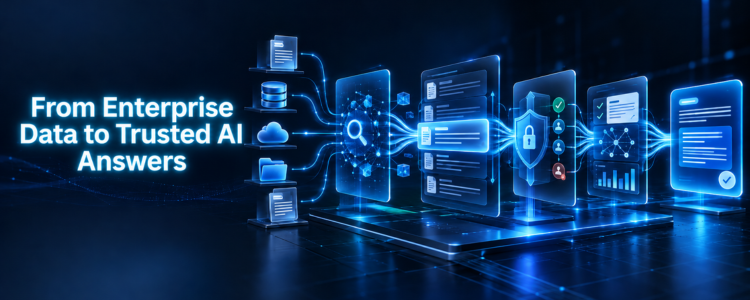

Enterprise RAG architecture is a blueprint that lets a large language model answer questions using your company’s data instead of guessing. Enterprise RAG architecture parses documents, splits them into chunks, and puts them in an index. When a user asks a question, enterprise RAG architecture uses search and re-ranking to find the most relevant passages, and then the model writes an answer that cites those passages, keeping within the user’s access rights. Enterprise RAG architecture. Evaluates every step. This yields answers free from hallucinations, which continue to be relevant without the need for retraining and which have more control over sensitive information. Chunking, vector databases, evaluation, RAG vs fine-tuning, agentic AI security, and a pilot’s habits are covered in the text below.
What is enterprise RAG architecture and how does it work?
Use the Version. A language model has only the things that it has been trained on. This week’s incident report, your contract templates, and refund policy have never been read by a language model. RAG (“retrieval-augmented generation”) addresses this by first retrieving passages and then answering.
It’s that same concept that is implemented when it needs to make the journey inside an organization – Enterprise RAG architecture.
Suddenly there are forty data sources instead of three. Some documents are confidential. Legal wants an audit trail. Finance wants to know what each query costs. Scale and governance turn a weekend demo into engineering.
The momentum is real. Research predicts that organizations will build 80% of their GenAI business applications on the data management platforms they already run by 2028. Read that closely. The value is shifting toward the data layer, and the model is becoming the part.
Why does enterprise RAG architecture matter more than the model you pick?
Because models are. Your data is owned. Today’s best model will be best next quarter, and teams that wired everything tightly around one vendor feel that pain at renewal time. A well‑built enterprise RAG architecture treats the model like a plug‑in.
Then there is what prompts cannot fix.
- Accuracy: answers are from trusted sources rather than from the model’s memory.
- No retraining is required for changes in the document to update the answer.
- Traceability: All answers can be traced back to their origin.
- Control: You’ll be able to control, down to the document level.
If you don’t think it through, your team typically comes up with a pretty good demonstration that breaks down when it comes to answering real questions.
What are the core layers of an enterprise RAG architecture?
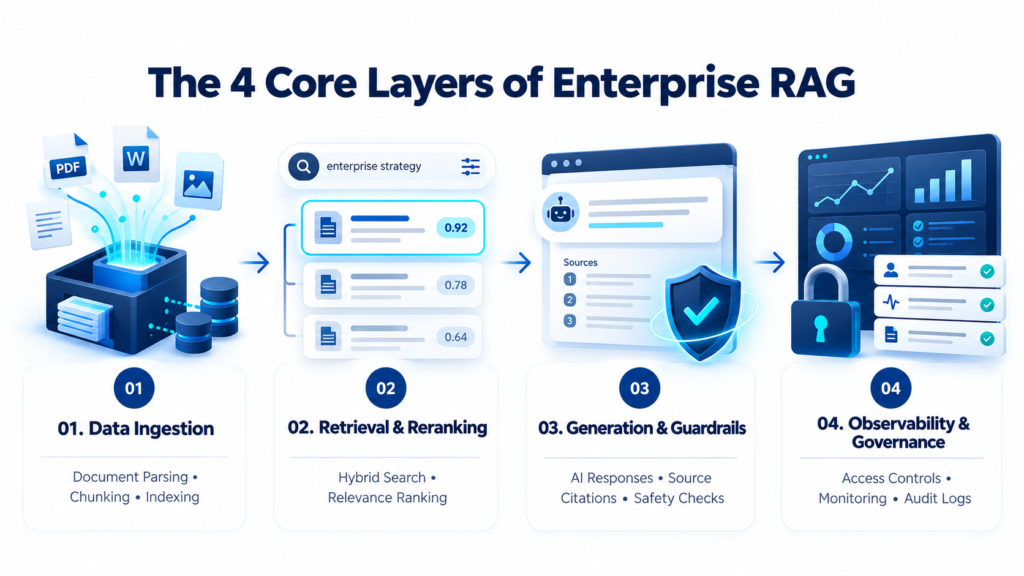
Diagrams usually show four boxes. Production systems have moving parts, but these four layers of an enterprise RAG architecture carry most of the weight.
Ingestion and document intelligence RAG
Your sources are messy: scanned PDFs, tables, slide decks, wikis, CRM notes. Document intelligence RAG adds parsing, layout detection, and table extraction so the system understands structure instead of reading everything as flat text. Bad parsing quietly ruins every step that follows.
Retrieval and re-ranking
RAG retrieval fetches a dozen answers that might be relevant. Each answer is then read next to the question by a re-ranker, which sorts the answers by their relevance. This step involves a hop, but one of the lowest-cost and easiest ways to increase accuracy.
Generation and guardrails
RAG generation needs to respond to the information provided, reference sources of the evidence, and state “I do not know” if the evidence is weak. The output is guarded to catch any policy violations. They check that claims are supported by the sources.
Observability and governance
On launch day, RAG observability begins. You will require logs for all queries, feedback buttons, and access rules that will be able to withstand an audit. Making this layer early is much easier than making it later.
How do you build a RAG chunking strategy that holds up?
Chunking is the decision that quietly caps your quality. Cut documents into pieces, and each piece loses its context. Cut them large, and the answer drowns in noise while your token bill climbs.
A solid RAG chunking strategy usually comes down to a few habits:
- Respect structure: Divide the document according to its structure (headings, sections, paragraphs) instead of by how many N characters there are.
- Include overlap: Allow some overlap between neighboring chunks – do not cut ideas in half.
- Attach metadata: Associate metadata to each chunk: source, date, owner, and those who can view it.
- Use parent-child chunks: Retrieve small pieces, then hand the model the larger surrounding section.
- Content tune: Tune the contracts, FAQs, and code differently, as they read differently.
No magic chunk size. Anyone quoting one is guessing. Take fifty user questions, try three setups, and keep whichever retrieves best. That one experiment does more for your enterprise RAG architecture than another week of model comparisons.
Which vector database wins in a vector database comparison enterprise teams can trust?
Honestly, none of them wins everywhere. A fair vector database comparison enterprise buyers can act on should score each option against your own needs, not a vendor’s benchmark.
Criteria worth scoring
- Scale and latency: performance at your real document volume and query load.
- Hybrid support: native keyword and vector search in one query.
- Metadata filtering: fast filters for permissions, dates, and departments.
- Security: encryption, role-based access, and tenant isolation.
- Deployment: managed cloud, self-hosted, or inside your private network.
- Cost: storage, compute, and the engineering time to run it.
Common options
For teams looking for minimal hassle, Pinecone managed services offer a solution. Open-source engines such as Qdrant, Weaviate, and Milvus are flexible and self-hostable. For smaller workloads, if you already have PostgreSQL, there’s pgvector; and search platforms such as Elasticsearch offer the functionality of keyword search + vectors. Consider implementing the best two before going forward with an enterprise RAG architecture stack.
Why is hybrid search RAG the production default?
Vector search understands meaning. Ask about “time off”. It finds the annual leave policy. Ask for policy HR‑2291. It may shrug because exact strings are not its strength. Keyword search (BM25) is the opposite: great with codes, names, and acronyms, but blind to paraphrasing. Hybrid search RAG runs both. Merges the results so you get meaning and precision together.
A typical flow looks like this:
- Run keyword and vector searches in parallel.
- Merge the two lists, with reciprocal rank fusion.
- Re-rank the list with a cross‑encoder.
- Send the best handful of passages to the model.
The re-ranker adds latency, and it is usually worth it. Knowledge graphs can help with multi‑hop questions. Only add one when your questions demand it. Begin with retrieval in your enterprise RAG architecture and add complexity when your evaluation numbers demand it, not before.
Which RAG evaluation metrics should you track?
Teams never test, and then spend months debating issues related to the system “feeling” better. RAG evaluation metrics allow breaking the problem into two parts: retrieval, finding the material, and using it appropriately.
Retrieval metrics
- Context precision: how much of what was retrieved is actually useful.
- Context recall: whether the needed information was retrieved at all.
- Hit rate and MRR: how high the right passage ranks.
Generation metrics
- Faithfulness: whether the answer stays within the retrieved evidence.
- Answer relevance: whether it addresses the question asked.
Operational metrics
- Latency, cost per query, and user feedback signals.
Construct a “test set” of actual questions, perform analysis using tools such as RAGAS or TruLens, and prevent releases that lower faithfulness. Run tests with an LLM, but validate with human reviewers, to increase the speed of testing. It’s that discipline which makes an enterprise RAG architecture reliable in the long term.
RAG vs fine-tuning: which one should you choose?
Different tools for jobs. RAG vs fine-tuning is not really a competition but more of a question about how things are arranged within your company’s RAG system.
Use RAG where the information is subject to frequent change, references are required for the answers, or when data is important.
Use tuning when you wish to speak in a particular manner, you would like to display the output in a particular manner, or if the original model is not good at certain words.
Both when both features are desired, both to adjust the model’s properties and to extract the facts. One sentence says it all: RAG is the model’s way of learning what it knows, while fine-tuning is the model’s way of learning how to speak. When solving business knowledge questions, use RAG as the starting point. It’s an easier, more cost-effective process to change.
How does Agentic AI security change enterprise RAG architecture?
A chatbot that answers is embarrassing.. An agent that takes the wrong action can be costly. Agents plan steps and call tools. When they write to systems, every weak point in your enterprise RAG architecture becomes more dangerous. The problem grows in scale.
The main risk is injection. This means instructions inside a document that a RAG system retrieves. These instructions can push the model off course. OWASP says neither RAG nor fine-tuning can fully stop injection. Why? Because the retrieved text ends up in the model’s context alongside the trusted instructions. Imagine a PDF that tells an agent with CRM access to export every contact. That is the kind of situation you must protect against.
Agentic AI security depends on rules:
- Least privilege: Give each agent only the access it needs for its job.
- Permission-aware retrieval: Filter what gets retrieved using the user’s permissions before the model sees any text.
- Human approval: Require approval for actions that have an impact.
- Source vetting: Cap how often an agent can call sensitive tools.
- Rate limits: Rate limit sensitive actions. Record every tool call.
- Audit logs: Record every retrieval and tool call for later review.
Enforce all these rules in the code and infrastructure outside the model. A phrase like “Please be safe” in a system prompt is not a control. It is not enough.
What RAG pipeline best practices should every team follow?
These are some of the most commonly successful RAG pipeline best practices:
- Start narrow: Choose one use case that is of high value. Put it in the trunk before filling it up.
- Clean your data first: Eliminate duplicates, obsolete, and incompatible versions.
- Evaluate from week one: Assess performance before changes in week 1.
- Cache wisely: Take advantage of caching to store answers to frequently asked questions to reduce costs and improve response time.
- Keep sources fresh: Automate re-indexing of documents when they change.
- Plan for feedback: Allow users to provide their answers and incorporate those answers into testing.
- Design for permissions early: It’s a pain and a waste of time to try to add access control after.
All of this is not smart. That is the point. If a business can sustain these things year after year, it has a durable enterprise RAG architecture; if not, then it can be rebuilt annually.
When should you bring in an AI development company?
The prototypes are very low cost, but production can be very costly. Seek assistance if your data is in systems that have compliance rules, and if no one on your staff has previously created retrieval and evaluation. The first step in creating any AI development company is to begin with the problem that the company is trying to solve. It’s all about the tools. Create a prototype of your enterprise RAG architecture. Then, it gives you a solution that your team can operate! Inquire about their experience in ingestion, retrieval, evaluation, and security. You don’t have to have a smooth demo; it’s not all that important.
Bottom Line
The greatest enterprise RAG architecture is not the one that has the parts. It is the one that retrieves the information with respect to permissions and verifies the quality of data. Use data, chunking, hybrid retrieval, and evaluation from the beginning. Add features and security as use cases are added. Keep measuring progress. Teams that consider RAG to be a living product. Not a project of one off. Achieve the results. For every build, design and scale this with the help of certified AI experts & results driven delivery, AnavClouds Analytics.ai has got your back. Give them a call to get started with your RAG roadmap today.
FAQs
What is enterprise RAG architecture?
Enterprise RAG architecture is an architecture that is a system. Relates a language model to data from a private company. The layers are ingestion, retrieval, generation, security, and monitoring. This design provides credible, referenced, and permissioned responses at business scale today.
What is the difference between RAG and fine-tuning?
RAG gets the information when there is a query. Fine-tuning comes when you use data to train a model, which fine-tunes its behavior. RAG is best used for knowledge. Tone, format, and domain-specific language are best suited for fine-tuning.
Which vector database is best for enterprise RAG?
There is no best. Select based on scale, hybrid search, metadata filtering, security, deployment requirements, and cost. Test out your decisions with actual data from your business.
How do you evaluate a RAG system?
Assess retrieval measures with accuracy and precision in context. Assess generation for faithfulness and relevance of the answer. Test on a labeled question set before each release. Track latency, expense, and user feedback.