

LLM Inference Cost Optimization is the practice of reducing what enterprises spend on running large language models in production. It combines model routing, prompt and token efficiency, caching, and FinOps for AI governance to control spend as usage scales across teams.
Additionally, AI spending is forecast to hit $2.59 trillion in 2026, a 47% jump, with inference the fastest-growing slice. If your invoice keeps climbing even as you ship fewer new features, this guide explains why. It also shows what you can do about it.
What Is LLM Inference Cost Optimization?
Essentially, LLM inference cost optimization means paying only for the compute and tokens that create business value. As a result, every time a model generates a response, you’re billed for input and output tokens plus API infrastructure. As models get embedded into more workflows, agents, and customer-facing tools, that per-call cost multiplies fast.
Why LLM Inference Cost Optimization Isn’t Just “Use a Cheaper Model”
Done well, LLM inference cost optimization isn’t about downgrading to a cheaper model everywhere. It’s about matching model capability to task complexity, cutting redundant token usage, and building visibility into where spend is going.
Who Owns LLM Inference Cost Optimization Inside an Enterprise?
Teams that treat LLM inference cost optimization as an ongoing discipline, rather than a one-time audit, see the biggest and most durable savings. Engineering owns the technical levers, finance owns budget tracking, and product owns the quality bar, working from one shared dashboard.
Which Industries Need LLM Inference Cost Optimization the Most?
Any enterprise running high-volume, customer-facing, or agentic AI workloads feels the pressure to prioritize LLM inference cost optimization sooner rather than later.
Regulated Industries Feel It First
Financial services and healthcare organizations, which layer compliance and human review on every model call, see costs compound fastest. Each review step, audit log, and guardrail adds to the real cost of a single inference call.
High-Volume Consumer Industries Feel It at Scale
Retail and e-commerce teams running real-time recommendation or support agents hit scale issues quickly, since traffic spikes translate directly into token spikes. Telecommunications, manufacturing, and BFSI enterprises running large customer support or document-processing pipelines also see outsize returns from LLM inference cost optimization, simply because call volume is so high that even small per-call savings compound into significant monthly reductions. The more central LLMs are to daily operations, the sooner a structured cost plan pays for itself.
Why Is My AI Bill Going Up?
This is the question most finance and engineering leads are asking right now. Token prices per model have fallen dramatically over the past two years, yet total enterprise AI spend keeps rising. The disconnect behind “why is my AI bill going up” comes down to volume, not price.
The Real Reasons Behind “Why Is My AI Bill Going Up”
- Agentic workflows multiply calls. A single user request can trigger 10 to 20 chained LLM calls behind the scenes, each consuming tokens.
- Output tokens cost more than input tokens. Many teams still price input and output equally, even though output generation is usually much more expensive.
- Context windows keep expanding. Longer chat histories, RAG retrieval, and system prompts inflate the input side of every call.
- No routing logic. Sending every query, simple or complex, to your most expensive frontier model wastes budget on tasks a smaller model could handle.
The Fix for a Rising AI Bill
Without LLM Inference Cost Optimization built into your architecture from day one, these factors compound quietly.
As a result, the monthly invoice becomes impossible to ignore.
This usually happens as several small costs stack up unnoticed.
That is why the question ‘why is my AI bill going up’ is common among teams that skipped this step.
What’s Driving AI Cost Optimization Enterprise-Wide in 2026?
AI cost optimization enterprise priorities have shifted from “can we build this?” to “can we afford to run this at scale?” Inference has overtaken raw infrastructure to become one of the largest line items in enterprise AI budgets, trailing only talent costs at many organizations.
Three Forces Pushing AI Cost Optimization Enterprise-Wide
- Boards want ROI proof: AI spend is now scrutinized the way cloud spend was a decade ago, and AI cost optimization enterprise programs are increasingly reported at the board level.
- Agentic AI is scaling token consumption: Multi-step agents can use five to thirty times more tokens than a single prompt-response interaction. That’s why Agentic AI ROI evaluation is necessary.
- Hidden costs are surfacing: Vector database storage, observability tooling, and human review loops in regulated workflows all add to the real cost of running models, well beyond the API invoice.
Making AI Cost Optimization Enterprise Standard Practice
For enterprises serious about AI cost optimization enterprise-wide, this means cost visibility has to sit alongside model performance as a core success metric, not an afterthought. A quarterly AI cost optimization enterprise review, tied to the same cadence as cloud cost reviews, keeps this from slipping.
How Do You Reduce OpenAI API Costs Without Sacrificing Quality?
Teams asking how to reduce OpenAI API costs (or costs from any major model provider) usually assume the only lever is switching to a cheaper model. That’s rarely the full picture.
Four Ways to Reduce OpenAI API Costs
Prompt compression
Trimming unnecessary context, boilerplate instructions, and repeated system prompts can shrink input tokens by 30% to 50% with no quality trade-off, one of the fastest ways to reduce OpenAI API costs.
Semantic caching
Instead of only caching identical queries, semantic caching recognizes similar intent and serves a cached response instead of triggering a fresh model call. This alone can cut API call volume significantly for high-traffic applications.
Batch processing
For workloads that tolerate a short delay, batch inference costs far less than real-time calls. It offers teams an easy lever to cut OpenAI API costs without changing their model.
Output length limits
Since output tokens are the more expensive half of the equation, capping response length for tasks that don’t need long-form answers adds up fast across millions of calls.
Why These Techniques Work Together
Together, these techniques underpin practical LLM inference cost optimization, while none require ripping out your existing stack.
What Is Model Routing and How Does It Save Costs?
Model routing cost savings come from a simple idea: not every query needs your most powerful, most expensive model. A routing layer classifies incoming requests by complexity and sends each one to the right-sized model.
How Model Routing Cost Savings Actually Work
Smaller, cheaper models handle simple tasks such as formatting, basic classification, or short extraction. Complex reasoning, nuanced generation, or multi-turn dialogue gets routed to frontier models. Enterprises that implement this well report diverting the majority of routine traffic away from premium models with minimal quality loss.
Why Model Routing Cost Savings Compound Over Time
This is one of the highest-leverage forms of LLM inference cost optimization available today, because it doesn’t ask you to compromise on the tasks that genuinely need a stronger model. It simply stops paying frontier prices for work a lighter model can do just as well. Pairing model routing cost savings with semantic caching compounds the effect further, since fewer queries reach any model at all, and the model routing cost savings grow as traffic volume grows.
How Do You Set an Agent Token Budget?
As agentic workflows become standard, an agent token budget is no longer optional. Without one, a single agent can spiral through dozens of chained calls on a task that should have taken three or four steps.
Practical Ways to Set an Agent Token Budget
- Cap the maximum number of tool calls or reasoning steps per task.
- Set a hard token ceiling per session, with graceful fallback behavior when it’s hit.
- Monitor cost-per-completed-task, not just cost-per-call, so you can spot inefficient agent chains early.
- Build in circuit breakers that halt runaway loops before they hit production.
What a Good Agent Token Budget Delivers
An enforced agent token budget turns unpredictable agent spend into something finance can forecast, and it’s quickly becoming a standard pillar of enterprise LLM inference cost optimization strategy. Teams that skip setting an agent token budget are usually the same ones surprised by their invoice at month-end.
What Does FinOps for AI Actually Look Like in Practice?
FinOps for AI extends the discipline that cloud teams already know- allocation, forecasting, and accountability- into the world of tokens and model calls. It’s the governance layer that makes LLM inference cost optimization sustainable rather than a one-off cleanup project.
The Four Pillars of FinOps for AI
- Visibility first. Tagging every LLM call by team, product, or use case so spend can be attributed, not just totaled.
- Budgets and alerts. Setting spend thresholds per project with real-time alerts before overruns happen.
- Regular cost reviews. Treating model and routing choices as living decisions, revisited quarterly, not locked in at launch.
- Cross-functional ownership. Getting engineering, finance, and product aligned on what “acceptable cost per outcome” means.
Why FinOps for AI Has to Start Early
Organizations that build FinOps for AI into their operating model from the start avoid the scramble that happens when a finance team discovers a runaway bill three months in. It replaces reactive fire drills with a predictable, repeatable process, and it’s the same reason FinOps for AI is increasingly a named role rather than a side responsibility.
What Role Do AI Development Services Play in Cost Optimization?
Not every team has the bandwidth to redesign inference architecture, build routing logic, and instrument cost observability while shipping product. This is where specialized AI development services add measurable value.
What Good AI Development Services Bring to the Table
Experienced AI development services bring pre-built routing frameworks, caching architectures, and FinOps dashboards that would otherwise take months to build internally. They’ve also seen the failure patterns before, so cost controls get designed in from the prototype instead of bolted on later.
Choosing AI Development Services for Cost Optimization
For enterprises trying to move fast without inheriting an unpredictable AI bill, working with a team that specializes in AI development services and LLM inference cost optimization is often faster than solving it alone. The right AI development services partner treats cost as a design constraint from day one, not a cleanup task later.
What Are the Best LLM Inference Cost Optimization Techniques to Start With?
If you’re prioritizing where to begin, start with the LLM inference cost optimization techniques that deliver the fastest, lowest-risk wins.
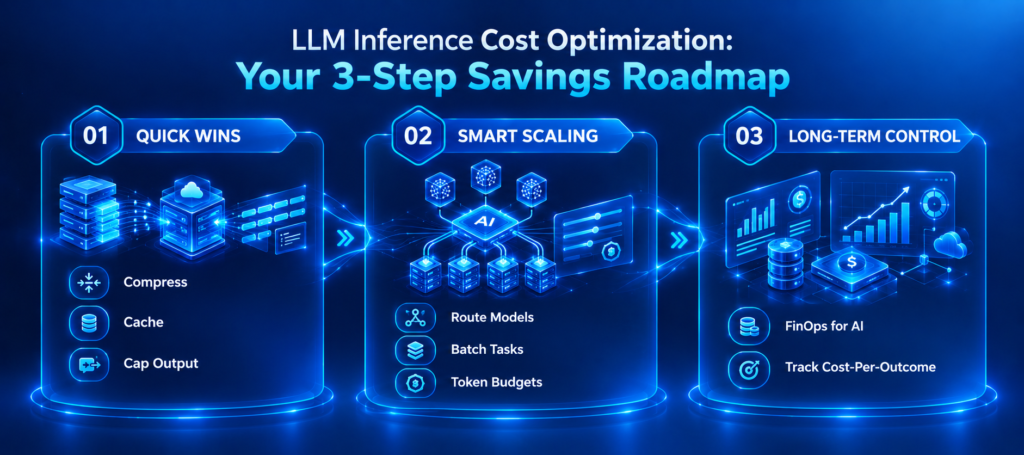
Quick Wins (Implement First)
- Prompt compression and de-duplication
- Semantic caching for repeated or similar queries
- Output length caps on high-volume endpoints
Medium-Effort, High-Impact
- Model routing based on task complexity
- Batch processing for latency-tolerant workloads
- Agent token budgets with monitoring
Strategic, Longer-Term
- Full FinOps for AI governance framework
- Cost-per-outcome dashboards tied to business metrics
- Periodic model and vendor re-evaluation as pricing shifts
This phased approach lets teams show savings quickly while building toward a more mature, governed system over time.
How Do You Measure Whether Your Cost Optimization Strategy Is Working?
Tracking the right metrics matters as much as implementing the techniques themselves. Cost-per-call tells you little on its own.
Metrics That Actually Show LLM Inference Cost Optimization Progress
- Cost per completed task or resolved ticket, not just cost per API call
- Input-to-output token ratio, since pricing this uniformly is a common blind spot
- Percentage of traffic routed away from premium models
- Cache hit rate across semantic and exact-match caching layers
Reading the Signals
When these metrics trend the right way month over month, it’s a strong signal your LLM inference cost optimization program is working, not just shifting costs around. If they stall, one lever- routing, caching, or budgeting, isn’t pulling its weight.
Final Thoughts
LLM inference cost optimization isn’t a one-time fix; it’s an operating discipline that has to scale alongside your AI usage. The enterprises pulling ahead in 2026 are the ones treating token spend with the same rigor they apply to cloud infrastructure: measured, routed, budgeted, and reviewed regularly. Whether you’re just getting visibility into your first cost spike or building a full FinOps for AI program, the earlier these controls go in, the less painful the invoice becomes. At AnavClouds Analytics.ai, we help enterprises design AI development services and inference architectures that keep performance high and costs predictable, so scaling AI never means losing control of the bill.
Frequently Asked Questions
What is LLM inference cost optimization?
LLM inference cost optimization is the practice of reducing the cost of running large language models in production, using techniques like model routing, caching, and token budgeting, while maintaining response quality for end users.
Why is my AI bill going up even though token prices are falling?
Usage volume is outpacing price drops. Agentic workflows, longer context windows, and unrouted queries to expensive models all multiply token consumption faster than per-token prices are declining.
How much can enterprises typically save with cost optimization?
Reported savings vary by workload, but many enterprises applying LLM inference cost optimization see meaningful reductions in inference spend using prompt compression, caching, and routing together, without measurable drops in output quality.
Do I need to switch AI vendors to reduce costs?
No. Most savings come from architecture changes, routing, caching, batching, and budgeting, applied to your existing provider, rather than switching vendors entirely.