
Every business today is sitting on data. The real question is — how many of them actually know what to do with it?
Most organizations gather more data than they analyse. It’s all transactions, customer behavior, operational logs, market signals, etc. But when it comes time for leadership to make a decision on pricing, inventory, hiring, or market entry, far too many teams are still going with their gut or last quarter’s spreadsheet. The disconnect is precisely why data analytics services have come to be among the fastest-growing investment priorities throughout industries in 2026.
In this blog, we will be going over what exactly modern data analytics services entail, how AI has influenced business intelligence, the concept of predictive analytics in various industries and the difference between a truly serviceable data analytics partner and a dash-and-go.
What Do Data Analytics Services Actually Include — And Why Does It Matter?
There’s a common misconception that data analytics services are just about building reports or visualizations. The scope is much broader — and the value compounds across layers. Here’s what a mature data analytics services engagement typically spans:
Data Engineering Services
Data has to flow, fix itself and drop at the correct spot before any analysis can be performed. Data engineering services creates the pipelines, cloud architectures and integration frameworks to make the raw data usable. If this layer is not present, then despite the best use of sophisticated analytics tools, the results will not be reliable.
Business Intelligence Development
This is where most people picture analytics — dashboards, KPIs, performance reports. But modern business intelligence development goes well beyond static charts. It creates dynamic, connected views of business performance that update in real time and speak directly to the decisions teams are making.
Predictive Analytics Services
Rather than reporting what happened, predictive analytics services forecast what’s likely to happen next. By applying machine learning models to historical and real-time data, businesses can anticipate customer churn, supply chain disruptions, revenue fluctuations, and more — before they become problems.
Data Strategy Consulting
Technology alone doesn’t create data-driven organizations. Data strategy helps businesses define what they’re trying to solve, which data sources matter, how governance should work, and how analytics investments should be sequenced to deliver meaningful ROI.
AI in Data Analytics
This is the layer that’s changed most rapidly. AI in data analytics means embedding machine learning, NLP, and automated modeling directly into analytics workflows — so insight generation happens continuously rather than in scheduled reporting cycles.
These capabilities work best when they’re connected. Fragmented tools with no underlying strategy rarely deliver what organizations hope for. That’s why data analytics services, at their best, function as an integrated discipline rather than a collection of separate products.
Why Is AI-Powered Business Intelligence Redefining How Decisions Get Made?
For long, business intelligence was nothing but cranking around the rear mirror. The news was reported. There were dashboards to monitor progress. Helpful, but delayed (and virtually reactive).
AI-powered business intelligence transforms the essence of BI. It’s not merely a record of the past! It uncovers patterns, flags anomalies, makes predictions, and suggests what to do — sometimes before the human analyst realizes there’s a problem.
The global data analytics market is worth $82.23 billion in 2025 and will reach $402.7 billion by 2030, with 79% of CIOs looking to boost their spending on data analytics and business intelligence in 2026, a 25% increase from 2025. No investment signal like that will come without results. Companies that have done so are noticing that decisions are quicker and more often right.
What AI specifically brings to business intelligence that traditional tools can’t match:
- Anomaly detection without manual queries: It’s not until a monthly review that it’s detected by a human, when AI spots a pricing irregularity, a sudden spurt in churn, or a drop in production quality.
- Natural language querying: Business users can ask a plain-English question and receive an instant answer, without requiring a data analyst to take out a report for them.
- Predictive dashboards: Dashboards now display probability-based forecasts and suggested measures of action, rather than past performance.
- Self-improving models: Models update automatically as new data arrives, ensuring insights are always up to date in dynamic environments.
Rather than replacing traditional business intelligence, the adoption of AI-powered business intelligence is a transformation. It’s about shifting the types of questions that organizations can ask — and the speed at which they can respond to them.
What Does Enterprise Data Analytics Look Like When It’s Done Right?
Enterprise data analytics has outgrown the “build some dashboards” phase. Organizations that are genuinely getting value from data in 2026 share a few consistent traits — and they’re worth understanding before making any investment decisions.
They started with strategy, not tools.
The most common reason analytics initiatives underdeliver isn’t a bad tool selection. It’s the absence of a clear data strategy. Organizations that invest in data analytics solutions upfront — defining governance, ownership, use case prioritization, and success metrics — get to value faster and waste less budget along the way.
Their data engineering is treated as a foundation, not a afterthought.
Analytics is only as reliable as the data feeding it. Enterprises that invest properly in data engineering services — clean pipelines, well-structured data models, reliable integrations — see higher model accuracy, faster reporting cycles, and far fewer trust issues with their outputs.
They measure business outcomes, not just model performance.
A predictive model with high accuracy is only valuable if it’s solving the right problem and the results are being used. The strongest enterprise data analytics programs define business KPIs upfront — revenue impact, cost avoidance, churn reduction — and tie every analytics initiative to those measures.
They build data literacy, not just data access.
Self-service analytics only works when people know what to do with what they find. Leading organizations treat data literacy as an ongoing training investment, not a one-time onboarding task. The goal is confident, independent data users at every level of the business.
They treat AI consulting services as a long-term function.
Deploying a model isn’t the end of the engagement — it’s the beginning. AI development services that include model monitoring, drift detection, and retraining schedules are what keep analytics investments delivering value as data and business conditions evolve.
What Business Intelligence Trends Are Shaping 2026?
The BI landscape is shifting quickly. A few trends are defining what leading organizations are building right now:
Generative AI embedded in BI platforms
This has given rise to new tools such as Power BI Copilot, which enables users to create reports, interpret trends, and build narratives using conversational prompts, and Tableau’s AI capabilities, which help users analyze data and visualize it in a narrative. This is driving the uptake of self-service at a good pace.
Real-time and edge analytics
By 2026, 60% of BI queries are expected to use natural language processing interfaces — and real-time processing at the edge is becoming standard in manufacturing, logistics, and IoT-heavy sectors where latency matters.
Agentic AI in analytics workflows
AI agents in data analytics are beginning to take action on insights, not just surface them. Analytics environments that trigger downstream workflows automatically — updating a model, sending an alert, initiating a process — are moving from experimental to production.
Augmented analytics and AutoML
In 2025, the augmented analytics market was estimated to be worth $15.26 billion, and it is projected to grow to $87.03 billion by 2032, indicating that organizations that lack robust data science teams are now able to leverage predictive capabilities through AutoML tools and augmented analytics platforms.
Data governance as an AI prerequisite
The poor data quality is estimated to cost an average of $12.9 million annually to organizations, and as AI is integrated into more analytics processes, the impact of poor data becomes even more significant. Data governance, data contracts, and metadata management have transitioned from compliance to strategic.
How Do You Identify the Right Data Analytics Company for Your Business?
The market for data analytics services is crowded. Choosing the right partner — one that drives outcomes rather than just delivering outputs — requires asking the right questions before signing anything.
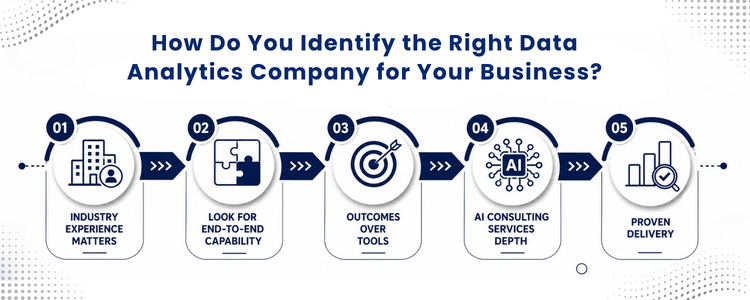
- Industry experience matters more than you’d think. Analytics use cases in regulated healthcare environments carry different requirements than those in fast-moving retail or complex financial services. A data analytics company with relevant domain experience shortens the time to value and avoids expensive mistakes.
- Look for end-to-end capability. Partners who can support the full data lifecycle — from data engineering services and data strategy consulting through to AI development and BI deployment — create more coherent solutions than those who specialize in only one layer.
- Outcomes over tools. The best data analytics services you can work with is one that start by understanding your business problem and work backward to the right technical approach. Be cautious of partners whose entire pitch is centered on a specific platform or technology.
- AI consulting services depth. As AI becomes central to modern analytics, the quality of services embedded in a data engagement matters significantly. Ask specifically how models are validated, monitored for drift, and retrained as business conditions change.
- Proven delivery. References, case studies, and demonstrated results in comparable organizations tell you far more than any sales presentation. Ask to speak to current clients and ask specifically about how challenges were handled — not just what went well.
The right data analytics services partner isn’t a vendor you manage. They’re a strategic extension of your team that helps you see around corners.
What Does a Strong Data Strategy Consulting Engagement Actually Deliver?
To sum up the state of business intelligence trends 2026, there is a ton of value that is enduring, and most often, it’s where companies cut corners to get to implementation early.
A good data strategy engagement will include:
- Current state assessment: objective and honest evaluation of the data, where it is located, the quality of data, and the use of data (or lack thereof) across the organisation.
- Use case prioritization: Prioritize potential measurable business impact to address the analytics problem, and correlate with resources and data readiness.
- Ownership & Governance design: Who owns what data, how quality is maintained & policies on access, privacy, and regulatory compliance.
- Technology roadmap: Suggesting suitable architecture, tooling, and integration path based on the organization’s growth plans, budgets and maturity.
- Measurement framework: setting up KPIs that tie analytics investments to business results, enabling leadership to monitor progress and validate further investment.
Businesses that fail to hire data strategy consultants end up with advanced tools, low buy-in, and data analytics that are irrelevant to the business questions being asked by decision makers. It all flows from the strategy layer.
Conclusion
The gap between organizations that treat data as a strategic asset and those that treat it as a byproduct of operations is widening every year. In 2026, data analytics services have become the infrastructure that separates businesses that lead from those that react. From predictive analytics and AI-powered business intelligence trends 2026 to data engineering services and data strategy, the capabilities are proven, the ROI is measurable, and the right partner makes all the difference. AnavClouds Analytics.ai combines certified AI expertise, deep domain knowledge, and an outcome-driven approach to data analytics services that help enterprises move from raw data to real decisions — faster and with greater confidence.
FAQs
What are data analytics services and what do they include?
Data analytics services collect, analyze and interpret data to help organizations make informed decisions. The ones most commonly mentioned include data engineering, business intelligence, predictive modeling and AI integration, as well as data strategy consulting, across businesses and industries of all sizes.
How is AI changing the way data analytics services work?
The automation of insight discovery, real-time anomaly detection, predictive modeling, and natural language queries can enable data analytics services to deliver forward-looking insights rather than historical reporting with AI.
What is the difference between business intelligence and predictive analytics?
Business intelligence is about monitoring past performance on dashboards and reports. The use of machine learning to predict what will happen or what should happen in the future and make recommendations before it occurs or happens is called predictive analytics.
How do I find the right data analytics company for my business?
Look for analytics services that offer industry-specific experience, end-to-end service, have a track record of delivering results in a comparable client engagement, prioritize business outcomes, and have verifiable results.