
AI workflow automation has transformed the way businesses see it, and it’s happening much quicker than most anticipated. Over the years, the chatter remained in the “pilot phase” – excitement without accountability and a hard-to-quantify ROI. That’s changing now. In 2026, the question isn’t “Does AI Workflow Automation Work?” in 2026. They’re asking how to scale that which is working and remove that which is not. The success of an AI adoption initiative hinges on the approach, the level of implementation, and the selection of the AI consulting services provider. The key to a successful AI adoption journey is in the strategy, depth of implementation, and the choice of the AI consulting services partner. This blog explores exactly what businesses are doing, the drivers for achieving real-world results, and how to create a system of automation that provides measurable and sustainable benefits.
Why AI Workflow Automation Is No Longer Optional for Enterprises
If you’re thinking of AI workflow automation as a future-state project, the data will speak for itself. The surge in AI usage across enterprises is showing signs of picking up, with the adoption rate for task-specific AI agents projected to rise from less than 5% in 2025 to 40% by the end of 2026. Businesses that fall behind are not only being beaten by their competitors, but they’re also being beaten by the standard.
It’s also a financial no-brainer. Businesses experiencing ROI from AI automation are achieving an average ROI of 5.8x within 14 months, with intelligent process automation being integrated into business processes, rather than being added as a standalone tool to business processes. The distinction matters.
The reality is that AI workflow automation has become a lot more mature. Previous generations of automation were mostly rule-based, rigid, brittle, and very expensive to maintain. The enterprise AI solutions of today leverage large language models, agentic reasoning, and real-time data processing to perform complex, multi-step workflows without much effort from humans. This evolution is what’s enabling ROI from automation at scale.
Does anyone know what the Real Cost of Broken Enterprise Workflows is?
But before you get into the nitty-gritty of how AI workflow automation works, it’s important to understand the real cost of shoddy workflows. Manual handoffs, disparate systems, and repetitive data entry aren’t just time-consuming—they compound errors, sap employee productivity, and expose compliance risk.
This inefficiency compounds in enterprises with teams in several business units and in various geographic locations. Customer onboarding that takes two weeks instead of two days. Invoice approvals that bounce between inboxes. HR processes that rely on spreadsheets nobody fully trusts. All of these are workflow issues — and AI workflow automation is the answer that’s growing in popularity.
Far more pressing is the fact that many organisations have attempted to automate these processes using the legacy RPA tools but are reaching a ceiling. Traditional RPA can work well with structured and repetitive tasks but struggles with situations where data sources are inconsistent, exceptions occur, or systems don’t communicate seamlessly. This is where the new generation of AI workflow automation, using a form of reasoning that can deal with ambiguity, works a lot better than the old generation.
What Enterprise AI Workflow Automation Actually Looks Like in 2026
Agentic AI: Autonomy That Goes Beyond Scripts
The most significant shift in enterprise workflow automation right now is the rise of agentic AI. These aren’t chatbots or simple trigger-response automations. Agentic AI systems can break down a goal into sub-tasks, select the right tools, execute across multiple systems, handle exceptions, and deliver an outcome — all without step-by-step human instruction.
In practice, this means an AI agent can handle the full arc of a workflow: from pulling data across systems, applying business logic, escalating edge cases appropriately, and logging outcomes — end-to-end. According to a report, agentic AI could drive approximately 30% of enterprise application software revenue by 2035, signaling that this isn’t a niche capability — it’s the direction the entire enterprise software market is heading.
For businesses evaluating enterprise AI implementation, the key question isn’t whether to adopt agentic AI — it’s which workflows to target first and how to sequence adoption without disrupting operations.
Intelligent Orchestration Across Departments
AI-driven workflow automation has come a long way from one-dimensional applications. Modern enterprise AI solutions allow for intelligent orchestration, which is a single layer that unifies all automation across all departments, systems, and decision points in a single breath.
Intelligent orchestration consolidates all of these into one tool to be used by Finance, not HR, and not Operations, but by one. AI workflow automation is the glue that holds it together: Approving, routing, triggering downstream actions, and uncovering insights–all under a unified governance.
This is particularly effective for companies with cross-functional processes such as customer contract renewals that involve Sales, Legal, Finance, and Customer Success. AI can speed up processes that can take weeks to hours.
Self-Optimizing Workflows
A feature that’s not always considered in today’s AI workflow automation is its ability to learn over time. Static automation processes are automated forever, whereas AI-backed workflows can review and monitor their own actions, detect the bottlenecks, and propose or even implement refinements.
This is useful because business conditions evolve: volumes increase, product lines go through changes, and compliance requirements change. A dynamic AI-based workflow system minimizes ongoing maintenance requirements and ensures that performance remains in sync with business performance and outcomes, not at the time of launch.
Building an AI Automation Strategy That Delivers ROI
1. Start With the Right Workflows, Not All Workflows
Another frequent pitfall of enterprise AI is attempting to automate in too wide and too quick a manner. Only 28% of AI use cases are successful and deliver ROI expectations, according to a survey of 782 I&O leaders — and that’s not because the technology failed. Bad workflow selection and expectations.
The ideal workflows are those that have three characteristics:
- High volume – enough repetitions to make a case for the economics of automation
- Measurable outcomes – clear metrics to measure before and after performance
- Moderate – complex enough that automation is useful, but not so much that the AI model must be fine-tuned for years to be useful
Across industries, the typical areas where AP automation excels are accounts payable, employee onboarding, handling customer support tickets, compliance reporting, and data reconciliation.
Define Your AI Automation ROI Framework Before You Build
AI Automation ROI cannot be measured. Set measurable goals for the AI workflow automation implementation: cost per transaction, error rate, processing time, headcount per workflow, customer satisfaction scores. These baselines enable measurement of actual impact rather than estimated impact.
Structured ROI (ROI) models that make connections between specific automation investments and specific measurable outcomes yield a median ROI of 320% over three years, with contact center use cases seeing payback in 6-9 months and back-office use cases in 9-18 months, according to data from NiCE.
The distinction is whether the automation project is renewed or defunded after the first year.
Address the Data Problem Early
Data quality is the top challenge for 52% of organizations when it comes to implementing AI. AI workflow automation doesn’t work well with inconsistent, incomplete, or siloed data. However, scaling automation requires companies to prioritize data hygiene, integration architecture, and governance frameworks to provide AI systems with reliable inputs.
The technical aspects of integrating AI systems, such as AI integration services, connecting different systems, normalizing data flows, and building clean pipelines, can make or break the success of automation initiatives. This is a basic requirement, NOT an option.
Industry Spotlights: AI Workflow Automation Across Sectors
Financial Services
Banks and insurers are applying AI workflow automation to loan processing, claims adjudication, compliance reporting, and fraud monitoring. AI-powered loan processing has achieved a 90% increase in accuracy and a 70% reduction in processing times, with approval timelines compressed from days to under a minute. For financial institutions with high transaction volumes, the automation ROI compounds quickly.
Healthcare
Healthcare organizations are using AI workflow automation to streamline prior authorizations, clinical documentation, and administrative scheduling. According to recent statistics, 94% of healthcare organizations now consider AI core to their operations, reflecting how deeply automation has embedded itself into clinical and administrative workflows. Reducing administrative burden means clinicians spend more time on patient care — an outcome with both financial and human value.
Retail and E-Commerce
Inventory management, demand forecasting, customer service automation, and personalized recommendations are all driven by AI workflow automation in retail. During peak periods, AI systems absorb volume spikes that would otherwise require significant seasonal headcount — a direct and measurable automation ROI benefit.
Manufacturing
AI workflow automation is driving real-time quality control, predictive maintenance scheduling, and supply chain coordination. Physical AI — autonomous systems that perceive and adapt to real-world conditions — is enabling smarter production lines that catch defects earlier and reduce unplanned downtime.
The Human Side of AI Adoption for Business
Implementing AI in the enterprise is not just a technical exercise. Most automation programs lose momentum or fail in the organisational side (change management, training, governance, and culture).
But employees are three times as likely to be using AI tools for at least 30% of their work as leaders believe, meaning AI adoption is taking place outside of formal programs. Structures for building governance and training are in place where employees are, not where leadership thinks they are.
To maximize the value of AI workflow automation, staff need to see it as a tool for boosting their productivity rather than as a replacement for them. Coaches who understand how to collaborate with AIOs, understand what they are generating, and know how to take the process to the next level are multipliers for the value of the investment in AIOs.
Always involve these elements in the AI automation strategy conversation: ownership, handling of exceptions, output audit, and review of performance. These are not questions for a bureaucrat; they are the difference between a smoothly functioning automation and an automation that slowly slides away from its intended purpose.
What to Look for in an AI Consulting and Development Partner
For most enterprises, building AI workflow automation capabilities in-house from scratch is neither practical nor the fastest path to ROI. The right AI consulting services partner brings three things: technical depth across the full automation stack, domain knowledge in your industry, and a methodology that prioritizes measurable outcomes over technology showcases.
Specifically, a strong partner in enterprise AI implementation should be able to:
- Map your existing workflows end-to-end before recommending automation scope
- Architect AI integration services that connect your existing systems without requiring wholesale replacement
- Build and deploy AI workflow automation that includes monitoring, exception handling, and performance reporting
- Provide ongoing optimization support — because the best automation programs iterate, they don’t just deploy
AI development services that cover the full lifecycle — from strategy and architecture through deployment and continuous improvement — deliver compounding value. Point solutions deployed in isolation rarely do.
Common Pitfalls That Derail Enterprise Workflow Automation
While some strategies and approaches may be effective, there are certain patterns that consistently hinder the effectiveness of AI workflow automation programs. Watch for:
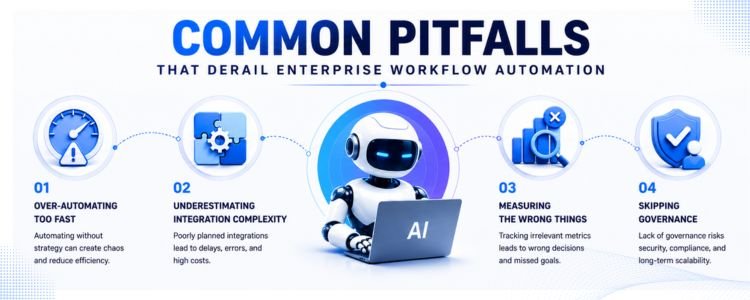
1. Over-automating too fast — Excessive automation can diffuse focus, over-stretch resources, and make it difficult to measure the effectiveness of automated processes. Sequence matters.
2. Underestimating integration complexity — AI integration services for enterprises are actually sophisticated. The architecture for integration is more important than the plug-and-play connectors of ERP, CRM, data warehousing, and legacy systems.
3. Measuring the wrong things — It’s easy to think you have made progress when you track automations deployed, but not the business outcomes they produce. Automation ROI is not about automation numbers; it’s about business impact.
4. Skipping governance – AI workflow automation systems require governance frameworks – who is managing the system, how are errors being identified, when do they need to be escalated to humans? Governance is not an overhead; it’s the thing that makes automation trustworthy over time.
Conclusion
AI workflow automation in 2026 isn’t a technology trend — it’s a business execution priority. Enterprises that treat it as a strategic capability, invest in the right workflows, build proper governance, and partner with experienced implementation specialists are compounding advantages every quarter. Those still waiting for a “better time” are ceding ground that gets harder to recover with every cycle. The path forward is deliberate, data-driven, and grounded in measurable outcomes — not automation for its own sake. If you’re looking to build or scale an enterprise AI automation program that delivers real, trackable results, AnavClouds Analytics.ai brings the technical depth, domain expertise, and outcome-first approach your organization needs to move from strategy to sustained impact.
FAQs
What is AI workflow automation and how does it differ from traditional automation?
Unlike traditional automation, which adheres to predetermined rules, AI workflow automation employs adaptive AI models to manage end-to-end business operations that are complex and unpredictable. Whereas humans need to memorize these exceptions and then adjust accordingly to changing inputs, AI can reason through them, adapt, and get better over time, making it far more capable for enterprise use cases.
How long does it take to see ROI from enterprise AI workflow automation?
ROI periods are dependent on the use case. The ROI for contact centre and customer service automation is usually achieved within 6-9 months, while back-office and compliance automation can take 9-18 months to pay off, depending on the extent of the automation project and the level of efficiency achieved by the implementation.
Which business processes are best suited for AI workflow automation?
The industries that achieve the best ROI from AI automation can be identified by high-volume, rules-based processes with measurable outcomes like invoice processing, employee onboarding, compliance reporting, claims processing, and customer support triage.
Do enterprises need to replace existing systems to implement AI workflow automation?
Not necessarily. AI integration services aim to seamlessly integrate AI workflow automation with the cloud ERP, CRM, and data platform using intelligent middleware and APIs, so that existing infrastructure is not replaced.