
Banks have a lot of data these days, but for years, most of that data has been utilized to describe what has already happened, rather than to predict what might happen in the future. That is changing. Predictive Analytics in banking has gone from a competitive edge to a business imperative, enabling financial institutions to proactively detect fraud, prevent customers from walking out the door, and make better and more informed lending decisions before the first loan is defaulted on. With a value of USD 3.63 billion in 2024, the global predictive analytics in banking market is expected to expand at a CAGR of 20.6% to reach USD 19.61 billion by 2033, as per Straits Research (source). Growth like that doesn’t just occur. In this blog, we will explore how banks are discovering the real and measurable value of data-driven intelligence.
What Predictive Analytics Actually Means in a Banking Context
It’s important to first understand what predictive analytics in banking is before moving on to use cases. It’s not just about running reports or dashboards. The use of statistical algorithms, machine learning within the banking industry, and behavioral data to predict future scenarios, such as a loan default, the likelihood of a fraudulent transaction, or the odds that a customer may be planning to close their account next month.
Banking data analytics is compiled from a variety of sources, including transaction histories, credit bureau information, digital habits, demographic profiles, and, more recently, alternative data, like utility payments or rental records. With predictive modelling, it can be transformed into a forward-looking intelligence engine.
This is a fundamental change. Traditional banking was reactive: You only find out about fraud when it has happened; you accept loans based on customers’ past scores; and you handle churn when customers have already left. However, that is reversed with predictive analytics in banking
Your bank’s next best decision is hiding in your data — find it.
Key Areas Where Predictive Analytics in Banking Creates Real Impact
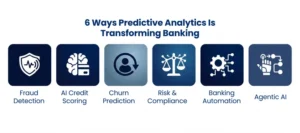
1. Fraud Detection That Works Before Damage Is Done
Predictive analytics has been around for a while in the banking sector, but the capacity to detect fraud has been a complete revolution. Legacy systems only identified transactions based on static rules. Nowadays, behavioral patterns are used in data analytics models that are continually learning and flagging anomalies as they occur in real time.
The results have significance. Machine learning-fueled fraud analytics in banking have proven to be effective at lowering the number of false positives, which is essential as too many bogus alerts can lead to customer annoyance and loss of trust.
Financial institutions are now stacking agentic AI in banking — artificial intelligence that goes beyond simply identifying fraud, but also acts autonomously and under rules and regulations. These agents watch transactions 24/7, automatically learn about new fraud tactics without manual training, and flag cases of fraud for human review when they occur at the edge of their capabilities.
2. AI-Powered Credit Scoring: Beyond the Traditional Model
Credit scoring is undergoing one of its most significant overhauls in decades. The traditional credit score, which is based on a narrow window of a borrower’s financial history, leaves out large portions of the creditworthy population who simply don’t have enough formal credit history.
This is where AI-based credit scoring comes in handy. Machine learning models can create a much more comprehensive picture of a borrower’s financial health by leveraging alternative data, including payments made by the electricity, gas, water, and sewer companies; rentals; professional trajectory; and granular spending behavior.
Retail banking is especially poised to take advantage of this evolution, with predictive analytics being a key area of opportunity. Retail banks have millions of customers, ranging from low to high income, many of whom are underserved by a one-size-fits-all credit model. Dynamic, AI-backed scoring opens up a new class of addressable loans that doesn’t necessarily widen the risk window; the model captures more nuances than less.
The adjustment also affects banks’ tracking of current borrowers. Predictive analytics in banking means that accounts are not reviewed on a set schedule; they are reviewed continually based on risk. The model calculates the borrower’s risk level and adjusts it in near real time if the borrower’s spending or income patterns change, such as if payments are missed on utilities, the bank’s risk profile changes, and it can intervene proactively.
3. Predictive Customer Analytics in Banking: Retention Before Churn Happens
It costs a lot more to acquire a new customer than to keep one. Predictive customer analytics in banking is one of the highest ROI applications for data science in financial services, just for that reason.
Today’s churn prediction models take into account dozens of behavioral metrics, like fewer transactions, fewer app logins, fewer direct deposits, more support calls, and more, and determine which customers are at risk of churning in the next 30 to 90 days.
Personalization is based on the same models. Predictive analytics in banking will not only help determine who’s likely to churn, but what product or service might keep them. In fact, it’s a good idea to make it a personal offering from the customer’s bank, rather than a generic one, and to send it out to a customer just before another bank does, to make the process more likely to lead to a successful outcome.
Predictive analytics in retail banking is leading towards hyper-personalization at scale – the right product, the right channel, the right moment, and for millions of customers at once.
4. Risk Management and Regulatory Compliance
The concept of risk management has always been central to the banking business. Financial data analytics and predictive modeling are about managing risk before it happens, rather than after it happens.
Predictive analytics in banking can help with scenario simulation, running thousands of scenarios simultaneously on loan portfolios, liquidity positions, and exposures to the markets. Banks can detect concentration risks, simulate the effect of rate hikes, and highlight potential operational roadblocks that could get in the way before they become a problem.
Predictive models will identify the compliance transactions based on violating patterns of money laundering, structuring, or sanctions evasion. This is particularly important in the context of the constant change in financial crime. Unlike static, rule-based systems, machine learning in banking systems is continually learning from new information, adapting to new typologies as they emerge.
5. Banking Automation Powered by Predictive Intelligence
Banking automation is becoming more tied to predictive analytics. While automation takes care of the execution, predictive analytics decides what to execute and when.
In cases such as loan processing workflows, predictive models can score applications before the human underwriter reviews them to identify missing documents and route the files by complexity, for instance, which can significantly advance the workflow. The outcome is quicker decisions made, lower processing expenses, and enhanced customer experience.
Similarly, cash flow forecasting — traditionally a manual exercise — is now powered by predictive forecasts that incorporate seasonal trends, macroeconomic indicators, and historical trends to provide treasury teams with forward-looking visibility. This directly affects the liquidity management and deployment of banks’ capital.
Banking automation is not just about the appliances and software; it also includes the services. Predictive models determine the reasons for a customer’s call before it starts, so that the call can be intelligently routed and/or solved quickly.
6. The Emergence of Agentic AI in Banking
A key trend for 2026 is the elevation of agentic AI in banking from pilot to production, a transition that is set to have a significant impact. A major development happening in 2026 is the progression of agentic AI in banking, changing from pilot to production, and it will make a difference. These are not rule-based chatbots or simple chatbots. Agentic AI systems are semi-autonomous, meaning they can sense and detect their environment, make decisions based on the rules they are given, and take action in multiple steps without the need for a person’s input at each step.
In the context of predictive analytics in banking, agentic AI serves as the execution layer. The agentic system reacts to the identification of the risk by the predictive model. It could even freeze a suspicious account, run a fraud investigation process, generate a compliance alert, or reroute a loan application — all within a prescribed governance process.
By automating the entire process, agentic AI is already driving productivity increases of 200% to 2,000% in workflows such as KYC and AML that are driven by compliance. These systems are coupled with robust predictive analytics features, and the resulting feedback loop yields actionable data, which in turn enhances future predictions.
Challenges That Come With the Territory
Implementing predictive analytics in banking is not without friction. A few key challenges deserve honest acknowledgment:
- Data quality and integration: The more reliable the data, the more reliable the predictive models. Most banks are yet to migrate to a single modern system, with data silos restricting the effectiveness of these models.
- Explainability requirements: With more stringent regulations, banks are required to be able to explain the decisions made by AI—especially in the granting of credit—in easily understood terms to customers and auditors.
- Model drift: The changes in financial behaviour over time. For example, models developed based on pre-pandemic data, such as pre-pandemic spending patterns, were poor at predicting the effects of the dramatic change in spending patterns during the pandemic. Continuous monitoring and retraining are a must.
- Talent and infrastructure: Deploying enterprise-grade predictive analytics in banking requires skilled data scientists, ML engineers, and the cloud-native infrastructure to support large-scale model training and inference.
These are challenges that can be solved — and ones that an organization equipped with the necessary AI development services can solve much more efficiently than working solo.
What the Future of Predictive Analytics in Banking Looks Like
The path is evident. Predictive analytics in banking is becoming more than just silo applications, to deliver an intelligence fabric that guides every product decision, risk assessment, customer interaction, and compliance process in real time with predictive intelligence.
A few trends worth watching closely:
- Real-time decisioning at scale: from batch scoring to millisecond-scale predictions built into customer-facing systems. Real-time decisioning at scale — from batch scoring to millisecond predictions built into customer-facing systems.
- An alternative data expansion: adding open banking data, behavioural signals, and even social and economic data to credit and risk models.
- Generative AI and predictive analytics coming together: Generative techniques can be used to generate unstructured data (documents, calls, emails) and then input into predictive workflows.
- Federated learning: Store and share data while training a model on shared patterns, to address privacy concerns and enhance model breadth, without exposing any raw customer data to banks
There is a clear advantage to the institutions that invest in machine learning in banking and lay the data foundations in the coming years.
Conclusion
Predictive analytics in banking debate has come a long way from the theoretical phase. Financial institutions with a vision of remaining competitive in 2026 and beyond are already putting these capabilities into practice, including AI-powered credit scoring, real-time fraud detection, and predictive customer analytics in banking, plus agentic AI-powered workflows. The data advantage is real, and the gap between early adopters and laggards is widening. At AnavClouds Analytics.ai, we specialize in helping financial institutions unlock the benefits of predictive analytics in banking with our custom AI and machine learning solutions. Built for scalability, designed for results, and aligned with the regulatory realities of today’s market. If your institution is prepared to leap from reacting to predicting, the discussion begins here.
FAQs
What is predictive analytics in banking, and why does it matter?
Predictive analytics in banking leverages historical data and real-time information combined with machine learning models to predict outcomes, such as fraud, loan defaults, and customer churn, which empowers banks to make proactive, informed decisions.
How does predictive analytics improve credit scoring in banks?
It uses all the information that a traditional credit score uses, along with alternative data, including utility payments and spending habits, to create more comprehensive and accurate risk profiles of loan applicants.
What is the difference between banking automation and predictive analytics?
Predictive analytics can anticipate what might occur, and banking automation can actually act. They allow them to achieve intelligent and end-to-end workflows with minimal manual effort.
How is agentic AI different from traditional AI in banking?
Unlike conventional AI, which merely makes recommendations, Agentic AI is semi-autonomous, capable of understanding context, reaching regulated decisions, and performing multi-step workflows without human authorization at each step within banking.