The world of business is increasingly demanding AI, and not just “soon” but now. However, the divide between the desire for AI and successful implementation is large. This is where AI consulting services come in handy. A study predicts that global spending on AI will be $2.52 trillion in 2026, up 44% from the prior year, making investing in AI for competitive businesses a necessity.
Whether you are new to AI or looking to leverage your current efforts, this guide tells you everything you need to know, from why and what it entails to its cost and when to start, as well as choosing the right partner.
What Are AI Consulting Services, Really?
AI consulting services are essentially solutions designed to assist businesses in planning, developing, deploying, and maintaining AI solutions that align with their unique operational requirements. These engagements are not about generic software subscription; they’re about applying human expertise to your business situation – your data, your workflow, your goals.
The first thing to note about a good AI consulting company is that they do not come with a ready-made solution and a presentation deck. It begins by comprehending your business issues, figuring out which areas AI can actually have the most measurable impact, developing a technically sound roadmap, and assisting you in executing it in a manner that can actually be adopted and owned for the long haul by your team.
Previously, enterprise AI consulting was something reserved for large companies that had money and a large data science team. It is now available to mid-market companies, scaling startups, and operators of a particular sector who need to remain competitive without developing all the capabilities they need in-house.
What Do AI Consulting Services Actually Include in 2026?
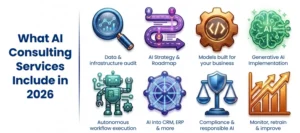
The scope of AI consulting services has expanded significantly. Here is what a well-rounded engagement covers today.
1. AI Readiness Assessment
The initial step is always a structured AI readiness evaluation prior to the development of any model or implementation of any tool. This assesses current data infrastructure, technology stack, internal skill deficits, and business processes to understand the potential for implementing AI — and where it is not appropriate.
A quality readiness assessment yields:
- A priority list of AI use cases by feasibility and ROI.
- An honest assessment of your data readiness for AI – what’s clean, what’s missing, and what needs to be fixed.
- A smart roadmap for investment in a sequence.
One of the most frequent causes of AI initiatives falling short is not taking this step. When enterprises are too hasty to develop without an appropriate check, they end up developing the wrong things on shaky ground.
2. AI Strategy and Roadmap Development
Strategy engagements address the questions that should be answered before writing code. What are the real business challenges that require AI solutions? What elements of the business can be better automated? What is the series of deployments that will last over 2 – 3 years?
A robust strategy engagement will include a scored use-case prioritization matrix, a 12-24 month phased roadmap, KPI definitions for each initiative, and a target operating model for AI governance.
3. Custom AI Development
Off-the-shelf AI tools are used to address general issues. Custom AI development is used for cases where no pre-built model exists, relies on proprietary data, or is based on unique business logic or workflows — for example, a recommendation engine designed specifically for a retailer’s customer behaviors, a fraud identification system trained on a bank’s transaction data, or a predictive maintenance system tuned to a manufacturer’s unique equipment.
A typical case study for custom AI consulting services is from 3 months to 6 months from start to first deployment. The trained model, data pipelines, inference infrastructure, monitoring dashboards, retraining playbooks, and documentation for future maintenance of the system after handover.
4. Generative AI Implementation
In the blink of an eye, Generative AI has gone from hype to production. Some of the most sought-after AI consulting services for 2026 include the creation and tailoring of generative AI solutions for enterprise applications such as intelligent document processing, internal knowledge assistants, AI-driven content workflows, automated code review, and personalized customer communications.
A proficient AI consulting partner in this area is more than just a conduit for your data and a big language model. The actual work is in the retrieval-augmented generation (RAG) architecture, prompt engineering at scale, LLM fine-tuning, responsible AI guardrails, and a tight integration with existing systems to enable the output to be truly usable within your business.
5. Agentic AI Design and Deployment
A major transformation within enterprise AI consulting today is the shift from task-based to agentic AI systems. Agentic AI is an autonomous agent that can reason about multi-step problems, work with tools, call APIs, and run full workflows without a human in the loop.
Agentic AI automates business processes rather than performing individual tasks. An agentic system is a customer support agent that accesses an order history, refunds an order, sends a confirmation, and updates the CRM, without the touch of a human. This is the direction that AI development services will be taking in 2026, and the best AI consulting companies are already creating these systems for their enterprise clients.
6. AI Integration with Existing Systems
Most businesses do not need to replace their entire tech stack. They need AI capabilities layered into what already exists. AI consulting services in this area cover how AI models connect with your CRM, ERP, data warehouse, marketing automation tools, and customer support platform.
This is technically complex work that requires API architecture expertise, data pipeline design, and a deep understanding of how AI outputs translate into actions within business systems. Poor integration is one of the most consistent reasons AI investments underperform.
7. AI Governance, Ethics, and Responsible Deployment
In an ever-evolving landscape of global regulatory frameworks, AI governance is an integral component of any credible AI consulting guide. To operate responsibly, businesses in regulated sectors like financial services, healthcare, HR, legal, etc., must have a structured governance framework for AI.
AI governance consulting includes data privacy compliance, legislation, documentation standards, explainability requirements, and bias auditing. This is no longer a choice in many markets; now it’s a mandate.
8. Ongoing AI Optimization and Support
Production is not static; AI models evolve as well. Data distributions evolve, business needs evolve, and predictions deviate from baseline over time. Maintenance engagements include model drift monitoring, periodic model retraining, optimizing inference cost as usage grows, and reactive incident response if the model produces a business impact.
If that discipline is not maintained, the AI system that was successful at launch can turn into a burden within 12-18 months.
How Much Do AI Consulting Services Cost?
AI consulting cost fluctuates significantly based on the breadth and depth of your project, its complexity, and the kind of partner you choose. The following is a look at the typical breakdown of prices in 2026.
Common Pricing Models
- Hourly or day rates: Independent consultants and specialist boutiques will quote $150- $500 an hour, depending on their specialism. For more sophisticated applications such as LLM fine-tuning or agentic system design, enterprise-grade companies might be able to demand much higher prices.
- Project-based pricing: An AI readiness assessment focused on one area is likely to range from $5,000 to $25,000. For enterprise-level implementations, a complete custom AI development solution, from model creation to integration and deployment, can easily cost anywhere between $30,000 and $250,000 or even more.
- Retainer-based partnerships: Ongoing AI support, optimization, and strategic advisory services can be organized as a monthly retainer fee that varies from $3,000 to $20,000 per month, depending on the level of ongoing services.
- Outcome-based pricing: A few of the best AI consulting companies are starting to charge based on tangible results – like cost savings achieved or revenue attributed to AI systems. This model is still being developed, but it does point towards an important move towards shared accountability.
What Drives the Cost?
The factors that most impact the price you pay for the work are the use case’s complexity, the quality and structure of your existing data, the level of integration needed within your tech stack, the geographic location of the consulting company, and compliance and governance considerations (particularly in regulated industries).
One of the major red flags: unclear pricing structure, distinguishing strategy, development, and continued support. Any reputable AI consulting company will break down the expense and rationale for each stage.
Clear Signs You Need AI Consulting Services Now
Many businesses wait too long — often because they underestimate how difficult it is to do AI well internally, or they overestimate how quickly their team can self-learn what they need. These are the clearest signals that it is time to hire an AI consultant.
You Are Drowning in Repetitive Manual Work
If your operations team spends hours on tasks that follow predictable patterns — data entry, report generation, ticket routing, document review — AI can almost certainly automate a significant portion of that work. The sooner you identify and address these bottlenecks, the faster you compound time savings across the organization.
Your Competitors Are Gaining an Edge
When competitors are personalizing at scale, responding faster, or making smarter decisions with apparent ease, AI is usually part of the answer. Closing that gap requires not just tools but the expertise to deploy them in ways that actually work in your operational context.
You Have Data but Cannot Extract Value From It
Years of customer, transaction, and behavioral data sitting in systems you cannot effectively analyze is a clear signal for AI consulting services. The combination of strong data engineering and AI can turn dormant data assets into real competitive intelligence.
Your AI Experiments Have Not Delivered
Subscribing to AI tools and actually extracting business value from them are very different things. If your team has experimented with AI assistants or automation tools without meaningful results, the problem is usually not the technology — it is the absence of a structured implementation approach and the expertise to configure these tools for your specific workflows.
You Are Undergoing Digital Transformation
If your business is undergoing a meaningful digital transformation, AI should not be a separate workstream. A good AI consulting partner will help you make AI-aware technology decisions throughout the transformation rather than retrofitting AI later at a much higher cost.
Industry-Specific Applications of AI Consulting Services
Understanding how AI consulting services apply in your sector makes it easier to frame your own opportunity.
Healthcare: AI consulting services are dedicated to optimizing clinical documentation, predictive patient risk analysis, medical imaging analysis, and data governance with compliance in mind. In this context, the sensitivity of health-related data underscores the importance of responsible utilization of AI.
Banking and Financial Services: Fraud detection, credit risk modeling, automation of regulatory compliance, and intelligent document processing are common use cases. Governance needs to be more stringent, and implementation more rigorous — hence the importance of experienced AI consulting services providers.
Retail and E-Commerce: AI consulting services for retail usually involve personalization engines, demand forecasting, dynamic pricing, inventory optimization, and AI-powered customer service automation. The ROI of these applications is well proven and highly apparent.
Manufacturing: The most significant applications in manufacturing include predictive maintenance, quality inspection automation, and scheduling of the workforce based on demand. Each one involves modeling and integration tasks that are domain-specific and require the experience of an expert consultant to provide.
Telecom: One of the most common use cases for enterprise AI consulting is network optimization, churn prediction, and intelligent customer support, which can significantly cut down on operational costs and enhance customer experience.
What Makes an AI Consulting Engagement Actually Work?
After reviewing countless AI consulting engagements, certain patterns consistently separate the ones that create lasting value from the ones that produce polished presentations but limited results.
- Clear problem definition upfront. Engagements that succeed start with a specific, measurable problem statement — not a general aspiration to “do AI.”
- Stakeholder alignment before technical work begins. AI projects without internal champions stall when they encounter organizational friction.
- Iterative delivery over big-bang launches. AI systems improve significantly with real-world feedback. Build in iteration cycles where early outputs are validated with actual users before full deployment.
- Honest assessment of data quality. Many businesses discover during an engagement that their data is not as clean as they thought. Consultants who surface this early create far better outcomes.
- A sustained partnership beyond launch. AI systems need ongoing monitoring, retraining data shifts, and refinement as usage patterns evolve. The AI consulting services providers worth engaging are interested in long-term partnerships — not one-time delivery.
Conclusion
The right investment in 2026 is the AI consulting services of the right partner, with the right strategy, and with the right foundations. The businesses that make the best use of these interactions see them as long-term relationships for capability development and not one-time events. Whether it is assessing AI readiness, creating custom AI solutions, or leveraging AI’s capabilities to drive business outcomes, the ultimate objective remains the same: to convert the potential of AI into tangible and enduring business results. It is achieved the right way at AnavClouds Analytics.ai with certified AI experts, a faster development cycle, and an outcome-driven approach that has been proven in businesses across the industry. Schedule a call today!
Frequently Asked Questions
What do AI consulting services include?
AI consulting services encompass AI readiness assessments, AI solutions design, AI implementation with generative AI, enterprise AI integration, governance frameworks, and continuous optimization, covering all the essentials to realize the benefits of AI in tangible business results.
How much do AI consulting services cost for a business?
AI consulting cost will depend on the scope of the services you require. The range of strategy assessment is between $5,000–$25,000; custom AI development from $30,000–$250,000+; and the usual AI consulting partner retainers come in at $3,000-$20,000 per month.
When should a business hire an AI consulting company?
Use an AI consulting firm if you have data you have yet to leverage, unsuccessful AI initiatives, competitive pressures, or enterprise AI consulting to develop a clear, actionable AI strategy and roadmap.
What is the difference between AI consulting and AI development?
AI consulting services are used to shape strategy and use case planning, whereas AI development services are dedicated to the development of the actual build. The top AI consulting firms provide both together in a single integrated, outcomes-oriented engagement.