

Picture this — a key metric tank on a Tuesday, but nobody on your team finds out until the Friday report drops. By then, the window to act has already closed. This is a frustration most data-driven teams know too well, and it’s exactly why the conversation around AI agents vs traditional business intelligence has become impossible to ignore. Businesses aren’t short on data anymore. What they’re short on is speed — the ability to catch problems early, understand why they’re happening, and act before things spiral. That gap is what separates where BI has been from where it’s heading. This blog gets into what’s changing, why it matters, and what it means for organizations trying to make smarter decisions in 2026.
Understanding Traditional Business Intelligence Tools
Let’s be fair to traditional BI before comparing it to anything — it solves a real problem. Before these tools existed, making sense of business data meant manually pulling numbers from spreadsheets and hoping everything lined up. Traditional business intelligence tools brought structure to that chaos.
The typical setup works like this: data flows in from various sources, gets cleaned and transformed, lands in a warehouse, and then analysts turn it into dashboards and reports. It’s a pipeline that millions of organizations have built their entire reporting infrastructure around — and for good reason.
What Traditional BI Does Well
There’s a reason that traditional business intelligence tools like Tableau, Power BI, and Qlik are still widely used. They genuinely deliver on a few things that matter:
- Standardized reporting — Everyone in the organization is working off the same numbers, same definitions, same logic. That consistency matters more than people realize.
- Visual clarity — A well-built dashboard can communicate a quarter’s worth of performance in under a minute. Charts and KPI tiles do a real job here.
- Compliance and governance — For regulated industries, having structured pipelines with clear role-based access isn’t optional. Traditional BI handles this reliably.
- Cost predictability — Licensing is familiar, infrastructure is known, and budgeting it doesn’t require guesswork.
None of that is small. Traditional BI isn’t flawed because it’s bad — it’s limited because the business environment around it has changed.
Where Traditional Business Intelligence Falls Short
Here’s where things get honest. Traditional business intelligence was built to answer questions people already knew to ask. That’s the core constraint.
Reactive by design
A dashboard shows you what has already happened. If revenue dropped last Tuesday and your team checks the report on Friday, the problem has already grown. Traditional BI doesn’t alert you — it waits for you.
Manual interpretation at every step
Someone must build the dashboard, read it, and decide what to do. Every stage depends on human input, which introduces delays and inconsistency.
Data freshness problems
Many traditional BI setups rely on batch processing — data may be 12 to 48 hours old by the time it appears on a dashboard. In fast-moving markets, that lag is costly.
Insights don’t explain themselves
Traditional BI will show you that customer churn spiked last month. It won’t explain why — and it certainly won’t suggest what to do about it.
These are precisely the limitations that make AI agents vs traditional business intelligence worth examining seriously — and why so many data and analytics leaders are actively rethinking their approach to AI agents vs traditional business intelligence strategy heading into 2026.
What AI Agents Actually Do in Business Intelligence
Here’s where the distinction gets interesting. In the context of AI agents vs traditional business intelligence, an AI agent isn’t just a smarter dashboard — it’s a different kind of tool entirely. It doesn’t wait for instructions. It monitors your data continuously, picks up on patterns and anomalies, responds to questions asked in plain language, and — depending on what it’s configured to do — can take action on what it finds.
The best way to see this is through a real scenario. You don’t log into a report and type a query. You ask: “Why did revenue drop in the Northeast last quarter?” and the agent goes through the data, finds the correlations, and gives you an explanation. No SQL, no waiting for an analyst to get back to you. That’s the practical difference.
What makes this possible is a combination of large language models (LLMs), machine learning, and natural language processing — all working together inside the analytics layer rather than bolted on as separate tools.
Core Capabilities of AI Agents in Business Intelligence
- Continuous data monitoring — Connects to CRMs, ERPs, financial platforms, and operational databases, running 24/7
- Automated anomaly detection — Flags issues without being prompted, unlike traditional business intelligence tools
- Natural language queries — No SQL required; users ask questions the same way they’d ask a colleague
- Predictive analytics in BI — Not just what happened, but what’s likely to happen next
- Workflow automation with AI — From alerting a team to triggering reorders or pricing updates, depending on configured permissions
At its core, this is what separates AI agents vs traditional business intelligence at an operational level. One system reports. The other reasons and responses.
AI Agents vs Traditional Business Intelligence: A Direct Comparison
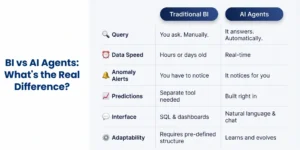
The gap in AI agents vs traditional business intelligence becomes even clearer when you consider decision speed. In AI-driven decision making, the window between data and action can shrink from days to seconds. In an environment where market conditions and customer behavior shift constantly, that difference compounds quickly.
The Rise of Agentic Analytics — and Why It Matters Now
Agentic analytics describes the broader shift in how organizations approach data. While AI agents in business intelligence refer to specific tools, agentic analytics describes a new operating model: rather than building dashboards to answer known questions, organizations deploy systems that surface the right information at the right moment — automatically. In many ways, it’s the organizational mindset shift that follows naturally from understanding AI agents vs traditional business intelligence.
The scale of this shift is becoming undeniable. According to a study, 40% of enterprise applications will be integrated with task-specific AI agents by the end of 2026, up from less than 5% today — a figure that illustrates just how quickly AI agents vs traditional business intelligence is moving from concept to standard practice.
What’s accelerating this?
- The maturation of LLMs, making natural language interfaces genuinely useful, not just novelties
- Better real-time data infrastructure, keeping AI agents in business intelligence continuously fed with live signals
- Growing frustration with traditional business intelligence tools that can’t scale insights without scaling analyst headcount
- Competitive pressure: when a competitor’s analytics infrastructure runs 24/7, and yours depends on a Friday report, the gap grows
Understanding AI agents vs traditional business intelligence today means understanding the agentic AI evolution as a trajectory — not a one-time event.
Machine Learning in BI: The Engine Behind AI-Driven Decision Making
One of the most significant differences in AI agents vs traditional business intelligence is native machine learning in BI workflows. Traditional BI could always be extended with predictive models — but those models typically lived in separate tools maintained by separate teams.
AI agents embed machine learning directly into the analytics process:
Predictive analytics in BI becomes standard
Rather than building a separate forecasting model, an AI agent continuously learns historical patterns and updates its predictions as new data arrives. Traditional business intelligence tools require a separate pipeline just to get there.
Automated data analysis replaces manual discovery
Instead of an analyst spending hour on root-cause investigation, the AI agent performs that work autonomously and delivers a clear summary with supporting evidence.
Workflow automation with AI becomes part of the intelligence layer
When an agent detects that inventory for a high-demand product is running low based on predicted sales velocity, it can trigger a reorder, update the supply chain system, and notify the relevant team — simultaneously.
This is what makes AI-driven decision making a meaningful operational shift in the AI agents vs traditional business intelligence conversation — not just a technical one.
Conversational BI: Democratizing Access to Insights
Another significant differentiator in AI agents vs traditional business intelligence is conversational BI. Traditional business intelligence tools have always had a “last mile” problem: the data might exist, but getting the right insight to the right person requires someone to build the right report first. Most business users can’t do that themselves, so they wait.
Conversational BI removes that bottleneck. A sales manager can ask, “Which enterprise account showed decreased engagement last month?“ and receive a direct, contextualized answer — no dashboard required, no ticket to the data team.
When reviewing business intelligence trends in 2026, this is one of the most impactful: the most competitive organizations aren’t just those with the most data — they’re the ones where the most people can act on it, quickly. AI agents in business intelligence make that possible at scale, in a way traditional business intelligence tools simply weren’t designed to. It’s one more dimension where AI agents vs traditional business intelligence shows a clear and practical divide.
Where Each Approach Performs Best
One thing worth saying clearly: this isn’t a “one replaces the other” situation. When you look at AI agents vs traditional business intelligence across real organizational needs, there’s space for both — it just depends on what you’re trying to accomplish.
Where Traditional Business Intelligence Tools Still Belong
Some workflows are well-served by traditional BI, and pushing AI agents into those areas doesn’t add much value:
- Board-level reporting and executive dashboards — When leadership needs a consistent, governed view of company performance, structured dashboards deliver exactly that. Stability matters here more than speed.
- Compliance and audit workflows — Regulated industries need traceable, standardized reporting. Traditional BI is built for this in a way most AI agent systems aren’t, at least not yet.
- Long-cycle strategic planning — When the goal is analyzing trends over months or years, historical depth is what you need. Traditional business intelligence tools handle this well.
Where AI Agents Outperform Traditional Business Intelligence
Outside those structured, governance-heavy scenarios, AI agents tend to pull ahead — sometimes significantly:
- Fraud detection — Anomalies need to be caught the moment they appear, not the next time someone checks a report. AI agents in business intelligence can flag suspicious patterns in real time.
- Customer churn prediction — By the time churn shows up in a traditional BI dashboard, you’ve likely already lost the customer. AI agents catch the early signals and recommend action while there’s still time.
- Supply chain management — Inventory levels, lead times, demand shifts — these variables move constantly. Continuous monitoring with AI keeps operations ahead of disruptions rather than reacting to them.
- Sales forecasting — Predictive analytics in BI through AI agents updates as deal activity changes, giving sales leaders a live view rather than a snapshot that’s already two weeks old.
The clearest way to summarize AI agents vs traditional business intelligence: traditional BI answers “What happened?” AI agents answer, “What should we do about it, right now?” That distinction, more than any other, captures what makes the AI agents vs traditional business intelligence comparison so strategically important.
The Agentic AI Evolution: What to Expect Next
The agentic AI evolution is already underway in platforms like Tableau Next, Microsoft Power BI with Copilot, and ThoughtSpot Spotter — all embedding AI agents into existing BI environments rather than replacing them outright.
This is an important nuance in AI agents vs traditional business intelligence: these aren’t necessarily competing systems. The most practical architecture for most enterprises combines traditional BI for governance and structured reporting with AI agents for real-time insight generation and conversational access.
Business intelligence services that haven’t evolved to incorporate AI agent capabilities are increasingly working with a narrowing toolkit. Likewise, AI development services that don’t account for BI governance requirements often build solutions that are technically impressive but hard to operationalize. Organizations closing this gap fastest treat AI agents vs traditional business intelligence as a capability investment — not just a technology swap.