


Agriculture is entering a new era driven by automation, data intelligence, and advanced machinery. Farmers are facing rising labor shortages, unpredictable weather patterns, and increasing global food demand. These challenges are accelerating the adoption of autonomous farming across the agricultural industry. By combining Artificial intelligence (AI) and machine learning (ML) with robotics and connected systems, farms can automate complex operations with greater precision. Modern autonomous farming technology allows machines to monitor crops, analyze field data, and perform tasks with minimal human intervention. As AI in agriculture continues evolving, automated farming systems are transforming traditional farming into smarter, more efficient, and sustainable agricultural ecosystems.
What Is Autonomous Farming?
Autonomous farming is a form of farming that involves the use of intelligent machines and digital technologies with little human intervention. These systems involve the use of sensors, robotics, software, and AI in agriculture to conduct farming activities automatically.
Most of the decisions in traditional farming are based on human judgment and manual labor. Nonetheless, autonomous farming presents the idea of intelligent machines capable of analyzing the situation in the field, making decisions based on the data, and functioning on their own.
These farms are overly dependent on automated farming and related technologies. Field data is gathered by sensors, crop health is observed by drones, and farming is done by intelligent machines that do the planting, fertilizing, irrigation, and harvesting.
An average autonomous agricultural robot will be able to traverse the fields, identify the problems of plants, and perform such activities as spraying or harvesting. On the same note, autonomous farming machinery such as self-driving harvesters and tractors could be running 24 hours without human intervention.
Such systems are further reinforced by the adoption of AI in the decision-making process. The AI algorithms process huge amounts of data related to agriculture and prescribe the most suitable measures to achieve positive crop results.
How Autonomous Farming Works
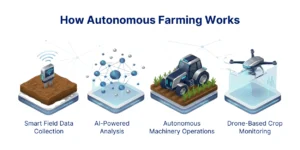
Autonomous farming is reliant on intelligent devices, networking devices, and automated machines to operate successfully. These systems gather data collected on the farm, process it with more sophisticated algorithms, and complete the chores with the help of robotic devices. All these abilities combined make it possible to develop efficient automated farm systems that enhance productivity, decrease manual labor, and facilitate data-driven agricultural management.
Data Collection Through Smart Sensors
The state of autonomous farming technology is best embodied by an initial good base of autonomous farming technology that involves real-time data gathering via sophisticated sensors and interconnectable devices. These sensors will be placed throughout the farm territory and connected to autonomous farming equipment to detect soil moisture, temperature, nutrients, and crop conditions. The constant gathering of data enables automated agriculture machines to provide the best growing conditions and identify changes in the environment within a short time. This surveillance system assists farmers in making the right operational decisions, and they will guarantee effective use of resources over expansive farming areas.
AI-Based Analysis and Decision Making
Upon gathering field data, one then analyzes the information with the help of Artificial Intelligence (AI) and machine learning (ML) algorithms. To reveal agriculture operations patterns, risks, and opportunities, these technologies process high volumes of data. With the use of AI in decision making, systems analyze the health of the soil, weather trends, and crop development patterns. Farms can forecast pest outbreaks, disease dangers, and yields with the help of AI and predictive analytics. This will enable AI to automate decision-making process and give the farmers the opportunity to adopt proactive measures and enhance the overall crop performance.
Autonomous Machinery and Robots
Once the insights are created, the smart machines can conduct the required farming activities with the least human intervention. Self-driving machines that are used to perform labor-intensive farming tasks include autonomous farming equipment, e.g., self-driving tractors, automatic seeders, and robotic harvesters. Moreover, autonomous farming robots such as drones and weeders are used to monitor crops and spray them specifically. Most modern farms use an autonomous farming robot, which can detect plant stress and apply fertilizers or pesticides with the highest precision, enhancing productivity and sustainability.
Computer Vision for Crop Monitoring
Computer vision technology has a big role in the development of AI in agriculture. Images of crops and soil conditions on high-resolution cameras are taken by cameras on drones or autonomous farming robots. AI models are used to analyze these pictures to identify weeds, nutrient deficiencies, and plant diseases. It is a visual intelligence that allows automated farming systems to detect issues early on and implement specific remedies, which would lessen crop loss and enhance the quality of yields and efficiency in a farm.
IoT Connectivity and Farm Management Platforms
Farming today is an autonomous system that is highly dependent on IoT technology to establish communication between machines, sensors, and software to manage the farm. Such integrated systems enable farmers to watch what is happening remotely and operate autonomous farming equipment through centralized dashboards. The IoT involvement also provides the opportunity to maintain an ongoing communication of the machine with the AI platform, which guarantees the correct data flow. This connectivity will enhance autonomous farming technology as it enables faster decision-making, efficient coordination, and enhanced operational visibility.
Precision Resource Management
The capability to control the farming resources is one of the most useful elements of autonomous farming. The intelligent systems measure the environmental conditions and automatically regulate irrigation, fertilization, and application of pesticides. Farms will be able to reduce wastage of resources and the ecological footprint through the assistance of AI Solutions and high-tech automated farming systems. The method enhances the productivity of crops, besides promoting sustainable farming activities and the profitability of the farms over the long term.
Key Technologies Behind Autonomous Farming
The development of autonomous farming is fast due to various advanced technologies that convert traditional farming into intelligent and data-focused operations. These technologies are a mix of automation, analytics, and connection to drive contemporary automated farming. Combining intelligent machines with digital platforms will allow farms to become more efficient, minimize manual labor, and manage their farms more intelligently.
Artificial Intelligence and Machine Learning
The contemporary technologies of autonomous farming are based on artificial intelligence (AI) and machine learning (ML). These systems handle bulk data on agriculture and produce insights to act on. Under AI in agriculture, farms have the ability to monitor crops, identify diseases at an early stage, predict yields, and increase productivity by using AI in decision-making.
Computer Vision
Computer vision technology enables machines to physically examine crops and field conditions at high resolution. Drones or autonomous farm robots are equipped with cameras, and the images are analyzed by Artificial Intelligence, which helps to identify the health of crops, detect weeds and quality of soil. This feature can enhance the work of autonomous farming equipment greatly and help to monitor the fields more efficiently.
Robotics and Automation
Robotics are important in facilitating effective automated farming processes. Agricultural robots are able to plant seeds, harvest, weed, and spray pesticides. These intelligent machines constitute the foundation of automated agricultural systems, with less dependence on labor, more speed, and precision of operation in large agricultural areas.
Internet of Things (IoT)
The IoT technology links sensors, machines, and online farm platforms to form a complete agricultural ecosystem. These interrelated devices constantly exchange field data and assist in monitoring autonomous farming machinery remotely. The IoT integration enhances autonomous agriculture, as it will provide real-time information, automated reactions, and better coordination among the machines.
AI and Predictive Analytics
The second solution is a highly developed AI and predictive analytics that enable farms to see the challenges of agriculture before they arise. These smart systems interpolate the weather, soil, and crop growth trends to predict risks and opportunities. As AI automates decision-making, farmers can plan irrigation, fertilization, and harvesting strategies more efficiently while improving overall farm performance.
Key Benefits of Autonomous Farming for Modern Agriculture
The modern agricultural practice is changing with the growing use of autonomous farming, which enhances efficiency, sustainability, and productivity. With the integration of intelligent machines and Artificial intelligence (AI) and machine learning (ML), farms will be able to automate their work and make smart decisions. These inventions enable agricultural companies to expand their activities without losing accuracy and consuming fewer resources.
Increased Operational Efficiency
Enhanced efficiency in the various farming operations is one of the significant Benefits of autonomous farms. The current automated farming systems are capable of performing planting, spraying, and harvesting tasks without errors. Farmers will be able to work around the clock using autonomous farming equipment that is more productive and does not have delays associated with their operation.
Reduced Labor Dependency
The shortage of labor is still an issue in the agricultural sector. Automated farming equipment can solve this issue through the automation of laborious and repetitive chores. Airborne farming robots and robotic harvesters are some of the technologies that allow farms to plough, plant, and harvest their farms without the need to use manual labor.
Data-Driven Decision Making
Cutting-edge analytics can be important in autonomous farming as it helps to manage farms more intelligently. Farms analyze environmental data, crop health, and weather by using AI in decision-making. With AI and predictive analytics, systems can predict possible risks, and AI automates decision-making to enhance farming strategies.
Precision Farming and Resource Optimization
Accurate utilization of natural resources like water, fertilizers, and pesticides is made possible by modern autonomous farming technology. Smart automated agricultural systems are used to check the state of the fields and to provide resources only when necessary. This focused practice decreases waste and enhances the quality and sustainability of crops for the environment.
Improved Crop Yield
The other beneficial impact of autonomous farming is improved crop productivity. Ongoing surveillance of agriculture with AI assists in identifying stress, illness, and nutrient deficits of nutrients in the plants before it is too late. Farms can act in time and keep the best conditions in crop development with the help of advanced AI Solutions.
Real-World Applications of Autonomous Farming
Implementation of autonomous agriculture is rapidly growing in contemporary farming. These technologies are based on Artificial Intelligence (AI) and machine learning (ML), which automatically conduct major farming processes and enhance their efficiency. High-technology autonomous farming assists farms to lower the level of labor reliance, maximize resources, and endorse mass-scaled automated farming procedures.
- Autonomous Tractors and Harvesters – Autonomous Harvesters and Tractors are high-technology autonomous agricultural machines that utilize GPS, sensors, and AI in their decision-making to plow, plant, and harvest easily.
- Drone-Based Crop Monitoring – agricultural drones take images of fields, which are analyzed by AI in agriculture to identify diseases, nutrient-deficiencies, and irrigation problems in diverse autonomous farming areas.
- Robotic Weed Control – In modern automated farming systems, the computer vision of intelligent autonomous agriculture robots is used to identify and eliminate weeds automatically, preventing the use of herbicides and enhancing sustainability.
- Automated Irrigation Systems – Smart irrigation systems apply sensors, AI, and predictive analytics to automatically modify and adjust the water flow, and further, automated agriculture can save water without compromising the perfect conditions of crops.
- Accurate Spraying and Fertilization – Current autonomous agriculture solutions used in the spraying and fertilization of agricultural fields use AI Solutions to help reduce chemical wastage and enhance crop yield and soil quality.
- Autonomous Crop Monitoring Robots – Autonomous Farming Robots are capable of constantly surveying the farm and identifying the health condition of crops, identifying the state of stress, and aiding AI in making quicker and more precise decisions regarding farm management.
Critical Challenges and Limitations in Autonomous Farming Adoption
Despite the immense benefits of autonomous farming, it is also faced with some operational and technological challenges. The use of new and improved autonomous farming technology needs robust infrastructure, trained personnel, and tactical investment. Knowledge of these constraints will enable agricultural enterprises to implement automated agricultural technologies more efficiently and increase the potential of AI technology in agriculture.
High Initial Investment
Implementing autonomous agricultural machinery and automated smart agricultural machines would cost a lot of money to initiate at the beginning in terms of robotics, sensors, and artificial intelligence Solutions. These costs might not be managed in smaller farms. These investments can be gradually compensated for by better productivity and efficiency due to autonomous agriculture.
Technology Integration Challenges
There are a lot of farms that use outdated equipment and conventional agriculture. The implementation of modern autonomous farming technologies in combination with the current ones may be complicated and time-consuming. The adoption process usually needs technical skills, high-end infrastructure, and trusted AI development services to facilitate a seamless process.
Data Security and Privacy Risks
Current autonomous agricultural settings rely strongly on interlinked systems, cloud computing, and data distribution. This through connectivity enhances exposure to cybersecurity threats and data breaches. The high-security structures, secure networks, and safe AI Solutions are necessary to protect sensitive agricultural information and manage data safely.
Skill Gap and Training Needs
The control of autonomous farm equipment and artificial intelligence tools demands professionalism and the development of specific expertise. The farm operators need to know about AI in decision-making, data analytics, and machines. This increasing skill gap is one of the major limitations of autonomous farming for most agricultural corporations.
Best Practices for Implementing Autonomous Farming
Implementing autonomous farming is a challenging process to embrace successfully when the strategy is planned and implemented carefully.
Start with Small Automation Projects
The farmers must start with the implementation of simple automated systems in farming, like smart irrigation or video surveillance. Slow implementation diminishes risk and enhances exposure to technology.
Invest in Reliable Data Infrastructure
AI in agriculture requires powerful data collection and storage. The farms should make certain that sensors and IoT devices provide data that is reliable and accurate.
Choose Scalable Autonomous Solutions
New autonomous agriculture machines must be able to accommodate upgrades and integration in the future. Scalable technology keeps the farms at par with the advancement of innovations.
Partner with AI Technology Experts
Agricultural applications of AI systems would need technical skills. Companies tend to cooperate with the providers of AI development services and sophisticated AI Solutions.
Conclusion
Autonomous agriculture is developing at an alarming rate; it is redesigning the future of farming and offering intelligent machines, analytics in real-time, and automated processes. Farms can be more productive using AI in decision making, robotics, and automated farming systems to optimize and reduce the costs of operation. Although there are some difficulties, such technology can be an effective solution to modern agriculture because of its long-term advantages in this sphere. With the ongoing innovation, companies need to embrace new AI Solutions and data-driven approaches to remain competitive. Organizations such as AnavClouds Analytics.ai assist companies in deploying AI-driven technologies and intelligent systems that can allow smarter, scalable, and more efficient operations in the agricultural sector in the future.