

Technology is changing the agricultural industry like a storm as it adapts traditional farming methods in the world. The core of this change is AI in Agriculture, which allows for making smarter, faster, and more accurate decisions. The modern farmer is facing an uncertain climate, cost escalation, and food demand at the same time. AI in Agriculture will assist in these issues with evidence-based information and smart robotization. AI solutions enhance productivity and sustainability; the fields include precision farming, predictive analytics, etc. The use of AI in agriculture and farming is turning out to be a necessity and not an option as it is being adopted. The smart technologies are transforming the way farms run, grow, and compete in an evolving international environment.
What AI in Agriculture Means for Modern Farming
AI in Agriculture entails the application of smart systems to analyze agricultural data and automate decision-making. These systems are based on AI algorithms and Machine learning (ML) models that identify patterns that humans will not identify. Information drones, sensors, satellites, weather systems, and farm equipment are continuously collecting information. AI in farming is used to process this data to produce actionable insights that can be used in making 12better operational decisions.
Contemporary farms produce enormous volumes of data that cannot be analyzed by humans at scale. This data is converted into predictive and prescriptive data with the help of AI technology in agriculture. The farmers can learn about the condition of the soil, the condition of crops, risks of pests, and the effects of weather at an earlier time. AI in Agriculture enhances the speed at which it responds and prevents losses before they can get out of control. This transforms farming into an aggressive as opposed to a reactive one.
Transform your farming operations with data-driven AI in Agriculture solutions built for real-world impact.
Key AI Applications in Agriculture Driving Smart Farming
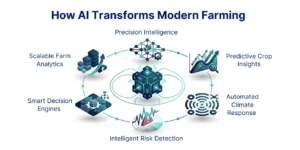
AI in Agriculture assists in intelligent applications that enhance efficiency, accuracy, and sustainability in farming processes. The applications assist farmers in shifting their decision-making processes by moving beyond manual decision-making to data-driven and automated decision-making processes. Farming will have the opportunity to optimize resources and minimize operational risks with the help of AI algorithms and Machine learning (ML) models. The use of AI in Agriculture is the key to contemporary smart farming ecosystems.
Precision Farming and Resource Optimization
One of the most significant AI applications in agriculture nowadays is precision farming. AI in Agriculture involves the analysis of soil, weather conditions, and crop conditions to achieve the maximum use of inputs. The farmers are given the right recommendations on the use of fertilizer, irrigation, and nutrients. This saves the consumption of water, reduces the cost of inputs and enhances the total yield of the crops.
The AI technology in the agricultural industry means that resources are utilized where they are necessary. This is a focused strategy that reduces waste and enhances sustainable agriculture. Artificial Intelligence in the Agriculture sector, on precision farming, enhances productivity, but does not damage the health of the soil. These artificial intelligence tools can assist farms in being more efficient with reduced environmental costs.
Intelligent Crop Monitoring and Disease Detection
The other vital field that AI in Agriculture provides quantifiable value is crop tracking. The computer vision systems compare drone and satellite data to check the health of crops at any time. AI in farming is used to identify the early onset of disease, pests, and nutrient deficiencies. Farmers are warned of the actual occurrence of visible damages on whole fields.
These use cases for AI in agriculture minimize the losses in crops to a large extent. Intervention at an early stage enhances the quality of crops and safeguards the production of yields. AI and ML solutions allow the ability to proactively manage crops rather than react to them. This enhances the short-term performance and sustainability of the farm in the long-term.
Yield Prediction and Harvest Planning
Effortless yield forecasting and harvesting reckoning are also sponsored by AI in Agriculture. Machine learning algorithms utilize historical data, weather patterns, and the development of crops. These facts enable farmers to plan their volumes of production long before harvesting. Greater forecasts enhance coordination and planning in the marketplace of the supply chain.
AI applications in agriculture decrease the uncertainty about when to harvest and yield. Farmers can plan how to store, transport, and how to labor more efficiently. It has the effect of reducing post-harvest losses and enhancing profitability. AI in Agriculture empowers the decision-making process throughout the lifecycle of production.
Smart Irrigation and Climate Adaptation
Another strong example of the use of AI in the field of Agriculture is smart irrigation systems. The algorithms of AI examine the moisture of soil, weather predictions, and crop water needs. These are automated irrigation systems that operate according to real-time conditions. This eliminates excessive use of water and manages the use of important water resources.
AI in agriculture and farming assists the farms in adjusting to variable climate conditions. Smart irrigation promotes the strength of crops when there is a drought. These artificial intelligences guarantee the maximum use of water and crop health. Smart irrigation is critical in the strategy of sustainable agriculture.
Benefits of AI in Agriculture for Farmers and Agribusinesses
The benefits of AI in agriculture extend much beyond simple automation and efficiency in the work sphere. Artificial Intelligence in Agriculture helps farmers and agribusinesses make smarter decisions based on real-time and data-driven insights. Such intelligent systems minimize uncertainty and enhance productivity in farming activities. AI in Agriculture establishes quantifiable value to small farms and big agricultural businesses.
Introduction of AI algorithms and Machine learning (ML) models gives a farm more insight into the crops, soil, and climate. AI in farming substitutes assumptions with precise predictions and suggestions. This results in improved planning, better utilization of resources, and better financial results. The benefits of AI in agriculture facilitate directly scalable and sustainable development.
Increased Productivity and Yield Optimization
AI in Agriculture has a substantial impact on enhancing productivity, whereby the limited land resources are maximized to produce high yields. Smart systems interpret crop data to prescribe the best planting, irrigation, and fertilization systems. The farmers will be able to optimize the inputs according to the requirements of crops and field conditions. This accuracy aids in obtaining uniform yields in different environmental factors.
AI in agricultural fields mitigates inefficiencies that, in most cases, affect agricultural output. Farmers can act promptly by rectifying the areas that are performing poorly before it is too late. The use of AI technology in farming means that each resource is productive for crops. The advantages result in increased production without an increase in acreage.
Cost Reduction Through Smarter Resource Management
One of the strongest benefits of AI in agriculture is reducing operational costs. AI in Agriculture assists in the reduction of the use of fertilizers, water wastage, and pesticides that are not necessary. Smart suggestions make sure that there are no unneeded inputs utilized. This specific strategy reduces costs and maintains the health of crops.
AI solutions minimize labor dependency as well because it automates tedious monitoring activities. Farmers do not have to concentrate on manual inspection, but rather on strategic decisions. AI and ML solutions enhance efficiency, but not quality. The direct effect of cost savings is increased profit margins of agribusinesses.
Improved Decision-Making with Data-Driven Insights
AI in Agriculture will enable the farmer to make sound decisions supported by the correct information. The machine learning models are used to process historical and real-time data to reveal trends and risks. Farmers have a clear understanding of the health of crops, weather trends, and soil. Such visibility enhances confidence in operational planning.
AI in agriculture and farming can help respond more quickly to the changing conditions. Decisions are made based on forecasts as opposed to observations made later. The insights provided by AI minimise mistakes, which are associated with human bias or lack of information. Sounder performance and stability of the farms are achieved because of better decisions.
Risk Management and Climate Resilience
AI in Agriculture is observed to be essential in dealing with farming risks. Predictive analytics assist farmers in being ready to face unfavorable weather patterns or climate changes. The early warnings enable the timely changes in planting, irrigation, and harvesting. These abilities minimize losses due to disruptions.
Market risk is also managed with the help of AI technology in agriculture. The forecasts of yield and demand can be used to match the production needs of the market. Artificial intelligence solutions make businesses more resilient to uncertain economic situations. Such advantages of AI in agriculture guarantee the long-term sustainability of farms.
Long-Term Sustainability and Competitive Advantage
Modern-day agriculture businesses are starting to use sustainability as a strategy. AI in Agriculture promotes sustainability in agriculture through optimal utilization of resources and a less negative effect on the environment. SMART systems are useful in keeping the soil and water sustainable. This will guarantee sustained productivity without the degradation of natural resources.
Agribusiness, which utilize AI development services, has a competitive edge in changing markets. The farms powered by AI are more responsive to changes in technology and the environment. Such advantages of AI in agriculture make businesses successful in the long term. AI-powered smart farming is a necessity and not an option.
Real-World Use Cases for AI in Agriculture
There are numerous real-world use cases for AI in agriculture across farms of different sizes and regions. AI in Agriculture is no longer restricted to big business entities with an advanced infrastructure. Smart tools are becoming available to small and mid-sized farms using cloud-based and mobile AI solutions. This availability is expediting the use of AI in the agricultural ecosystems of the world.
Thousands of acres of land are managed on AI-powered platforms in large-scale farms. In farming, AI allows crops, soil, equipment, and weather to be centrally monitored. Advisory tools offer actionable insights with no complex setups to small and mid-sized farms. Smart decisions about Agriculture are provided by AI at any level of the farms or location.
The AI can also apply to the agricultural supply chain, other than production. Predictive analytics match the output of crops to the real-time demand in the market. There is a minimization of post-harvest losses by farmers with better storage, transportation, and logistics planning. AI in Agriculture enhances the collaboration between farmers, distributors, and consumers.
Key Practical Use Cases of AI in Agriculture
Applications of AI in agriculture provide value in various fields of operation. These examples illustrate the way AI technology in agriculture makes a tangible difference.
- Accurate crop surveillance based on AI algorithms and computer vision to identify diseases and stress in time.
- Machine learning (ML) models that predict yields and forecast production are used to plan production better.
- Automated irrigation control reduces the usage of water according to the state of the soil and weather conditions.
- Robotic pest and weed identification minimize the excessive use of pesticides and damage to crops.
- The livestock monitoring systems monitor the health and feeding habits, as well as the movement of animals.
- Optimization of the supply chain, better forecasting of demand, and minimizing post-harvest losses.
- AI-based farm equipment optimization to assess performance and downtime reduction.
Such AI applications in the agricultural industry enhance efficiency, decrease risk, and increase profitability. AI in Agriculture creates more predictable and controlled operations of farms. These applications are becoming the norm in contemporary farming activities as they are widely adopted. The actual effect persists in its growth with the AI development of services.
Conclusion
The use of AI in Agriculture is transforming the way contemporary farm’s function, plan, and develop sustainably. Smart systems enhance productivity, minimize risk, and maximize resources in agricultural processes. AI solutions will provide quantifiable business value, whether in real-time monitoring or predictive decision-making. Data-driven farming is on the rise, and the use of AI and ML solutions is essential to ensure its success in the long run. Such organizations as AnavClouds Analytics.ai assist agribusinesses in the implementation of scalable and customized AI development services based on real farming challenges. The current investment in AI in Agriculture will help farmers be smarter, create resilience, and grow positively in the future.