

The issue of customer churn prediction has turned into a burning issue for companies working in competitive, subscription-based, and digital-only markets. The loss of customers without knowing the cause of such loss has a direct effect on revenue, growth, and sustainability in the long run. In the traditional forms of churn analysis, it may be difficult to detect the initial behavioral indicators or customer intent change. This is the place where AI and machine learning transform the way businesses examine the issue of customer churn prediction. Combining historical and real-time data, AI-driven models reveal the patterns that were not previously obvious, forecast the risk of churning with high accuracy, and provide opportunities to implement retention strategies proactively. Organizations leveraging AI for customer churn gain deeper visibility into customer behavior, allowing them to act early, personalize engagement, and protect customer lifetime value more effectively.
Why Customer Churn Prediction Is Critical for Business Growth
Customer churn prediction assists companies in forecasting those customers that would likely leave the company before they actually disengage. Past methods were very dependent on simple statistics and historical averages, which could not reflect the actual intention of behavior. The current AI and ML methods are not just limited to whatever is obvious on the surface of the customer interactions and engagement data, but they are also analyzed through intricate patterns underlying them.
Machine learning algorithms are constantly analysing trends in use, transactional behaviour, sentiment indications, and support responses. These insights provide some of the early warning indications, including decreasing engagement, sentiment change, or product dependency. The accurate customer churn prediction enables businesses to have insight into the risks that are not well understood through manual analysis.
Key Business Reasons to Prioritize Customer Churn Prediction
- Reduce Revenue Leakage: Knowing the customers who are at risk at an early stage will stop the recurrent loss of revenue and cushion profitability in the long run.
- Lower Customer Acquisition Costs: It is much cheaper to maintain the current customer base compared to acquiring a new one in competitive markets.
- Enable Proactive Retention Strategies: With the help of teams, it is possible to intervene with special offers, personalized communication, and timely support measures.
- Improve Cross-Team Alignment: The marketing, product, and customer success teams operate based on the same churn data and objectives.
- Maximize Customer Lifetime Value: Predictive insights assist in increasing customer relationships and customer value in the long run.
The right prediction of customer churn leads to active decision-making in the entire organization. The smallest improvements in churn rates can have a significant financial effect when it is implemented on a large scale. Retaining rather than reacting through recovery helps a business save revenue, enhance customer experience, and develop sustainable growth models.
How AI and ML Models Empower Retention Strategies
The models of AI and ML are essential in contemporary customer churn prediction since they scale historical and live customer information. In contrast to conventional approaches, artificial intelligence-based systems consider behavioral indicators, transactional data, engagement dynamics, and sentiment metrics at the same time. This is a multidimensional method that will allow businesses to identify the chances of churning earlier and much more precisely, enabling teams to act when customers are still engaged.
AI customer churn prediction software that transforms predictive insights into prospective retention actions. These platforms divide the customers according to the risk of losing them, usage habits, buying habits, and interactions with the support. Machine learning solutions have real-time analytics and lifelong learning, which make customer churn predictions accurate with behaviour changes to enable businesses to launch timely campaigns, automated processes, and personalised incentives to enhance retention performance.
Clear Business Benefits of AI-Based Customer Churn Prediction
The application of AI for customer churn strategies provides valuable retention and growth for organizations with long-term and quantitative value. Customer churn AI transforms a business from a business that is reactive in response to new demands to one that is proactive in interaction and consequently efficient and effective.
Enhanced Predictive Accuracy
The AI and ML models take into account vast, heterogeneous data in many touchpoints, such as CRM systems, product usage logs, and customer interactions. This is a feature that allows customer churn prediction to a great degree of accuracy, as opposed to the old-fashioned statistical techniques.
Proactive Intervention Strategies
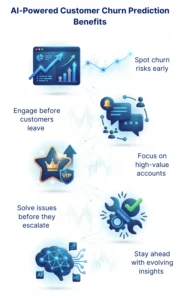
The businesses have dependable churn risk scores to attract customers before they disengage. Customer insights related to churn using AI can help offer timely deals, personalized messages, and targeted retention behavior to minimize churn.
Optimized Resource Allocation
AI customer churn prediction software enables the teams to concentrate on high-value and risky customers. This is a precise strategy that would maximize marketing investment, support services, and retention investments.
Improved Customer Experience
Predictive insights identify customer pain points at early stages so that the business can eliminate issues before they escalate. Active interaction based on AI and ML models enhances the level of trust and total satisfaction.
Continuous Model Evolution
AI development services allow churn models to change constantly with the appearance of new data. Such flexibility will keep customer churn prediction up to date with the evolving customer expectations and market forces.
Best Practices for Implementing AI for Customer Churn Prediction
The implementation of AI to churn customers is not easily achievable and does not just need the use of algorithms. To make customer churn prediction a profit-driving activity, businesses should align the data, processes, and strategy so that their ROI can be assessed. Adherence to best practices assists organizations in creating robust, scalable, and operable machine learning solutions to long-term retention targets.
Integrate Diverse and High-Quality Data Sources
Proper customer churn prediction requires complete data coverage. Having CRM records, product usage data, support tickets, transaction histories, and sentiment signals enables a single customer view. The AI and ML models are more effective when trained on a larger range of data that allows them to learn more about customer behavior and make predictions with increased accuracy among various categories of customers.
Segment Customers by Risk and Lifetime Value
Customer churn strategies that use AI must focus on customers with high churn risk and those with high business value. The AI customer churn prediction software allows the segmentation of high-risk and high-value customers, which should be addressed urgently. This method makes retention activities target accounts that have the highest revenue contribution so as to maximise marketing and support expenditure.
Personalize Retention Strategies Using AI Insights
To prevent churning, it is crucial to personalize. AI and ML models can be used to determine certain churn drivers, which a business can use to modify engagement approaches. Machine learning applications assist in individualized offers, personalized messaging, and personalized interactions with support, which is more likely to result in retention of success.
Monitor Churn Signals in Real Time
Real-time monitoring is an important factor in improving the efficiency of AI in churning customers. Teams can react immediately to churn risk increase using dashboards, alerts, and automated triggers. Timely intervention with the help of real-time customer churn prediction will help to decrease disengagement and enhance customer experience.
The Future of AI-Driven Customer Churn Prediction
The field of customer churn prediction is in a more intelligent and autonomous stage of development, and the AI and machine learning technologies are evolving. The businesses do not have to limit themselves to detecting the churn risk once the patterns have been detected. The AIs and MLs are developing to predict the behavior of customers even earlier, recognize the intent more precisely, and steer a retention strategy with minimum human intervention. The developments are redefining the way organizations are retaining customers at scale.
Predictive Intelligence That Recommends Actions
AI-driven customer churn systems for the future will no longer be risk-scoring-based, but action-oriented and intelligent. Rather than merely signaling at-risk customers, AI product customer churn forecast software will suggest the most appropriate retention strategy, depending on past results, customer tastes, and behavioral backgrounds. Reinforcement learning will enable the systems to continuously optimize such suggestions by learning which interventions provide optimal outcomes.
Deeper Behavioral and Sentiment Understanding
An artificial language processing will be an even bigger contribution to the customer churn prediction, as it will find a solution to the unstructured data analysis, e.g., support, feedback, reviews, and social interactions. It will allow AI and ML models to interpret emotional signals, intent, and dissatisfaction signals in a more accurate manner so that the business can anticipate churn risk sooner and more effectively personalize its response.
Unified Omnichannel Churn Insights
Solutions in machine learning are now turning their attention to the development of a channelized perspective of customer activity. Customer churn AI will consume the digital platform data, customer services, mobile apps, and offline data to provide a comprehensive behavioral image. The omnichannel channels make sure that customer churn prediction is made based on actual customer experience and not on individual touchpoints.
Key Trends Shaping the Future of Customer Churn Prediction
- Self-Optimizing AI and ML Models: The systems are going to keep adapting without retraining as customers change their behavior.
- Real-Time Decision Automation: AI functions will allow for making an instant churn prevention decision based on automated procedures.
- Explainable AI for Business Teams: The developers of AI will pay attention to explainable models that will identify the churn drivers in a clear way.
- Scalable Machine Learning Solutions: Churn prediction systems will be able to handle large volumes of data in an enterprise with uniform accuracy.
Those organizations that plan well by investing in advanced customer churn prediction technologies that are advanced will earn their competitive advantage permanently. Through continuous engagement and intent prediction, recommendation, and optimization of engagement through the use of AI and ML models, businesses can lower churn, enhance loyalty, and achieve sustainable long-term growth.
Conclusion
AI and machine learning-driven customer churn prediction allow companies to change their approach to customer retention, which used to be reactive. The sophisticated AI and ML frameworks utilize sophisticated customer data, detect the churn threat at the early stages, and provide specific actions that enhance the retention rates. With AI customer churn predictive software, organizations will be able to maximize resource allocation, improve customer experience, and maximize long-term profitability. Collaboration with a proven AI development company guarantees scalable, precise, and continually self-upgrading machine learning solutions. With the constantly increasing customer expectations and the ever-intensifying competition, the option to invest in AI-based customer churn prediction becomes no longer a choice. It is a competitive edge that assists companies in retaining customers, building relationships, and achieving sustainable growth.
FAQs
What is customer churn prediction?
Customer churn prediction refers to the ability to help determine the customers who will not use a product or service anymore. Customer churn prediction is a predictive model based on AI to predict the churn risk using behavioral, transactional, and engagement data.
How does AI improve customer churn prediction accuracy?
Large amounts of structured and unstructured data are processed by AI and ML models at the same time. This enables businesses to track minor trends and red flags that would otherwise remain elusive to conventional methodology.
What data is required for AI-based customer churn prediction?
The AI customer churn prediction software normally incorporates the CRM data, usage trends, purchasing history, customer services, and customer feedback to provide the right churn predictions.
Which industries benefit most from AI for customer churn?
SaaS, telecom, banking, eCommerce, healthcare, and subscription-based service industries are some of the industries where AI has played an important role in customer churn due to high customer competition and recurring revenue modules.