



Not long ago, deploying an AI model meant signing up for a cloud API, agreeing to someone else’s terms, and hoping your data stayed where it was supposed to. That model worked — until it didn’t. Costs climbed. Data policies blurred. And every time a provider updated their model, someone’s integration broke.
That’s a big part of why businesses are increasingly choosing to run local LLMs on their own infrastructure. Not because it’s the easiest path, but because it’s the right one for organizations that need real control over how their AI works — and what it does with sensitive data.
This blog walks you through what that decision actually involves: the benefits, the trade-offs, the use cases where it makes the most sense, and a practical starting point for teams ready to move forward. AI development services play a key role in making this transition work, and we’ll get to that too.
So, What Exactly Is a Local LLM?
A local LLM is a large language model that runs entirely on your own infrastructure — your servers, your data center, and your environment. No third-party API calls, no data leaving your network, no monthly per-seat fees tied to someone else’s pricing decisions.
When you run local LLMs, the model lives on your hardware. Every prompt, every output, every piece of data it touches stays within your walls. That’s fundamentally different from cloud-hosted models, where every query you send travels to an external server before a response comes back.
The open-source ecosystem has made it genuinely viable for businesses of all sizes to run local LLMs. Models like Meta’s Llama 3, Mistral, Qwen, Gemma, and Phi are freely available on Hugging Face, which now hosts over 2 million models. Deployment tools like Ollama, vLLM, and LM Studio have lowered the technical bar significantly. A year ago, this felt like territory reserved for well-resourced engineering teams. Today, the infrastructure to run local LLMs is more accessible than ever.
And the numbers reflect just how fast this shift is happening. On-premises architectures held 57.46% of the global AI infrastructure market share in 2025. Showing that more than half of enterprise AI deployment is already happening outside the public cloud. Organizations that choose to run local LLMs are not swimming against the current. They’re riding it.
Your AI should work for you — not the other way around.Take full control with a private, secure, locally deployed model built around your business.
Why Businesses Are Making the Switch
Privacy and Compliance Aren’t Optional Anymore
Here’s a scenario that plays out more often than it should: a company sends internal data to a cloud AI provider, assumes it’s protected, and later discovers that the provider’s data retention policy left room for ambiguity. In regulated industries, that ambiguity is unacceptable.
When you run local LLMs, there’s nothing ambiguous about it. All data processing happens on your own hardware. Prompts stay internal. Outputs stay internal. Training data never leaves your environment. This makes it far easier to satisfy frameworks like GDPR, HIPAA, SOC 2, and regional data residency requirements — not as an afterthought, but by design.
For businesses managing patient records, financial data, or confidential client information, this is the core appeal of AI solutions built on private infrastructure. It’s not just about ticking compliance boxes — it’s about not having to explain a breach to a regulator or a client.
The Cost Math Eventually Favors Local
Cloud AI looks cheap at first. Twenty dollars per user per month sounds reasonable until you’re running it across fifteen departments and a customer-facing application. Token-based pricing compounds fast, especially as context windows grow and use cases multiply.
Organizations that run local LLMs trade that recurring expenses for a one-time hardware investment. The break-even point typically lands somewhere between six and twelve months, after which every query costs essentially nothing additional. For teams relying on AI models for businesses at high volume, that shift in economics is hard to ignore.
Latency That Actually Matches the Use Case
Cloud AI has a ceiling on responsiveness. Network latency, API rate limits, shared infrastructure during peak hours — all of these introduce friction that’s invisible in demos but very visible in production.
Businesses that run local LLMs don’t deal with any of that. There’s no internet hop between the query and the response. For time-sensitive applications like Gen AI in customer support, conversational AI interfaces, and real-time AI decision making, response latency matters significantly. An LLM-powered platform running on local infrastructure can process hundreds of concurrent queries at sub-second speeds, consistently, without throttling — something that cloud-based deployments often struggle to maintain cost-effectively at the same scale.
Your Business Has Context That Generic Models Don’t
Ask a general-purpose cloud model to interpret an internal support ticket, review a contract written in your legal team’s specific format, or answer a question using your company’s proprietary terminology — and it will often get it wrong. Not because it’s a bad model, but because it has no idea who you are.
Businesses that run local LLMs can change that. Fine-tuning internal documentation, customer interaction history, and operational data shapes the model around your specific context. That’s where generative AI stops being a generic productivity tool and starts becoming something with genuine competitive value — a system that understands your workflows, your language, and your business logic.
No More Depending on Someone Else’s Roadmap
Provider-side model deprecations, surprise pricing changes, API outages — these are real operational risks for any team that has built workflows around a third-party AI service. When the provider decides, you absorb the impact.
When you run local LLMs, that dependency disappears. Your models run on your hardware. They work when your internet is down, when a provider has an outage, and when a model gets deprecated without warning. For anything mission-critical, that kind of operational independence matters a great deal.
Where Businesses Are Putting This Into Practice
Customer Support and Conversational AI
A hosted conversational AI system, trained on your product catalog and support history, provides fast and more precise responses than a generic cloud model – without directing customer data to third-party servers. This is among the best arguments in favor of Gen AI in customer support, particularly in the regulated sectors.
Financial Services
AI models are used by businesses on private infrastructure by financial services and fintech teams to detect fraud, model credit risk, and report compliance. Data sensitivity and large volume of queries nullify the need to use a local deployment as a security enabler and a cost-efficient option.
Healthcare
Health networks and hospitals work with patient records, clinical documentation related to it, and speed up the process of research, all in HIPAA-compliant settings. Healthcare-specific organizations with local LLMs can refine models on clinical notes, laboratory data, and treatment protocols and develop institutional knowledge that is enhanced over time.
Enterprise Knowledge management
The self-hosted models implemented by large organizations allow the employees to enquire about internal policies, contracts, and technical documentation in plain words. The data remains in-house, the search takes the form of a discussion, and the teams no longer must spend hours searching through the shared drives.
Manufacturing and Supply Chain
Solutions based on machine learning are applied together with operational data, which drive demand prediction, quality management, and supplier evaluation. The fact that low latency is an advantage that you get with local LLMs is particularly useful in a factory floor where you cannot afford real time AI decision making waiting a round trip to the cloud.
Legal and Compliance
Models that have been fined tuned on domain-specific language are of use in legal and compliance work such as contract review and due diligence as well as regulatory research. Self-hosted generative AI retains sensitive legal data in place and provides the accuracy that generic models cannot provide.
A Practical Way to Getting Started
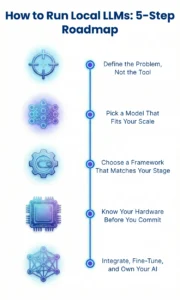
Start With the Problem, Not the Technology
The most common mistake teams make is picking a model before defining the use case. Whether you’re building an LLM-powered platform for customer queries, enabling real-time AI decision making for operations, or automating internal document search, the use case should drive every downstream decision about model size, hardware, and deployment approach.
Match the Model to Your Capacity
Smaller models like Phi and Gemma are efficient, capable, and well-suited to focused tasks on standard hardware. Larger models like Llama 3 70B handle more complex reasoning but need significantly more compute. Most organizations starting out to find the 13B–34B parameter range hits a practical sweet spot — capable enough for real business tasks, manageable enough to deploy without enterprise-grade GPU infrastructure.
Pick a Framework That Fits Your Stage
Ollama is the right starting point for teams just beginning to run local LLMs — straightforward setup, offline operation, good model support, and low overhead. vLLM is the production choice for high-throughput, multi-user environments where you need to run local LLMs at consistent speed under load. LM Studio works well for smaller teams that prefer a visual interface over a command line.
Know Your Hardware Constraints Up Front
GPU memory is the binding constraint. A 7B model runs on a 16GB VRAM consumer GPU. A 70B model needs enterprise-grade hardware or a multi-GPU setup. For lower-frequency use cases, CPU-only setups with tools like Ollama let businesses run local LLMs on standard server hardware — a useful entry point before committing to heavier infrastructure.
Build for Production From Day One
Connect your model to internal data sources via RAG, fine-tune on proprietary datasets, and integrate it with your existing applications and workflows via API. Set up monitoring, access controls, and logging before you go live — not after.
This is where working with experienced generative AI development services makes the biggest difference. Getting the architecture right from the start avoids expensive rework later and ensures your deployment is secure, scalable, and useful in production from day one.
Local LLMs Are Not Just a Technical Choice — They’re a Strategic One
Local LLM is a choice in the end, but it is a choice of control over the running of your data, costs, performance, and AI roadmap. When the regulatory pressure increases and the enterprise AI has reached maturity, self-hosted deployment is becoming the industry standard of the organizations that take their AI solutions seriously. Regardless of whether businesses are determined to develop an AI that will be secure, scalable, and strategically aligned, it is not a choice anymore but a necessity to have a local LLM running. At the AnavClouds Analytics.ai, we assist businesses in navigating this change using the correct architecture, models, and implementation strategy to realize the actual, quantifiable value of AI.
Frequently Asked Questions
What does it mean to run local LLMs?
Local running refers to running AI language models on your own infrastructure – it does not require cloud functionality, there is no data out of your network, and you have full control over both performance and privacy.
Why should businesses run local LLMs instead of using cloud AI?
Local LLMs offer a full ownership of data, reduce long-term expenses, reduce reaction time, and none reliance on vendors, which is why they are a more intelligent option in terms of security-conscious high-volume enterprise settings.
Which industries benefit most from running local LLMs?
The greatest benefits go to healthcare, finance, legal, and manufacturing as these are the industries where the concept of data privacy, regulatory compliance, and real-time decision making have no alternative ways of operations.
How much does it cost to run local LLMs for a business?
The first investment is hardware. The average business recovers in six to twelve months – beyond that, a local LLM will be substantially cheaper to maintain than the cloud API subscriptions on a large scale.
Can small businesses run local LLMs without a dedicated AI team?
Yes. It can be available even to lean teams with the help of such tools as Ollama. To implement AI in production grade, it is recommended to engage an expert AI development service that will implement it at a faster, safer, and cheaper rate.