



The field of legal operations is known for complex manual processes. Many tasks, such as contract management, research work, drafting legal documents, and ensuring regulatory compliance, usually need a lot of time and resources. Any innovation in the field is only adopted after a lot of consideration. In this blog, we shall navigate through the use of generative AI for legal operations, its benefits, applications, and any possible challenges.
Generative AI in Legal Operations
Legal professionals not only need to navigate the dynamic regulatory compliance landscape but also manage the increasing amount of data and case information. All of these demands immediate attention. The adoption of advanced technologies, especially artificial intelligence, can transform the entire sector in a good manner. With time, more and more legal professionals are switching to AI for streamlining their work, reducing manual efforts, and enhancing their services. Among the diverse AI technologies, generative AI technology promises to support many functions of the legal sector. Right from document management to client communication and AI in regulatory compliance, generative AI in legal operations is an all-in-one solution for the sector.
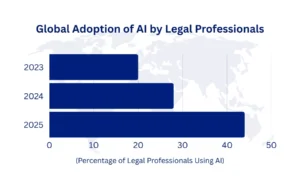
As of now, about 44% (almost half) of legal professionals globally use AI. This number has risen considerably from 20% in 2023 and 28% in 2024. These numbers show how the adoption of AI in legal operations is increasing every day. The technology is gradually becoming an important asset for legal professionals to increase their efficiency and reduce manual efforts. Many professionals rely on AI’s research capabilities, text generation, and summarization features. Let us dive further into the use cases of generative AI in legal operations.
Use Cases of Generative AI in Legal Operations
Generative AI is reshaping legal operations by automating complex functions, improving efficiency, and supporting decision-making. Generative AI streamlines several processes like contract drafting, document review, legal research, and compliance management. It saves time and also reduces human errors. Generative AI helps lawyers in identifying patterns, analyzing huge amounts of legal data, predicting case outcomes, and generating insightful strategies. It also plays an important role in managing legal risks, safeguarding sensitive information, and ensuring compliance.
-
Legal research optimization
Legal research is an important aspect of case preparation; it helps the team build strong arguments and stay up to date with laws and precedents. Generative AI in legal operations helps with case law analysis and retrieval by helping to find relevant legal information quickly. AI tools do so by going through a large amount of legal datasets and case studies. It also studies current trends to optimize an informed and effective case strategy.
-
Contract creation, evaluation, and oversight
AI helps draft contracts and manage them through thorough evaluation and oversight. Effective management of contracts ensures compliance, helps avoid risks, and streamlines the legal processes. AI tools simplify the management of contract-related tasks to improve efficiency and reduce errors. It automates contract drafting by generating customized contracts based on legal requirements. It also reviews and analyzes contracts to identify potential risks and opportunities in a contract. AI helps automate contract lifecycle management by giving reminders about upcoming contract renewals.
-
Document review and e-discovery
Document review and e-discovery are necessary to uncover crucial information and preparation of legal cases. AI tools enhance these processes for better document handling and case preparation. AI reviews documents and analyzes a large amount of other documents to compare and find evidence. AI for legal operations helps in organizing and managing e-evidence for legal proceedings. It classifies documents securely for easy access as required. It does a preliminary scan of documents to identify basic issues before human oversight.
-
Regulatory Compliance and monitoring
Laws keep evolving with time, and thus, it is hard to keep up with regulatory compliance. However, for the legal sector, compliance is crucial. Generative AI for legal operations helps analyze and assess documents for regulatory compliance. It also keeps an eye out for every update and facilitates real-time changes.
-
Litigation support and case preparation
An effective litigation support helps prepare for cases and enhances the outcomes with strategic insights and early evaluation. AI tools help analyze the case and prepare relevant and effective strategies. Through early assessment, AI in legal operations enables legal teams to decide whether to pursue, settle, or negotiate in specific cases.
-
Intellectual Property (IP) management
Proper management of intellectual property (IP) is necessary for encouraging innovation and reducing legal risks. AI tools support efficient handling of IP tasks to secure and protect valuable assets. It manages and tracks IP assets like patents, trademarks, and copyrights. It enables trademark surveillance and monitoring to protect it under different jurisdictions. Artificial intelligence also simplifies the review of licensing agreements.
-
Client engagement and self-service solutions
Generative AI for legal operations enhances client engagement by improving custom communication and streamlining routine tasks. This also frees up lawyers for better client engagement. It can happen through client support chatbots that provide real-time responses 24/7. AI development companies can help build AI-powered self-service client portals to handle basic queries independently. This reduces the lawyer’s burden of being available for minor queries and frees up time. AI systems also help automate the client onboarding process by collecting basic details and documents, classifying, and assigning the case to appropriate lawyers in a firm.
-
Knowledge management and automation
A well-organized knowledge management helps get easy access to legal information. This helps increase productivity without much effort. AI in legal sector helps create a legal knowledge base with a repository of all the legal knowledge and best practices. It becomes easy to access specific information through smart search and document summarization. An AI-powered chatbot can also be used to help trainees learn easily with a question-and-answer format of research.
-
Document automation and generation
Automation of the document creation process enhances efficiency and ensures consistency in legal documents. AI tools for legal work streamline the document generation process for accuracy. Especially for standard legal documents like contracts, agreements, and briefs, AI helps automate their generation. It can customize legal documents based on specific circumstances and requirements. AI tools can read and compare different versions of a document, utilizing natural language processing to understand context and highlight differences. It helps in legal citation and document formatting to reduce errors and improve compliance. AI tools also help in understanding legal documents through easy translations.
Benefits of Using AI for Legal Operations
We have seen how the legal sector is rapidly adopting generative AI for legal operations. There are several benefits of AI use in the legal sector, like:
-
Increased Efficiency
Generative AI for legal operations streamlines the amount of time spent on document drafting, research work, and analysis, saving time for lawyers to focus on more complex tasks. Thereby, it improves the efficiency of operations.
-
Improved Accuracy
The accuracy of AI algorithms allows professionals to use them for legal documents. This reduces manual errors and creates contextually relevant documents accurately.
-
Competitive Advantage
Law firms that harness the potential of AI can offer prompt and more personalized services. This improves customer satisfaction and gives a competitive edge over other competitors.
-
Data-driven Decision-making
The analytical capabilities of generative AI for legal operations allow firms to gain valuable insights through data analysis. This supports the decision-making process, resulting in informed and effective decisions.
-
Saving the time of Legal Professionals
By automating several routine tasks and basic queries of clients, AI tools save the time of legal professionals like lawyers. This frees them up for more complex and strategic, high-value tasks.
-
Long-term Success and Growth
Adopting genAI allows law firms to have an all-in-one business solution as well. It provides them necessary tools that help them adapt to the complexity and changing demands of their clients.
Challenges Regarding Generative AI for Legal Operations
When it comes to integrating generative AI for legal operations, law firms and organizations face certain challenges that need to be addressed beforehand. With careful consideration, these challenges can be addressed, and the potential of AI technologies can be put to legal use. These challenges mainly include:
- Data privacy and security concerns
- Regulatory compliance and ethical standards
- Accuracy and reliability of AI-generated output
- Integration with existing legal systems
- Implementation and maintenance costs
- Skills gap and training requirements
How Can AnavClouds Analytics.ai Help?
AnavClouds Analytics.ai is a trusted AI development company with first-hand experience in integrating AI tools in various industries. With experience comes expertise, and we take pride in our dedicated team of AI experts. With a demo consultation call to strategic planning, customizations, smooth deployment, and post-deployment support, you get a full support package when you choose us. Be it a law firm or any business across industries, our cloud services are accessible to everyone around the world. We provide excellent data analytics services, generative AI development services, and custom AI tools for your business growth. If you are planning to automate your workplace with AI agents or machine learning solutions, book a demo soon to understand the best solutions for your requirements.
Conclusion
The increasing adoption of generative AI in retail, marketing, and IT is quite well known. However, the legal sector has long been characterized by complex manual work and time-consuming paperwork. Generative AI technology has capabilities to automate and streamline even the legal sector with its accuracy, speed, natural language processing, and analytical features. Every business needs to integrate artificial intelligence tools in their workflow to remain competitive in the coming era of AI. With the help AnavClouds Analytics.ai, any business across industries can easily consider AI adoption in their organization.
FAQs
Can AI replace judges in court?
It is highly unlikely that AI will ever replace lawyers or judges in the legal sector. Although some AI agents work exceptionally good in the legal sector, but that is supposed to be used as an assistance and not as replacement. Artificial intelligence lacks human emotions which are necessary to consider in judiciary system.
How is AI used in legal?
Generative AI in legal operations is a useful tool for lawyers. Lawyers can use it for research, document management, and e-discovery phases.
Is LLM a type of generative AI?
Generative AI focuses on generating new content in different forms like text, images, sound, and even synthetic data. However, LLM specifically refers to the model that focuses on language; i.e. text generation. Thus, LLMs are generative AI but all generative AI are not LLM.
Can AI be used in a court of law?
Although using AI for support in legal procedure is allowed, courts focus on the importance of not relying on AI too much. AI should not replace human effort entirely in research and strategic proceeding of legal cases.
Can AI generate legal documents?
With the power of large language models (LLMs) utilizing natural language processing (NLP) and natural language generation (NLG), generatve AI models can create context aware, accurate, and compliance friendly legal documents.