



The concept of Edge AI in 2026 will be the new norm for the design and implementation of intelligent systems. When businesses produce huge amounts of real-time data, the conventional cloud-centric models cannot keep up. The future of Edge AI lies in more processing of intelligence at the point of origin, where speed, privacy, and reliability are the most important aspects. Competitive enterprises no longer have AI at the edge as an option. Scalability, resilience, and smarter decision-making are all strategic requirements. From advanced Edge AI use cases to agentic and multimodal intelligence, Edge AI in 2026 is reshaping how organizations operate across industries.
Why Edge AI in 2026 Matters for Businesses
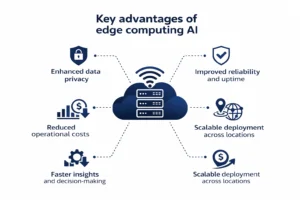
Edge AI in 2026 is developing into an essential core of the modern business that requires speed, robustness, and intelligent decision-making. The future of Edge AI lies in the decentralization of processing that does not rely heavily on the cloud to conduct real-time operations. With ever-increasing data volumes, the transmission of information to remote servers adds to latency and infrastructure expenses. Edge AI in 2026 will allow real-time analytics, as it will process data at the point of generation. AI at the edge enhances response times, better user experiences, and data privacy through the localization of sensitive information.
Operatively, Edge AI in business provides quicker insights, less cloud expenditure, and enhanced reliability of the system. The Edge AI technology enables an organization to operate at high performance levels even in low-connectivity areas. Common Edge AI use cases are predictive maintenance, intelligent retail, and smart mobile applications. To expand such capabilities, companies are turning more and more to the services of experienced AI development companies that develop safe, high-performance edge solutions in accordance with corporate objectives.
Driving Trends Behind Edge AI in 2026
The use of Edge AI in 2026 is rapidly growing and is being driven by the need by enterprises to have quicker intelligence, enhanced privacy, and deployable models. Major technological changes that transform the way AI at the edge is implemented across devices, environments, and industries are defining the future of Edge AI. These trends are changing Edge AI in business to be a support system instead of a fundamental digital strategy.
1. Real-Time Decision-Making Becomes Standard
Edge AI in 2026 will allow the systems to interpret and take action on data without dependence on the connection to the cloud in real time. Such a real-time feature is critical to the Edge AI applications, where latency is a source of danger or inefficiency. Autonomous vehicles, robotics, surveillance systems, and industrial controls depend on immediate responses. AI at the edge uses data collected by sensors in the area to make decisions fast, more safely, and reliably, and to deliver consistent performance in dynamic settings. Businesses also enjoy continuous business operations even in the case of network latency or outages.
2. Innovation in Hardware Accelerates Adoption
Powerful AI chips and energy-efficient processors are some of the factors that are propelling advancement in Edge AI technology. Through these advancements, intricate AI models can directly execute edge devices using little power. Hardware optimization lowers the cost of deployment and increases Edge AI in business in the fields of manufacturing, health care, and logistics. With the growth of processing power, organizations are becoming exposed to advanced analytics without being overly dependent on the cloud.
3. Hybrid Architectures Unlock Balanced Performance
The future of Edge AI will be based on hybrid architectures that integrate edge intelligence and cloud scalability. With edge AI in 2026, processes are being done locally, and model training and system coordination are handled on cloud platforms. This will provide speed, flexibility, and centralized control. Businesses are implemented in an optimized way without compromising scaling and governance.
4. Federated Learning Protects Data Privacy
The Edge AI of 2026 is based on a privacy-first design. Federated learning enables models to learn locally and share insights as opposed to raw data. Compliance and trust are enhanced throughout Edge AI deployments using this technique. To deploy secure and compliant edge systems, a number of organizations engage in AI development companies and AI development services.
Core Edge AI Use Cases Transforming Industries
Edge AI in 2026 will transform the ways industries are operated, as it introduces intelligence at the point of action. The future of Edge AI is informed by meaningful high impact uses that require speed, precision, and data confidentiality. With the maturity of AI at the edge, organizations are implementing Edge AI use cases that provide a tangible business value and less reliance on centralized cloud systems.
Manufacturing and Industrial Automation
Edge AI in 2026 is very important in intelligent manufacturing. On-assembly lines, AI can be used to detect defects in real-time to enhance the quality of a product and decrease waste. Through the Edge AI technology of predictive maintenance, anomalies in equipment are identified before failure. This will reduce downtime, reduce maintenance costs, and enhance efficiency in the running of industrial facilities.
Healthcare and Wearables
There are speed, privacy, and reliability cases that may be exciting in healthcare in relation to the use of Edge AI. The idea of edge AI in business assists in portable diagnostic tools as well as wearables that always track vital signs. AI at the edge handles sensitive patient data in place, enhancing the response time and preserving patient privacy. These functions are crucial in remote care, emergency care, and personalized healthcare provision.
Retail and Customer Experience
Retailers will use Edge AI in 2026 to improve customer interaction and operational flexibility. The edge AI technology allows tracking inventory in real-time, offering personalized recommendations in the stores, and removing cashiers at the checkout. On-device analytics enable retailers to respond immediately without the need to have cloud connection. Such Edge AI applications add value to satisfy customers and enhance the retail process.
Smart Cities and Urban Mobility
The intelligent urban infrastructure is based on Edge AI in 2026. AI at the edge enables traffic systems to become dynamic for congestion and incidents. Environmental sensors are driven by Edge AI technology that analyzes data on-the-fly and sends alerts. These applications enable safer mobility, effective management of resources, and urban planning that is driven by data in smart cities.
Emerging Advances Driving the Future of Edge AI
Edge AI in 2026 is in a new maturity state that is facilitated by intelligent autonomy, more comprehensive data insight, and enterprise-level customization. Faster processing is no longer the future of Edge AI. It is becoming smarter, self-directed, and more efficient. These developments are transforming the nature of value creation by Edge AI in business through real-world settings.
Multimodal Generative AI at the Edge
Multimodal generative AI is being incorporated in Edge AI in 2026 to process audio, text, images, and video as a unit. AI on the edge is now able to comprehend complex environments by synthesizing some data sources locally. This allows more intelligent interactions, quicker insight, and more human-like responses. Enterprises gain access to more valuable Edge AI applications without necessarily having to be connected to the cloud.
Agentic AI Evolution Across Devices
A massive change in the Edge AI technology is agentic AI. These systems are capable of planning, decision-making, and acting independently among devices. This progress of agentic AI enables local control of workflows by Edge AI in 2026, adapts to new conditions, and minimizes human intervention. This development enhances real-time functioning and raises the scalability of Edge AI in business.
AI Development Services and Competitive Edge
With improved adoption speed, organizations use focused AI development services to create custom solutions. The major AI development firms create safe, streamlined Edge AI systems in accordance with business requirements. The future of the Edge AI is guaranteed to perform well, comply, and achieve long-term competitive advantage when it comes to custom development.
Challenges and Strategic Considerations Ahead
The opportunities offered by edge AI in 2026 are high, and their implementation should be planned and done carefully. With Edge AI accelerating in the future, companies should be able to strike a balance between innovation and operational preparedness. The nature of edge AI in business has brought in novel technical, organizational, and governance issues that require a systematic approach and not a stand-by method.
Managing Energy Efficiency and Device Constraints
Control of the energy consumption of edge devices is one of the main issues of Edge AI in 2026. In many cases, AI on the edge is executed on small hardware, with very strict power requirements. The Edge AI technology needs to be streamlined in such a way that it provides high performance without consuming resources. To sustainably use Edge AI, businesses need to review hardware capabilities and model efficiency.
Maintaining Model Accuracy and Reliability
Stability in models applies in both directions, and this is why consistency of model accuracy is a vital issue in Edge AI in 2026. Performance may be affected by a lack of computing power and changes in data situations in the long-term. The development services of AI are essential in the optimization, monitoring, and updates of the model on a continuous basis. It will require consistent Edge AI in business to be based on adaptive learning and improving systems that do not need to stop.
Security, Privacy, and Governance Frameworks
Governance can only become a necessity as Edge AI systems become more autonomous. Edge AI needs stringent security measures, ethical standards, and a regulatory infrastructure in the future. Companies should establish reasonable data management policies, responsibility in decision-making, and system management. Collaborating with established AI development firms will assist in creating strong governance frameworks that will assist with scalable and responsible Edge AI implementation.
Conclusion
Edge AI in 2026 marks a critical shift toward faster, more autonomous, and privacy-first intelligence. Edge AI has a future of real-time decision-making, innovative Edge AI technology, and scalable hybrid architectures. The rise of Edge AI in business provides organizations with the opportunity to create long-term value by aligning strategy, infrastructure, and governance. It is a matter of success by engaging in the appropriate Edge AI applications and collaborating with the specialists who comprehend enterprise requirements. Our services at AnavClouds Analytics.ai assist businesses by utilizing AI development services to create secure, high-performance Edge AI solutions that not only result in quantifiable growth and sustainable competitive advantage.
FAQs
What is Edge AI and how does it work in 2026?
Edge AI in 2026 will denote the execution of artificial intelligence on hardware at the data generation site. It operates using locally processed data that is faster, reduces latency, and enhances data privacy without relying on the cloud all the time.
What are the main benefits of Edge AI in 2026?
Edge AI in 2026 will provide real-time decision-making, lower cloud expenses, and better security, as well as offer a more reliable system. The above advantages render AI at the edge to be suitable in time-constrained and data-intensive business applications.
What industries are using Edge AI the most?
The application of edge AI is universal in the manufacturing, healthcare, retail, transportation, and smart cities. In business, edge AI assists these industries to become more efficient, automated, and customer-friendly.
How is Edge AI different from cloud AI?
Edge AI is localized, and cloud AI is centralized using centralized servers. Edge AI in 2026 will reduce latency, provide offline support, and enhance privacy, which is why it is applicable in the critical real-time setting.