



Every plant manager has lived through it at least once. The line was running fine — production targets were being met; nothing seemed off — and then something failed. Not gradually, not with obvious warning signs, but suddenly enough to throw an entire shift into chaos.
What makes those moments so frustrating isn’t just the downtime. It’s finding out afterward that the data was there. Temperature readings were climbing. Vibration patterns have shifted. Something in the numbers had quietly changed days earlier — but nobody caught it in time. And with the global anomaly detection market projected to grow fromUSD 6.90 billion in 2025 to USD 28.00 billion by 2034 (Precedence Research), it’s clear the industry has already started paying attention to anomaly detection in manufacturing.
That’s the real problem anomaly detection in manufacturing solves. Not just monitoring data but making sense of it fast enough to do something about it.
What Is Anomaly Detection in Manufacturing?
At its core, anomaly detection in manufacturing means identifying when something on the production floor starts behaving differently from how it normally does — and flagging it before that difference becomes a breakdown, a defect batch, or a safety incident.
Most traditional monitoring tools work on rules someone set manually. A reading goes too high, an alarm fires. That approach works in simple, stable environments. In a modern manufacturing facility running multiple product types across different shifts and machine configurations, it falls apart quickly. The thresholds that made sense six months ago may not make sense today. And the subtle early signals that actually predict failures — the ones that don’t breach any hard limit — go completely unnoticed.
AI anomaly detection changes how this works. Instead of relying on pre-written rules, machine learning models study how each machine, line, and process actually behaves over time. They build a baseline that reflects real operating conditions, not theoretical ones. When something starts drifting from that baseline — even in ways that wouldn’t trigger a conventional alarm — the system picks it up.
This is what separates machine learning anomaly detection from traditional monitoring: it learns what normal looks like, so it can recognize when something isn’t. That’s what makes anomaly detection in manufacturing a fundamentally different capability from anything rule-based monitoring can offer.
Key Use Cases of Anomaly Detection in Manufacturing
Most conversations about anomaly detection in manufacturing start and end with predictive maintenance. That’s fair — it’s where the ROI is most visible. But limiting it to one use case is like buying a swiss army knife and only ever using the blade.
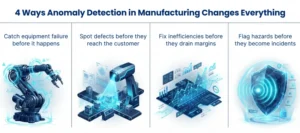
Predictive Maintenance: Catching Equipment Failures Before They Happen
Think about how maintenance decisions are made in most plants today. A technician walks the floor on schedule. They check what they can check. They replace what looks worn. And somewhere between two of those rounds, a machine that seemed fine yesterday decides it’s done.
The problem isn’t the technician — it’s the information they’re working with. Anomaly detection in manufacturing gives maintenance teams a live, continuous read on equipment health that no manual walkthrough can match. When an ML model has spent weeks learning how a specific motor behaves at different loads and temperatures, it starts noticing things that don’t show up on any checklist — a vibration pattern that’s shifted by a fraction, a current draw that’s climbing in a way that doesn’t match the operating conditions. Those are the signals that precede failures. Catching them a few days early is the difference between scheduling a two-hour intervention and dealing with a twelve-hour breakdown. That’s the kind of shift anomaly detection in manufacturing that makes it possible when it’s applied to equipment health.
AI-Powered Quality Control: Detecting Defects in Real Time
Defects that reach customers are expensive. Defects caught mid-line are manageable. Defects caught before they ever form — by spotting the process conditions that produce them — are where AI anomaly detection really earns its place in quality operations. This is exactly where anomaly detection in manufacturing proves its value beyond the maintenance department.
Visual inspection systems trained on actual production data don’t just look for known defect types. They pick up patterns that correlate with quality drift — changes in surface texture, dimensional variation, inconsistencies in how a product moves through a stage — and flag them before a full batch is compromised. For operations running tight tolerances or high-mix product lines, that capability matters enormously. It’s not about replacing inspectors. It’s about giving them something more useful than their eyes alone.
Process Stability: Fixing the Anomalies That Don’t Trigger Alarms
This is the use case that gets the least attention and causes some of the most persistent damage. A machine isn’t failing. Quality isn’t obviously off. But cycle times are slightly longer than they should be. Yield is a point or two below target. Energy consumption is higher than the production volume justifies.
None of these triggers an alarm. None of them shows up as a problem in a daily report. But they’re all symptoms of process drift — and manufacturing data analytics built around industrial anomaly detection can find them by looking across multiple data streams at once. Anomaly detection in manufacturing, applied to process data, surfaces these patterns before they become structural problems. When you can see how process parameters, machine behavior, and output quality relate to each other over time, the patterns behind these slow-burning inefficiencies become hard to miss.
How Industrial Anomaly Detection Improves Workplace Safety
Safety monitoring tends to rely heavily on periodic audits and incident reporting — which means most of the data arrives after something has already gone wrong. AI in manufacturing shifts that dynamic by watching continuously for the conditions that precede incidents, not just the incidents themselves. This is why anomaly detection in manufacturing is increasingly being applied to safety monitoring, not just equipment reliability.
Pressure readings are drifting outside their normal range. Thermal patterns near electrical systems that don’t match historical behavior. Environmental readings that are technically within limits but trending in the wrong direction. These aren’t the kinds of signals that show up on a daily walkthrough. But they’re exactly what a well-configured industrial anomaly detection system catches — and acting on them early is far cheaper than any alternative.
Reactive vs. Predictive: Why Traditional Maintenance Fails Modern Manufacturing
Walk through most manufacturing plants today, and you’ll find maintenance teams caught between two imperfect approaches — and the limitations of both are well understood by the people living with them.
Reactive maintenance means waiting until something breaks. The repair itself is usually the least expensive part of the problem. What follows — cascading equipment damage, halted lines, missed shipments, and the scramble to source replacement parts under pressure — is where the real costs pile up.
Preventive maintenance tries to get ahead of that, but it’s built on a simplification that rarely holds in practice: that every piece of equipment degrades a predictable, time-based schedule. The reality is that two identical machines running different products at different loads in different environments won’t degrade at the same rate. Applying the same maintenance interval to both means over-maintaining one and under-maintaining the other.
Machine learning anomaly detection gives maintenance teams a third option — one that’s based on how equipment is actually behaving right now, not on averages or assumptions. It doesn’t replace scheduled maintenance entirely. It makes the decisions behind it smarter, so teams are intervening when the data says it’s needed rather than when a calendar says it’s due. This is precisely the gap that anomaly detection in manufacturing fills — condition-based intelligence that neither reactive nor preventive models can provide.
Data Readiness for AI: The Step Most Manufacturers Skip
Getting anomaly detection in manufacturing right starts long before any model is trained. There’s a version of this conversation that jumps straight to algorithms and model accuracy — and that version skips the part that determines whether any of it works in production.
Manufacturing environments carry years — sometimes decades — of accumulated data complexity. Different machines log data in different formats. Legacy systems that weren’t designed to talk to each other. Sensor data that’s inconsistently labeled or stored in ways that make it difficult to use at scale. OT and IT environments have historically operated in separate worlds.
Data readiness for AI is the process of addressing all of that before a model ever gets built. It means creating unified data pipelines that connect disparate sources, establishing governance structures that keep data clean and trustworthy over time, and making sure the information feeding a machine learning anomaly detection system reflects what’s happening on the floor — accurately and consistently.
This is the step most manufacturers underestimate. It’s also the step that most often determines whether an AI and ML system development project delivers lasting value or stalls after a promising proof of concept. The right AI consultancy partner treats data infrastructure as seriously as model development — because without it, even the most sophisticated machine learning solutions produce outputs nobody can rely on.
What Does a Manufacturing Anomaly Detection System Actually Include?
When teams ask what anomaly detection in manufacturing actually looks like end-to-end, the honest answer is: more than most vendors lead with.
The visible part — the dashboard, the alerts, the model outputs — is what gets shown in demos. What actually determines whether a manufacturing anomaly detection system works in a real production environment is everything underneath that.
Data has to come from somewhere. In most manufacturing facilities, that means pulling from IoT sensors, vision inspection systems, MES platforms, SCADA outputs, ERP records, and machine event logs — often simultaneously, often from systems that weren’t originally designed to share information. Getting that data to flow cleanly, consistently, and in a format that a model can actually use is genuinely hard work. It’s also non-negotiable. A model trained on patchy or poorly contextualized data doesn’t produce reliable outputs — it produces noise with a confidence score attached.
Once the data infrastructure is solid, the models themselves need to be built around how your specific equipment behaves, not around generic industrial averages. Machine learning anomaly detection that’s calibrated to one facility’s operating conditions will always outperform a pre-trained model dropped into a new environment without adjustment. That calibration process takes time and domain knowledge — but it’s what separates a system that teams trust from one they learn to ignore.
Then there’s the question of what happens when an anomaly is actually detected. An alert that goes to a generic inbox and sits there isn’t useful. Machine learning solutions built for production environments route findings into the workflows where action can happen — maintenance ticketing, quality holds, supervisor notifications — with enough context attached that the person receiving it knows what they’re looking at and what to do next.
And none of these stays fixed. Production environments change. New products get introduced. Equipment ages. Seasonal demand shifts operating patterns. A manufacturing anomaly detection system that isn’t designed to adapt to those changes will gradually become less accurate and less trusted over time. Manufacturing software development done properly for this space includes the MLOps infrastructure to retrain and recalibrate models as conditions evolve — without pulling the system offline every time an update is needed. That’s what a production-ready anomaly detection in manufacturing setup looks like — not a dashboard, but a fully connected operational system.
Final Thoughts
The manufacturers who are pulling ahead right now aren’t the ones with the most machines or the largest headcount. They’re the ones who figured out how to make their data work harder than their problems. Anomaly detection in manufacturing is a big part of how that happens — turning the signals already flowing through a production environment into early warnings that protect uptime, quality, and profitability before they’re at risk.
Getting there isn’t just a technology decision. It’s a data infrastructure decision, a process integration decision, and a people decision. The right foundation for anomaly detection in manufacturing is part technology, part data strategy, and part operational alignment. At AnavClouds Analytics.ai, we’ve helped manufacturers across industries work through all three — building AI anomaly detection capabilities that go live fast, hold up over time, and deliver outcomes that show up in operational metrics, not just dashboards. If you’re ready to move past reactive operations, we’re ready to help you do it.
Frequently Asked Questions
What does anomaly detection in manufacturing detect?
It spots unusual behavior in equipment, production processes, and product quality — catching early warning signs before they turn into failures, defects, or unplanned stoppages.
How does AI anomaly detection reduce manufacturing downtime?
It monitors equipment around the clock and picks up subtle performance shifts that signal trouble ahead — giving teams time to act before a breakdown happens.
Is machine learning anomaly detection suitable for small manufacturers?
It works across operations of all sizes. What matters more than scale is data availability and how well the system is configured to the specific environment it’s operating in.
How long does it take to deploy a manufacturing anomaly detection system?
It depends on how complex the existing infrastructure is. With a solid data foundation, anomaly detection in manufacturing deployments can go live within weeks and scale from there.