



The operations in warehouses are changing fast with businesses experiencing increasing demand, complicated supply chains, and heightened customer expectations. AI in warehouse management nowadays is one of the primary forces of efficiency and expansion in this rapidly evolving environment. Through AI and machine learning, companies may automate their processes and enhance accuracy, as well as obtain real-time visibility in operations. With the automation of AI warehouses and the next step of smart warehouse technology, organizations are turning traditional systems into a highly responsive and scalable environment. It is not merely a move towards automation, but the creation of intelligent warehouse operations that can scale, optimize, and provide a steady performance in contemporary supply chains.
What is AI in Warehouse Management?
AI in Warehouse Management can be described as the application of modern technologies, such as AI and machine learning, to streamline and automate the work of warehouses. It assists companies in optimizing operations to increase the precision and efficiency of operations in contemporary warehouses.
Contrary to the past system of warehouse management, the AI-based system of warehouse management can learn and adapt to real-time information and business trends. These systems respond to changes in demand and conditions with better flexibility and responsiveness to processes. This transformation promotes smart warehouse functions that minimize delays and enhance overall productivity.
The introduction of smart warehouse technology allows businesses to have real-time access to inventory, movements, and performance metrics. The AI decision-making process is faster and more precise due to the use of AI, which helps to control the inventory effectively and simplify the order delivery process. Moreover, computer vision is used to improve precision through automated scanning, tracking, and quality control.
This applies equally to the use of AI in supply chain management, as the implementation of AI warehouse automation builds a networked and effective ecosystem. The new technologies, such as GenAI in warehouse management, are even better at enhancing planning and optimization, which can assist the business in converting traditional facilities to high-performing and scalable smart warehouses.
Why AI in Warehouse Management is Driving the Shift Toward Smart, Scalable Warehouses
Efficiency has been brought to the forefront of current business owing to the accelerated development of e-commerce and international logistics. Businesses are moving towards automation of AI warehouses to handle large volumes of orders without compromising speed and accuracy. This change indicates the increasing significance of AI in Warehouse Management in the construction of scalable and future-oriented operations.
Improved Operational Efficiency
AI in Warehouse Management enhances efficiency through the automation of tedious activities such as picking, sorting, and packing. AI and machine learning enable warehouses to optimize workflows, cut human labor, and improve the speed of operations, allowing warehouses to be faster and more productive in modern smart warehouses.
Real-Time Inventory Visibility
Through AI-powered warehouse management and smart warehouse technology, the business forms real-time access to inventory movements. In supply chain management, AI will constantly monitor the stock level, minimize discrepancies, and enhance the planning process, as it enhances coordination between AI to ensure smooth operations.
Reduced Human Errors
Automation of AI warehouses has removed human errors through automation of important activities such as scanning and sorting. The high-order computer vision applications can enhance precision in the inventory management and quality inspection process to guarantee reliability in fulfilling orders and overall efficiency in smart warehouse management.
Cost Optimization
AI in Warehouse Management is beneficial in lowering the operational cost through better efficiency and reduced errors. The AI-based warehouse management helps businesses to optimize labor, minimize waste, and improve resource allocation to achieve improved profitability and scalable growth in competitive supply chain settings.
Enhanced AI Decision Making
The high-level analytics helps to make decisions on AI more rapidly and accurately in warehouses. Providing real-time insights and predictive functionality, AI in Warehouse Management can assist businesses to react fast to demand fluctuations, optimize operations, and enhance the overall performance in dynamic supply chain settings.
Key Technologies Powering Smart Warehouse Technology
The blending of powerful technologies is bringing the rapid development of AI in Warehouse Management. These technologies allow intelligent warehouse technology, enhance efficiency, and facilitate highly intelligent warehouse operations throughout contemporary supply chains.
Machine Learning Algorithms
The application of AI and machine learning is essential in the efficient optimization of the work of the warehouse by comparing past and present data. Such algorithms can assist in forecasting demand trends, optimizing stock quantities, and simplifying operations, which will allow managing AI-run warehouses more efficiently and enhance the overall accuracy of operations.
Computer Vision Applications
The computer vision applications further improve AI in Warehouse Management by allowing automatic scanning of objects, detecting objects, and performing quality inspections. These systems enhance error reduction during the sorting and inventory tracking and save on manual errors, hence making the warehouse operations quicker, more dependable, and in harmony with the latest smart warehouse technology.
Autonomous Mobile Robots (AMRs)
The AI warehouse automation is the autonomous Mobile Robots that move around warehouse environments. They move products, help in picking products, and ease human resources by handling products. The speed is increased, labor reliance is lowered, and scalable intelligent warehouse functions are enhanced in environments with high demands via this automation.
Predictive Analytics
Predictive analytics enhances AI in managing the supply chain through forecasting demand patterns and detecting the bottlenecks of operations. It allows companies to organize inventory and staffing needs more efficiently, which means operations in AI-driven warehouse management systems will be streamlined and use resources more efficiently.
Generative AI (GenAI)
Optimization of workflows and decision-making GenAI in warehouse management is changing the manner in which businesses make and optimize decisions. It allows simulating the scenarios, automated reporting, and smart insights, improving AI decision making, and assisting organizations in creating more adaptive, efficient, and future-ready intelligent warehouses.
Core Use Cases of AI in Warehouse Management
The use of AI in Warehouse Management is fast growing with companies seeking better efficiency, accuracy, and scalability. The AI-driven warehouse management allows for smarter, quicker, and more dependable operations in contemporary smart warehouses, including inventory control, optimization of logistics, etc.
Inventory Optimization
AI in Warehouse Management applies to AI and machine learning to comprehend the demand trends and ensure an optimum level of inventory. This minimizes overstocking, stockouts, and enhances efficiency in storage. Real-time insights also help businesses to plan better and conduct intelligent warehouse activities.
Order Picking and Packing
Automation in AI warehouses improves picking and packing jobs by robotizing and making the warehouse intelligent. These solutions will accelerate, improve precision, and minimize manual effort. Through the optimization of the workflow, companies increase the rates of order fulfillment and demonstrate continuity in performance in AI-based warehouse management systems.
Demand Forecasting
Through advanced analytics, AI in supply chain management can be used to make accurate predictions of demand based on both historical and real-time information. This assists businesses in predicting customer demand, minimizing inventories, and minimizing wastage. With better predictions, planning is reinforced and aids effective operations throughout smart warehouse technology systems.
Route Optimization
AI streamlines internal warehouse operations and external logistics paths to increase the speed of deliveries and make them more efficient. With AI decision making, companies can save on the amount of time spent traveling, optimize resource allocation, and maximize delivery time, and the process of conducting business in AI-enhanced warehouse management systems becomes more efficient.
Quality Control
The computer vision application is critical in quality control, as it can be utilized to identify flaws and correct the product prior to delivery. This minimises returns and enhances customer satisfaction. Inclusion of AI-based usage of quality checks improves reliability and general performance in smart warehouse processes.
Expanding Role of AI in Supply Chain Management Beyond Warehouse Operations
The role of AI in warehouse management is rapidly expanding beyond internal operations and into the broader supply chain ecosystem. With the rise of AI in Warehouse Management, businesses are now building interconnected systems that improve visibility, coordination, and efficiency across every stage of the supply chain.
AI in supply chain management connects warehouses with suppliers, distributors, and logistics partners through real-time data and intelligent automation. This integration creates a unified ecosystem powered by AI-powered warehouse management and smart warehouse technology, enabling faster communication, improved planning, and seamless execution across operations.
AI enables:
- Better demand planning and forecasting
- Faster response to disruptions
- Improved supplier collaboration
- Real-time shipment tracking
By leveraging AI and machine learning, businesses can enhance AI decision making, reduce operational delays, and optimize end-to-end workflows. This level of integration ensures smoother, more efficient operations while strengthening the overall performance of intelligent warehouse operations and the entire supply chain network.
Key Benefits of AI-Powered Warehouse Management
Implementing AI in Warehouse Management empowers companies to realize an objective value of efficiency, accuracy, and scalability. As AI-based warehouse management and smart warehouse technology are integrated, organizations will be able to convert the usual workflows into the most optimized intelligent warehouse processes.
Increased Productivity
Automation in the AI warehouse can greatly enhance productivity through the provision of less manpower and automation of monotonous work. Assisted by AI and machine learning, warehouses enhance throughput, optimize labor utilization, and guarantee faster accomplishment of daily operations in contemporary smart warehouses.
Higher Accuracy
AI in Warehouse Management improves accuracy in that it automates the process of tracking inventory and orders. Such technologies as computer vision applications guarantee the accuracy of scanning and verification and minimize fulfillment errors. The result is the trustworthy performance and efficiency of AI-based warehouse management systems.
Faster Operations
AI decision-making can offer real-time observations and automation to ensure faster processes at the warehouse. Businesses are able to facilitate faster picking, packing, and shipping times and enhance turnaround times. This pace enhances general results and facilitates smooth collaboration in the AI of supply chain management.
Scalability
AI-based warehouse management allows companies to scale without massive infrastructure expenditures. Artificial intelligence systems respond to demand and optimize resources and are efficient. This flexibility has enhanced the ease of expansion of operations without compromising the consistency of its performance in intelligent warehouse operations.
Better Customer Experience
AI in Warehouse Management can deliver faster and improve the accuracy of filling orders, enhancing customer satisfaction. Transparency and reliability are improved by real-time tracking and optimized logistics. This gives rise to greater trust and loyalty in the customers amidst high competition in the market.
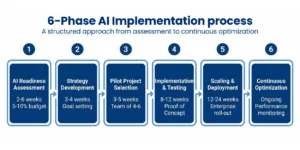
How to Get Started with AI in Warehouse Management
AI in Warehouse Management should be implemented in a gradual and strategic way to achieve success in the long-term. With a combination of AI-based warehouse management, intelligent warehouse technology, and the appropriate implementation strategy, companies can develop effective and scalable intelligent warehouse activities.
Assess Current Operations
Start with the analysis of existing workflows, detecting their inefficiency, and assessing performance gaps. This assists in identifying the areas where AI in Warehouse Management can be used to provide the best results. A clear evaluation will guarantee the enhanced congruence of the automation of AI warehouses with business objectives and priorities in operation.
Choose the Right Technology
Choose the tools to aid AI-powered management of the warehouse and fit your operational requirements. Take into account the platforms that make use of AI and machine learning, predictive analytics, and automation. The appropriate foundation of technology guarantees the adoption of smart warehouse technology to be scaled and efficient.
Integrate with Existing Systems
Achieve the smoothness of AI solutions with the existing Warehouse Management Systems (WMS). Adequate integration will enhance data flow, better visibility, and coordination in AI in supply chain management, resulting in more integrated and efficient warehouse operations.
Partner with Experts
Partnership with the providers of AI development services would make the implementation process more unproblematic and quicker. Professionals can design, deploy, and optimise AI in Warehouse Management solutions, mitigate risks, and allow business organisations to create trustworthy and scalable intelligent warehouse operations.
Monitor and Optimize
Monitor performance at all times with analytics and real-time insights. The artificial intelligence decision-making process can be used to establish areas of improvement and streamline the processes over time. Frequent tracking helps to guarantee that AI warehouse automation is able to provide consistent value and adjust to the evolving needs of the business and supply chain.
Conclusion
The use of AI in Warehouse Management is no longer a choice made by companies that want to remain competitive and scalable. Having such features as AI decision making, computer vision applications, and predictive analytics, organizations will be able to simplify their operations, save money, and improve overall efficiency. With the continuous development of AI-controlled warehouse management, the first companies to invest in it will be at a great competitive edge in terms of speed, accuracy, and customer satisfaction. Collaboration with such professionals as AnavClouds Analytics.ai will make the implementation process smooth and successful in the long term, making businesses realize the full potential of AI-driven, smart warehouse technology and supply chain operations of the future.