



The retailers are increasingly struggling with the difficulties of selling in multi-channel formats, a wide range of products, and changing consumer demand. AI for Inventory Management assists companies in making smarter inventory choices using Artificial intelligence in inventory management, machine learning algorithms, and AI-powered predictive analytics. These technologies process high volumes of data, predict demand correctly, and use robots to plan stocks in an efficient way to minimize these inventories in retail. Through operation risk reduction, avoiding imbalances in stocks, and ensuring optimal availability of products, retailers can utilize AI in retail inventory management and Advanced AI technologies, which are transforming inventory management in the modern AI in retail industry.
Why Retailers Need AI for Inventory Management Today
One of the most complicated issues in retail operations is inventory management. Retailers are always faced with volatility in demand, supply chain failure, and poor methods of stock forecasting.
The conventional systems are very reliant on manual analysis and fixed reporting, which cannot be able to adjust fast to the changing consumer behavior. The increasing number of retail processes being conducted through several channels makes inventory management a challenging task.
This is the reason why many companies are integrating AI for inventory management with a view to injecting automation, intelligence, and real-time intelligence in inventory planning. The implementation of Artificial Intelligence in inventory management helps retailers keep track of inventory in real-time and react fast to changes in demand.
AI-powered predictive analytics can look through past sales trends, weather data, promotions, and consumer behavior to predict demand more effectively. This will enable the retailers to have the best level of stock without overstocking or shortages of merchandise.
Other benefits of implementing AI in retail inventory management include increased supply chain coordination and efficiency in the organization’s warehouse. Consequently, it leads to improved retail inventory optimization by businesses, lower operational costs, and enhanced profitability.
Transform retail operations with AI for Inventory Management and achieve smarter inventory decisions.
How AI for Inventory Management Works in Retail
Contemporary retailing landscapes produce colossal amounts of operational and consumer information daily. AI for inventory management processes complicated information to produce intelligent data, which can be used to make faster and more precise inventory choices. Through incorporating Artificial intelligence in inventory management, machine learning algorithms, and AI-driven predictive analytics, retailers will be able to automate the forecasting process, manage inventory levels optimally, and enhance retail supply chain operations.
Data Analysis Using Artificial Intelligence in Inventory Management
Retail systems receive POS systems, warehouses, online platforms, and supply chain network data daily. Continuous analysis of this information by artificial intelligence in inventory management can identify patterns, trends, and correlations that can guide the inventory demand in the AI in the retail industry.
Demand Forecasting with Machine Learning Algorithms
Hi-tech machine learning algorithms learn the sales trends, seasonal demand fluctuations, promotions, and customer behavior indicators. These models enhance the accuracy of the forecasts and assist the retailers in earlier predicting the demand trends so that the retail inventory optimization and proactive planning of stock can be used.
Pattern Detection Through Machine Learning Tools
The contemporary machine learning applications identify latent purchasing behavior and product demand indicators, which are usually ignored by the old inventory management system. The data obtained through the application of AI in retail inventory management can give valuable insights to retailers that can be used to make automated replenishment decisions and more intelligent inventory distribution strategies.
Unified Systems with Advanced AI Technologies
Numerous retailers deploy Advanced AI technologies that combine inventory intelligence with ERP systems, warehouse management systems, and POS networks. This integrated ecosystem maintains a smooth flow of data and allows it to track inventory flows in real time in all retail channels.
Real-Time Insights Through AI-Powered Predictive Analytics
AI-powered predictive analytics enables retailers to have real-time insight regarding changing demand, product performance patterns, and possible supply chain breaks. These are the insights that enable businesses to make quicker decisions and keep their inventories optimized.
Intelligent Inventory Allocation Across Retail Channels
With an AI for inventory management, retailers can dynamically place products in warehouses and stores, as well as online fulfillment centers. This is an intelligent distribution strategy to ensure that the right products are at the right location at the right time.
Top Benefits of AI for Inventory Management in Retail
The current retail environment is a very competitive one, whereby the accuracy of inventory has a direct effect on the profitability and satisfaction of customers. AI for inventory management assists companies in automating forecasting, gaining visibility, and optimizing supply chains. Retailers can utilize machine learning based on algorithms, AI-based predictive analytics, and Advanced AI technologies to optimize retail inventory in a smarter way. The available benefits describe why Artificial intelligence in inventory management is changing operations in the AI in retail industry.
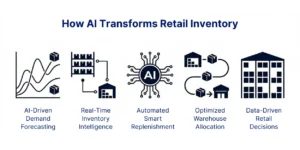
1. Accurate Demand Forecasting
AI for Inventory Management enables highly accurate demand forecasting using ML algorithms and AI-powered predictive analytics. The systems evaluate historical sales, seasonal demand, promotions, and customer behavior. The retailers have enhanced retail optimization of inventory, minimizing the risks of stockouts and excess stock.
2. Real-Time Inventory Visibility
Artificial intelligence in inventory management gives retailers centralized inventory visibility. AI in retail inventory management, POS systems, warehouses, and supply chain platforms are integrated to track the product movement in real time. Such transparency helps in ensuring quicker decision-making and efficient inventory tracking throughout retail operations.
3. Intelligent Stock Replenishment
AI for inventory management is an automated replenishment decision maker based on sophisticated machine learning algorithms and smart forecasting models. These systems identify the trends in demand in advance and automatically activate restocking. Retailers maintain optimal stock levels while improving supply chain responsiveness within the evolving AI in retail industry.
4. Reduced Operational Costs
The application of AI for inventory management lowers operational costs in terms of warehousing, logistics, and handwritten inventory tracking. The companies use the power of Advanced AI and machine learning tools to automate their operations, minimize mistakes, and optimize workflows, enhancing operational efficiency and profitability, in the end, respectively.
5. Improved Customer Experience
Retailers using AI for inventory management provide customers with improved experiences and maintain regular product availability. Predictive analytics based on AI is useful in allocating products across channels when it is efficient. This will guarantee customers get the preferred products fast, boosting satisfaction and loyalty to the brand in the competitive AI in retail industry.
Real-World Applications of AI for Inventory Management in Modern Retail
Problems like intricate supply chains, variable demand, and increasing product catalogs are becoming challenges that are being addressed by retailers using AI for inventory management. Using Artificial intelligence in inventory management allows the business to automate decision-making, have more accurate forecasts, and make smarter retail inventory optimisation.
The high-performance solutions that run on machine learning algorithms, predictive analytics fueled by AI, and Advanced AI technologies provide retailers with the ability to process extensive amounts of operational data in a short period of time. The systems can assist businesses to respond more efficiently to demand changes, optimize inventory allocation, and enhance supply chain efficiency with the dynamic AI in retail industry.
Key Highlights of AI in Retail Inventory Management
- Demand Pattern Analysis: Retailers apply machine learning systems to predict customer demand patterns and seasonal changes in demand for various products.
- Predictive Stock Planning: This AI-based predictive analytics will allow any business to predict demand in the most accurate way and stock up before major retail seasons.
- Warehouse Optimization: AI for inventory management assists in defining areas with the highest demand for warehouses and supply chain performance.
- Dynamic Pricing Insights: Artificial intelligence in inventory will examine how pricing and promotions affect product demand and stock turnover.
- Marketing and Inventory Alignment: Retailers apply AI in retail inventory management to match marketing campaigns with stock and prevent overstocking and shortages.
By implementing AI for inventory management, retailers can have access to data-driven insights that enhance decision-making processes, reinforce supply chain activities, and support long-term growth in the competitive AI in retail industry.
The Role of Generative AI in Inventory Management
Whereas predictive AI is interested in forecasting, generative AI solutions present new functions of retail inventory management. Generative systems are capable of replicating various inventory conditions and statistically creating optimal plans.
The retailers are also aggressively moving towards the use of Generative AI Development services to enhance supply chain planning and demand forecasting. Such systems create different inventory planning scenarios depending on different conditions of demand.
As an example, one can use generative models to model a spike in demand during holidays, supply chain breakdowns, or unforeseen changes in the popularity of a specific product. The businesses are then able to make contingency plans.
When integrated with AI for Inventory Management, generative AI provides a powerful decision-support system for retailers. Technology assists businesses in making smarter inventory planning decisions faster.
Challenges Retailers Face Without AI for Inventory Management
The retailers who are dependent on the old method of inventory system mostly have difficulties in dealing with the increasing complexity of operations. Without AI for Inventory Management, businesses face limited forecasting capabilities, fragmented data visibility, and inefficient stock planning.
The contemporary retail contexts produce vast quantities of stock and sales information daily. Nonetheless, it is hardly possible to analyze this information correctly without Artificial intelligence in inventory management. This leads to operational inefficiencies by the retailers, which directly translate into profitability and customer satisfaction in the dynamic AI in retail industry.
Inaccurate Demand Forecasting
The traditional forecasting techniques are based on historical information and the use of manual calculations. Retailers cannot predict demand changes with high accuracy without machine learning algorithms and predictive analytics based on AI. This usually results in stock outages, misplaced sales, and poor retail inventory.
Frequent Stockouts and Overstocking
Retailers do not tend to keep the best levels of stock in their stores and warehouses without AI for inventory management. Poor forecasting would lead to overstocking or out-of-stock products. All these complicated operations cause bad customer experience.
Limited Visibility Across Inventory Systems
Customers with retailers using more than one channel of sale are usually faced with disjointed inventory information. In the absence of AI in retail inventory management, companies will not be able to monitor the movement of stocks in warehouses, online stores, and retail outlets with ease. This invisibility interferes with the effective management of inventory.
Inefficient Data Processing and Decision-Making
Contemporary retail activities produce huge datasets on a daily basis. It will be slow and inefficient to analyze such datasets without Advanced AI technologies and machine learning tools. Retailers are losing opportunities to access useful information that would enhance forecasting and supply chain performance.
Difficulty Adapting to Market Changes
Promotions, seasonal trends, and market conditions are some of the factors that keep consumer demand patterns constantly changing. Without AI-powered predictive analytics, retailers cannot respond quickly to these shifts. Using AI in inventory management allows companies to respond more quickly and stay competitive.
Why Businesses Should Partner with AI Experts
In the implementation of advanced inventory intelligence, strong technical skills and experience in the industry will be required. There are a lot of companies that cooperate with special providers that provide AI development services and Generative AI Development services.
A skilled AI consultancy partner could assist companies in determining the most appropriate technologies, creating custom AI models, and embedding solutions in a unified way. Such alliances speed up the process of digitalization and reduce the risk of implementation.
Retailers also have the advantage of ongoing optimization, system enhancement, and planning of AI roads. Under professional supervision, companies will have the opportunity to realize the full potential of AI in inventory management.
Conclusion
AI for inventory management is an essential technology for achieving long-term business success because of the increasing complexity in retail operations. By using Artificial Intelligence to make supply chain optimization, AI-based predictive analytics, and machine learning algorithms, retailers can optimize their supply chains, minimize inventory expenses, and enhance the accuracy of demand predictions. These are smart solutions that allow the optimization of retail inventory and allow businesses to react fast to the varying consumer demand in the changing AI in retail industry. AnavClouds Analytics.ai provides robust AI development services for advanced generative AI solutions to organizations intending to implement smarter solutions for retail operations.