



The contemporary business world is dynamic and quite competitive due to the dominance of data and uncertainty. Any decision influences development, productivity, and sustainability. The conventional decision models are unable to absorb the increasing amounts of data and real-time indicators. This disconnect has enhanced the use of AI in decision making in industries. Artificial intelligence is applied by organizations to examine patterns, make predictions, and minimize risks. AI decision making allows making decisions more quickly, more accurately, and consistently. Enterprises can no longer rely on intuition to make decisions by integrating automation, analytics, and intelligence. Intelligence based on decision-making with data is now critical towards maintaining competitiveness, agility, and operational excellence.
What AI Decision Making Means for Enterprises
AI decision making helps enterprises transform huge amounts of data into viable and precise business information. It combines historical and real-time information through artificial intelligence systems. Decision-making in artificial intelligence removes uncertainty from critical enterprise workflows. The use of artificial intelligence in decision making assists in strategic, operational, and tactical decisions at the departmental levels. AI for decision making is applied by enterprises to ensure consistency and congruence. This develops a centralized layer of intelligence that enhances visibility, coordination, and accountability within an organization.
Adaptive learning and feedback loops enhance the AI decision making continuously. AI algorithms are adaptable to the results, performance metrics, and business-changing conditions. This minimizes the bias but maximizes accuracy and reliability in the long run. Organizations use AI-powered decision-making in cases where human judgment is needed to provide a context. AI-based decision-making implements the actions independently in the situation when speed and scale are the most essential factors. A successful AI implementation can assist businesses to make decisions more quickly, make improved choices, and grow sustainably.
Transform your business with predictive insights, faster actions, and scalable intelligence using AI-powered decision-making solutions.
Why Traditional Decision Models Fail at Scale
Conventional decision models were developed in slower environments with scanty data. Due to business expansion, the complexity of decisions arises in functions as well as in markets. Paper methods are unable to be real-time. The result of this gap is sluggish execution, uneven results, and operational risk. Scaling decisions become ineffective and untrustworthy without intelligent support.
Limited Capacity to Handle Growing Data Volumes
Conventional models of decisions are based on limited datasets and automated methods of analysis. Processing is slow and incoherent as the amount of data grows. Teams have difficulty assessing real-time information. This decreases the accuracy and relevance of the decision. These restrictions are magnified by scaling among departments.
Dependence on Assumptions and Historical Patterns
Traditional models are based on previous data and predetermined assumptions. They are not able to adjust to business conditions that keep changing at an alarming rate. Changes in the market tend to nullify past trends. Risky decisions are made on old assumptions. This inflexibility constrains scalability.
Human Bias and Inconsistent Judgment
Cognitive bias and emotional influence are induced through human-based decision making. Consistency is further decreased by fatigue and pressure. Individuals and teams make different decisions. With the growth of organizations, inconsistency increases. This undermines the overall cohesiveness in the enterprises.
Slow Response to Real-Time Changes
Conventional models are unable to take real-time data. The speed of the market gets out of step with the decision cycles. Late responses are caused by late understanding. Opportunities and threats are ignored. Under scale, competitive advantages are destroyed.
Fragmented Decision-Making Across Functions
Making decisions is usually solitary and in separate departments. Data silos do not allow you to see the business in a unified way. Cross-functional alignment is problematic. This division enhances inefficiency. Decision scaling that is not followed by integration results in operational failures.
How AI Decision-Making Processes Work
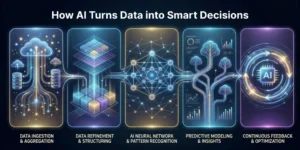
The AI decision-making processes are created to transform the raw information into intelligent and actionable information. These processes are continuous, and scale, speed, and complexity are beyond their ability to handle. The use of AI decision making has a structured process that is precise, consistent, and flexible. Every phase is part of trusted artificial intelligence decision making within enterprise functions.
Data Collection From Multiple Sources
The concept of AI decision making starts with the gathering of both structured and unstructured information from different sources. This involves customer behavior, customer transactions, customer operational metrics, and customer market signals. AI for decision making provides data exchange between internal systems through third-party platforms. Wide-scoped data is better contextual and decision-relevant.
Data Preparation and Standardization
Artificial intelligence-driven decision making cleans, validates, and standardizes the data received automatically. Scalability eliminates errors, duplication, and inconsistency. This is done to guarantee the quality of data before the analysis. Quality data is essential in the proper AI decision-making processes.
Pattern Recognition and Trend Analysis
The AI algorithms process standardized data to determine patterns and correlations. Such patterns show relationships that human beings do not notice very much. The decision making of artificial intelligence identifies trends over time, behavior, and performance measures. This level of analysis enhances the reliability of insight.
Predictive Modeling and Scenario Evaluation
Machine learning algorithms explain the results based on the learned probabilities and patterns. The AI decision making system compares itself with various situations at the same time. Every situation consists of possible risks and effects. This will allow AI-powered decision-making to facilitate proactive planning.
Continuous Learning and Feedback Loops
AI decision-making processes are enhanced by providing constant feedback and analyzing the outcomes. Models are based on successes and failures. AI algorithms are self-adaptive to transforming patterns of data. This makes sure that the AI decision making is in line with the changing business conditions.
Key Benefits of AI Decision Making for Modern Businesses
The benefits of AI decision making can be measured by the fact that it alters the perspective on data analysis and decision-making in organizations. The artificial intelligence decision making enhances the speed, accuracy, and scalability of the enterprise functions. Companies using AI for decision making have greater risk, performance, and long-term development control. The fundamental advantages of AI for decision making are listed below:
- Faster decision speed across departments
The AI decision making allows real-time analysis of business units. Decisions that took days before will be made within a minute. This enhances sensitivity to market and operational changes.
- Higher decision accuracy with reduced bias
Artificial intelligence decision making considers full datasets without being affected by feelings. The AI algorithms minimize the possibility of mistakes based on assumptions or biased information. This enhances trust in business.
- Improved scalability without workforce expansion
AI-powered decision-making allows the expansion of operations that do not require more manual work. The businesses are consistent as the complexity increases. This renders scaling less expensive and managed.
- Proactive risk identification and mitigation
Predictive analytics is applied in AI decision making to identify risks at the initial stage. Before the escalation, anomalies and inefficiencies are detected. This secures business and survival.
- Proactive risk identification and mitigation
AI decision-making processes standardize the decision evaluation process. This eliminates interpersonal and inter-team variation. Companies develop better functionality alignment.
- Higher profitability and business resilience
AI-powered automation improves efficiency across high-volume decisions. Artificial intelligence-driven decision making is a way of optimization in the allocation of resources. Enterprises attain both long-term sustainability and sustainable growth.
Importance of AI for Decision-Making in Competitive Markets
The significance of AI in decision-making is also on the increase, with the markets getting faster, more volatile, and highly competitive. Companies have to react immediately to the behavior of the customers, the change in prices, and the changes in the economy. AI decision making allows the real-time analysis of large and complex data. Agile strategies can be supported through artificial intelligence decision making, which can provide predictive and situational information. Companies that rely on AI as a decision maker become clear-cut during stress. AI-powered decision-making allows enterprises to anticipate trends rather than react late. The result of this speed and foresight is the development of competitive advantages in the dynamic market that are measurable.
Those companies that practice AI decision making innovate more and respond to disruption better. Artificial intelligence-driven decision making enhances customer experience by providing personalization and responses in real-time. The decision-making processes of AI increase the resilience of the operations of the organization, as risks are detected in advance. The absence of AI decision making makes businesses slow in their response and reduces their relevance. Intelligence based on data has turned into a growth requirement. Companies that focus more on AI-powered automation and AI-supported decisions place themselves in a favorable position to become competitive in the long term and maintain their competitive edge in the market.
Best Practices for Successful AI Implementation
Successful AI implementation requires more than deploying advanced technology. Companies need to ensure that AI decision making is correlated with business objectives, data preparation, and business processes. The organized approach makes artificial intelligence decision making worth measuring. When the best practices are demonstrated by businesses, it minimizes the risk factor and gives the business a faster uptake. The practices assist in ensuring that organizations scale AI to make decisions in a way that is both sustainable and confident.
Identify High-Impact Decision Use Cases
Successful AI implementation begins by targeting decisions with clear business value. The high-frequency or high-risk decisions should be considered as the priority of organizations. AI decision making provides more rapid outcomes when implemented on quantifiable applications. This concentration is a guarantee of early victories and the backing of stakeholders.
Start With Pilot Projects Before Scaling
Pilot projects make assumptions true and test the work of AI decision-making at a safe level. They assist in uncovering data gaps and integration issues at an early stage. Successful pilots make the process of AI-powered decision-making easier to scale. The strategy reduces interference and the risk of expenses.
Ensure Strong Data Governance and Quality
Artificial intelligence-driven decision making depends heavily on data quality. Organizations need to put governance structures in place to achieve precision, safety, and adherence. Quality and precise data enhance artificial intelligence algorithms. Good governance includes confidence in AI-assisted decision-making results.
Enable Continuous Monitoring and Optimization
The AI decision making entails continuous monitoring to ensure that it is accurate and relevant. Models have to be flexible to any pattern of change in data and market conditions. Optimization is a process that can be enhanced continuously. This would make AI-powered automation effective and compliant.
Invest in Team Training and Collaboration
AI implementation still requires human expertise to be successful. The teams should learn how to work with AI systems. Adoption and confidence in AI decision making is enhanced through training. The best results are provided by human and AI cooperation.
Conclusion
AI decision making has emerged as a basic building block for new businesses in search of sustainability. It gives the organizations the power to make predictive and confident decisions in place of reactive ones. DAIC increases the pace, precision, and scale of critical business operations. Companies investing in intelligence that is driven by AI change more quickly and become successful. It needs strategy, governance, and proper technology expertise to be implemented successfully. AnavClouds Analytics.ai will be of great importance here. AnavClouds Analytics.ai allows organizations to unlock measurable value because it assists businesses in designing, developing, and scaling intelligent decision solutions. AI decision making is not a choice anymore, as it is what the future-ready businesses are.