



Just imagine a system that is capable of thinking, planning, and taking action independently- decisions faster than any human being. The combination of intelligence, logic, and autonomous action is making AI agents revolutionize the manner in which businesses are being conducted. In contrast to old-fashioned automation or chatbots, these agents can sense what is going on around them, interpret information, rule, and perform actions without necessarily needing human interference. These intelligent systems allow organizations to be ahead of the competition through streamlining their workflow to optimization of their operations. Understanding how these agents think, decide, and act is key for businesses aiming to leverage AI agents for automation and unlock real operational efficiency.
What Are AI Agents?
AI agents do not operate as fixed programs on fixed instructions. They are smart systems that are created to perceive their surroundings, comprehend information, and take goal-oriented action. They are in a cyclic mode and not a single command. This capability renders them applicable in the real-life and business world, where everything is dynamic.
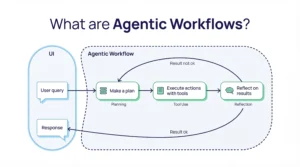
The fundamental loop of AI agent intelligence is a very basic one, yet a powerful one. This cycle enables them to evolve and develop with time. This hierarchical cycle is referred to as the AI agent workflow.
Step 1: Observe
In stage one, the AI agents gather information on the surroundings. The source of this data can be user activity, system activity, APIs, sensors, or digital platforms. This is aimed at knowing what is happening at this time. They will not be able to respond appropriately without this stage of observation. AI agent logic is based on strong perception.
Step 2: Think
Once the data is collected, agents process it with the help of internal rules, trained models, and logic systems. This is where AI agent intelligence is manifested. The system recognizes what is important, what one can leave behind, and what has to be done. It also verifies the goals and priorities before making a decision. The level of intelligence and trustworthiness of the agent is determined by this level of thinking.
Step 3: Act
After making a decision, AI agents become activated. They can initiate workflow, refresh systems, provide messages, generate tasks, or get connected with other tools. Every action follows a goal. This does not happen to be automated. It is context-based logical conduct.
The Continuous Loop
These three stages never happen just once. AI agents repeat this cycle again and again. This ongoing loop is known as the agentic workflow. Each cycle helps them to learn from results. Good outcomes strengthen future decisions. Poor outcomes change future behavior. This is how AI agent intelligence grows over time.
Because of this structured workflow, AI agents can work in changing environments. They adjust when data changes. They improve when results fail. This is what separates them from static software. They are built to evolve, not just execute.
How AI Agents Think and Decide
The thinking power of AI agents comes from a layered decision system, not a single rule engine. They are built with internal structures that manage memory, logic, priorities, and outcomes. This structure allows them to handle complex choices instead of simple reactions.
At the center of this system is AI agent logic. This logic defines how information is judged, ranked, and converted into decisions. They do not treat all data equally and assign value to signals based on urgency, risk, relevance, and goals. This ranking system is what shapes AI agent intelligence.
Perception Layer
These agents first convert raw inputs into meaningful signals. This is not simple data collection. They filter noise and highlight useful patterns. This step decides what deserves attention and what can be ignored. Strong filtering improves the quality of every later decision.
Analysis Layer
In this stage, agents apply models, rules, and learned behavior to understand meaning. They compare current inputs with stored knowledge and past outcomes. This is where AI agent intelligence becomes visible. The system predicts what each choice might lead to.
Planning Layer
The agents do not jump to action. They simulate multiple paths before choosing one. Each possible action is scored using success probability, cost, time, and risk. The plan with the highest value becomes the chosen path. This makes them reliable in uncertain situations.
Decision Layer
After the simulation, they commit to one direction. This is where AI agent’s logic locks the final choice. Once selected, the plan becomes active and ready for execution. Rules, goals, and performance targets control this stage.
Learning Layer
After results appear, AI agents evaluate success or failure. Good results strengthen the same logic path. Bad results weaken it. This is how AI agent intelligence grows over time. The system becomes smarter through outcomes, not guesses.
This multi-layer thinking system is what powers Agentic AI. In Agentic AI, multiple agents think independently but align toward shared goals. Each agent follows its own logic but supports the larger system.
Because of this design, they can become proactive. They do not wait for problems. They predict them using learned patterns. They act before damage happens. This ability makes them suitable for real business environments where timing matters most.
AI Agents vs Chatbots: Understanding the Difference
AI agents and chatbots are often put in the same category, yet their roles are quite different. Chatbots are primarily constructed in the form of conversation. They provide answers, provide directions, and take dialogue courses. The majority of chatbots require user input to initiate any activity. In the absence of a message, they remain dormant.
Chatbots: Chatbots are optimized in the area of customer support, lead capture, and simple helpdesk. They respond using scripts, rules, or language models. Communication, rather than execution, is their primary objective. That is why chatbots can only talk and not work.
AI agents: Far beyond conversation. They are expected to operate autonomously. They can network with systems, retrieve information, assess situations, and act independently without having instructions. This renders them applicable in complicated and real-time tasks.
The biggest difference appears in behavior style:
- Chatbots are reactive. They can only be activated when a user speaks or clicks.
- AI agents are proactive. They observe systems, identify indicators, and take automatic action.
The difference alters their application to businesses. Chatbots enhance communication. Artificial intelligence agents enhance functions.
Inside the Mind of an AI Agent
As far as the decision logic is concerned, AI agents are based on predictive algorithms, memory structures, and computational models. These systems are not merely reflection systems; they analyze choices, consider the consequences, and decide the most appropriate action given some set of objectives and the intended outcome. This renders their intelligence so that they can deal with complex situations.
For example, an agent designed for workflow automation might:
- Identify a problem in a data stream: It can identify errors, delays, or anomalies in real-time, and this is the initial move towards self-resolution.
- Predict the best solution using pattern analysis: The agent gets the most accurate and efficient path of action by comparing the history with the patterns.
- Execute a series of steps in automation tools: The agent is capable of initiating workflows, updating systems, and performing multi-step actions with little human oversight.
- Monitor results and adapt for improvement: It constantly measures the consequences of its activity and changes the strategies to make them as effective as possible.
This observation, reasoning, and execution cycle is what distinguishes scripted automation from AI agents. It enables them to solve complicated problems, manage uncertainty, and perform without supervision.
Real-World Uses of AI Agents
The uses of AI agents are wide and increasing. In different industrial sectors, they are being implemented to add functionality and bring efficiency to businesses. Some of high impact situations are:
AI Agents for Automation
Examples of repetitive duties that can be automated with these agents would include data entry, scheduling, and lead nurturing. They liberate human teams in order to work on strategic work.
AI Agents in Enterprise
Enterprise agents in the environment organize the systems and process performance data and initiate corrective measures in real time. This makes it possible to make decisions faster and scale operations.
Proactive Agents
Such agents extend beyond the monitoring process; they predict the trends, and they intervene before things get out of control. This will help minimize downtimes and enhance customer experiences.
Through such deployments, the author shows the effectiveness of these agents in streamlining business processes.
Why AI Agents Matter for Your Business
With the use of AI agents, businesses receive substantial competitive advantages in terms of speed, precision, and the level of automation. Such intelligent systems extend past conventional automation to integrate AI agent logic, predictive, and on-the-job learning to optimize operations. Companies that use them can make smarter and faster decisions and become more efficient in their work. These systems help organizations:
Reduce manual workload through smart automation
Tasks that are repetitive and involve data entry, system upkeep, and report generation will be handled by these agents. The automation of routine work ensures that the employees will be able to concentrate on strategic projects and minimize human error and delays in operations.
Improve decision quality with data-driven logic
These systems can process complicated datasets, make patterns, and suggest the best solutions with the help of high-level AI agent intelligence. The decisions are not made using guesswork anymore, but predictive intuition and real-time analytics.
Accelerate workflows across departments
AI agents plan activities, inter-system interaction, and initiate activities automatically. The efficiency of the departments can be enhanced, teamwork is enhanced, and project schedules are reduced without the need for more manual intervention.
Scale digital operations without linear cost growth
By deploying AI agents for automation, businesses can increase output without proportionally increasing resources or overhead costs. These systems expand capabilities, handle growing workloads, and maintain consistent performance.
The use of AI development services that involve agent design and deployment has the potential to unlock previously unknown sources of productivity and minimize operational bottlenecks, as well as place businesses in a position to succeed in the long run in competitive markets.
Conclusion
With businesses adopting smart automation, AI agents are coming up as influential tools to promote efficiency, precision, and proactive decision-making. Having the capacity to reason, act on their own, and see, they are much more competent than the traditional automation or chat-only systems. Their automation aspect can help businesses to decrease the number of manual tasks, improve the speed of work processes, and expand operations as well, without adding expenses. Considerable productivity can be achieved by investing in AI development services, which incorporate the design and deployment of AI agents. Looking to harness the full potential of these advanced systems, AnavClouds Analytics.ai provides expert solutions to implement and optimize AI agents, enabling smarter, faster, and more efficient business operations.
FAQs
What are AI agents?
AI agents are smart systems with the ability to sense their environment, assess data, and make independent judgments. They are self-initiating to do tasks and enhance them through AI agent reasoning and learning.
How do AI agents differ from chatbots?
They are proactive, unlike chatbots that merely react to user input. They can track systems, are triggerable, and perform tasks automatically.
How do AI agents make decisions?
They are based on computational models, memory structures, and predictive algorithms to analyze several alternatives. They choose the most appropriate action in terms of objectives, trends, and previous results.
Why should businesses use AI agents?
The companies uses AI agents to automate the workflow, minimize manual work, and make faster and more data-driven decisions. They assist in the effective scaling of operations and the increase in overall productivity.