



Here is a scenario most data teams know too well. A key metric drop. Someone noticed it in a Monday morning report. By the time the team figures out what happened, the window to act has already closed.
This is not a people’s problem. It is a tool problem. Traditional analytics was never built to keep up with the speed at which businesses generate — and need — data today.
That is exactly why AI agents for data analysis are getting so much attention right now. These systems — AI agents for data analysis — do not wait for someone to spot an issue. They monitor your data continuously, catch problems as they happen, dig into the root cause on their own, and give you a clear picture of what to do next. No prompt required, no analyst on standby.
By the end of 2026, more than 40% of enterprise applications will include task-specific agents — and AI agents for data analysis are no longer a future investment. They are quickly becoming the standard — and this guide walks you through everything you need to understand about them.
What Are AI Agents for Data Analysis, and Why Are They Built Differently?
Most AI tools you have probably used are reactive — you type a question, and they give you an answer. That’s it. AI agents for data analysis work very differently. You give them a goal, say “monitor our customer retention numbers” or “flag any unusual spikes in return rates,” and they take it from there.
They connect to your data sources, figure out what questions need to be asked, run the queries, check their own findings, and come back to you with a structured output that tells you what happened, why, and what you should consider doing about it.
That is what makes data analysis AI agents — and AI agents for data analysis broadly — stand out. It is not just the speed — it is the autonomy. They are not waiting for your next instruction at every step. They reason through the problem the way a good analyst would, just without the bottleneck.
This proactive, self-directed behavior is what people mean when they talk about agentic analytics — and it is a meaningful departure from how most businesses have handled data up until now.
Traditional BI vs Agentic Analytics: What Has Actually Changed and Why It Matters
If you have been in the data space for a while, you have seen analytics tools evolve — but if we are being honest, the core workflow has stayed pretty much the same. Someone notices a problem, a data team pulls reports, everyone spends hours trying to understand what they are looking at, and by the time there is an answer, decisions have already been made without it.
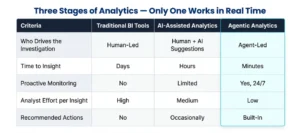
Here is how the evolution looks in practice:
Traditional BI tools were designed for reporting, not investigation. Analysts queried databases, built dashboards, and interpreted results by hand. Useful, but slow and entirely backward-looking. Business intelligence services built on this model simply cannot keep pace with modern data volumes.
AI-assisted analytics brought AI into the workflow as a helper — autocomplete for queries, auto-generated charts, and trend highlights. Better, but humans still had to drive every step of the investigation. The dependency did not go away; it just got slightly faster.
Agentic analytics is where the real shift happens. The agent takes the wheel. It monitors, investigates, validates, and reports — and humans’ step in to review outputs and make calls, not to do the legwork.
When you look at it this way, the gap between traditional BI vs agentic analytics is not a feature difference — it is an entirely different relationship between people and data.
How AI Agents for Data Analysis Actually Work, Step by Step
It is worth understanding what happens under the hood when AI agents for data analysis are running — this shapes where they add value and what AI agents for data analysis need to succeed.
They start by understanding the goal. The agent receives a prompt or a scheduled trigger — something like “revenue is down 11% today, find out why.” Using natural language understanding, it maps out what needs to be investigated.
They build their own analysis plan. Rather than following a fixed script, AI agents for data analysis break the problem into smaller tasks and sequence them dynamically. If something does not add up at step three, they adjust — they do not just barrel forward.
They go get the data themselves. Agent-based analytics means connecting to databases, warehouses, APIs, and external tools — pulling exactly what is relevant at each step. No waiting for someone to prepare a data extract.
They check their own work. Before surfacing anything, the agent cross-validates its findings. If results look inconsistent or a data source seems unreliable, it flags it or tries a different approach. This self-correction loop is a big part of what makes autonomous data analysis trustworthy.
They deliver something you can actually use. AI agents for data analysis do not hand you a spreadsheet and walk away. They produce a structured output — what happened, the most likely cause, the supporting data, confidence levels, and a recommended next step. That is AI decision-making built into the workflow, not bolted on afterward.
Types of AI Agents in Analytics and When to Use Each
One thing worth understanding early on — AI agents in analytics are not all built the same way, and picking the wrong type for your situation is a very common mistake.
Chat-based agents
If your team is tired of routing every data question to an analyst, chat-based agents are probably the right starting point. Business users type a question in plain language, and the agent pulls out the relevant data, builds a chart, and explains what it found. It takes a lot of pressure off data teams and gets answers to the people who need them faster. This is where AI-driven analytics stops feeling like a technical project and starts feeling practical.
Background monitoring agents
These agents are what most operations and finance teams eventually land on. You configure the signals that matter — revenue, churn, inventory, whatever is critical — and the agent watches them without you having to think about it. When something looks off, it does not just send an alert. It investigates, puts together a brief, and tells you what it found. That kind of continuous coverage used to require a person on call. Now it runs on its own.
Single-agent systems
For teams just getting started with AI agents for data analysis, single-agent systems tend to be the lowest-friction entry point. One agent, one workflow — a weekly performance summary, a nightly data quality sweep, a monthly report that used to take half a day to compile. Simple to build, easy to trust, and a good way to understand what AI development services can deliver before going broader.
Multi-agent systems
These agents are a step up in complexity. Think of it as a small team of specialized agents, each handling a piece of the puzzle, with an orchestrator making sure they are working together rather than duplicating effort. These work well for cross-functional workflows but require more governance upfront — clear rules, shared context, and someone keeping the system honest.
Domain-specific agents
They are in many ways the most practical option for businesses that want fast adoption. An agent built specifically for fraud detection, compliance, or student outcomes in AI for EdTech and Education already understands the terminology, the edge cases, and what a useful output looks like in that context. Teams trust these faster because they feel built for them — and this is where agentic AI evolution is most visible, with agents getting sharper and more reliable with every iteration.
Where AI Agents for Data Analysis Are Creating Real Impact
Real-time monitoring and anomaly detection are where AI agents for data analysis show their clearest wins. AI agents for data analysis watch your metrics constantly and surface issues before they compound. AES, the global energy company, used AI agents for data analysis to automate safety audits — cutting audit time from 14 days to one hour and reducing costs by 99%.
Fraud and compliance monitoring is another area where AI agents for data analysis prove real worth. Elanco, a global animal health leader, uses AI agents for data analysis to process over 2,500 compliance documents per manufacturing site, preventing up to $1.3 million in productivity losses tied to outdated information.
Self-service data analysis has been a game-changer for organizations trying to democratize access. Suzano, the world’s largest pulp manufacturer, deployed AI agents for data analysis that translate plain-language questions into SQL queries — giving 50,000 employees direct data access and cutting query time by 95%.
Automated reporting is where a lot of teams first see the ROI of AI agents for data analysis. AI-driven analytics agents pull data, apply business logic, generate visualizations, and write summaries on a schedule — without anyone sitting down to do it manually.
Predictive forecasting and root cause analysis push into territory that traditional tools simply cannot reach. Multimodal generative AI-powered agents can model what is likely to happen next, not just what has already occurred. This is where agentic AI evolution is heading — from explanation to prediction to recommendation, all in one workflow.
What You Need to Get Right Before You Deploy AI Agents for Data Analysis
This part tends to get glossed over in most guides, but it is honestly where most deployments succeed or fall apart.
The first thing people underestimate is data quality!
AI agents for data analysis are fast — and that speed amplifies whatever is wrong with your data. If your pipelines have gaps, inconsistencies, or poorly defined fields, the agent will find ways to surface all of that at scale. Getting your data house in order is not a nice-to-have before deployment. It is the whole foundation.
Security is the other area where shortcuts come back to bite you!
AI agents in analytics connect to multiple systems, which means the blast radius of a misconfigured access policy is larger than with traditional tools. Define permissions tightly from the start — least-privilege access, role-based controls, full audit trails. If you are in a regulated industry, the compliance requirements need to be baked into how the agent behaves, not checked in a review after the fact.
Then there is the question of trust!
A lot of teams set up AI agents for data analysis and find that people simply do not act on the outputs. Usually, it is because the agent cannot explain it. If someone cannot see what data was used, how a conclusion was reached, or why a recommendation was made, they will default to ignoring it — even if it is right. Explainability is not a technical nice-to-have; it is what actually drives adoption.
The pattern that works best across successful deployments of autonomous data analysis is starting with one specific, measurable problem. Not “let’s automate our analytics.” More like “let’s use an agent to monitor weekly churn signals and flag anything unusual.” Prove that it works. Build confidence. Then expand.
Conclusion
Businesses pulling ahead right now are not doing anything dramatically different. They picked one real problem where slow, manual analysis was costing them time or money, deployed AI agents for data analysis around it, got something working, and kept going from there. That is it. No grand transformation strategy required.
What is changing fast, though, is how wide the gap is between organizations that have started and those that have not. AI agents for data analysis are becoming part of how competitive businesses operate — not a future initiative, but a current one. If your team is still producing insights the old way while your competitors are getting answers in minutes, that is a gap that compounds.
The good news is that the entry point is more accessible than most people think. If you want to see what that looks like for your data environment, AnavClouds Analytics.ai is a good place to start.
Frequently Asked Questions
If our data is messy across systems, will AI agents for data analysis still work?
Not reliable. Messy data is the fastest way to get wrong outputs at scale. Cleaning your pipelines before deployment is not optional — it is what determines whether AI agents for data analysis actually help.
Do we need a big internal tech team to start using AI agents for data analytics?
Not necessarily. Working with an AI development services partner like AnavClouds Analytics.ai means you can deploy AI agents for data analysis without hiring an entire data engineering team first.
Our BI tool already has AI features — so why do we need agentic analytics?
Those features respond when you ask. Agentic analytics does not wait — AI agents in analytics keep watching your data and surface problems on their own, before anyone thinks to check.
Which industries are actually seeing results from AI agents for data analysis today?
Finance, healthcare, manufacturing, retail, and AI for EdTech and Education are leading right now — mostly because the data volumes are high, and the cost of slow decisions is very visible.