
Logistics is always a high-pressure industry. All this has to move, all this has to pass, all this has to go on — every single day. This was achieved manually and with effort by businesses for years. However, with increasing volumes and shrinking margins, it’s no longer working. AI adoption in logistics is changing the equation. From automating invoice processing and demand forecasting to making smarter and faster automated decision-making possible across the supply chain. This blog looks at what successful AI adoption in logistics looks like, where the greatest benefits will be seen, and how organisations can lay the foundations for long-term success.
Why AI Adoption in Logistics Is No Longer Optional
AI in logistics was once thought to be a privilege of the tech giants and billion-dollar retailers. That’s over.
These statistics are hard to take for granted in a business with such thin profit margins, as enterprises that have fully embraced AI in their supply chains save 15–30% on logistics costs, inventory drops by 20–50%, and service levels see a boost of up to 65%, according to a report.
The findings, however, do not diminish the fact that only 23% of supply chain organizations have a formal AI strategy, according to Gartner. Many companies are missing out on cash right there – between intent and execution.
The problem is not in the lack of interest in AI adoption in logistics, but in the lack of structure. Teams tend to focus on a single use case, experience minimal results, and conclude that AI is a hype cycle. Teams typically automate a single use case and experience minimal results and then say, “AI must be a hype cycle.” In fact, it is a problem of fragmentation. The results of AI are only achieved when it’s put into the workflow, not just on a touchpoint.
The Real Cost of Manual Operations in Logistics
It’s important to understand the costs of manual operations before diving into solutions.
AI-Powered Invoice Processing: Solving the Silent Cost Drain
The concept of AI-driven invoice processing is not just a buzzword; it’s a reality in logistics that many are talking about for good reason. A medium-sized logistics business can get hundreds of invoices a day, whether for its carriers, freight brokers, fuel suppliers, or third-party vendors. Every time an invoice is to be issued, it must be captured, validated, compared to a purchase order, sent for approval, and added to the ERP system.
When that process is manual, problems compound fast:
- Data entry errors creep in across PDFs, emails, and scanned documents
- Approval delays pile up when workflows depend on email chains and unclear handoffs
- Disconnected systems mean finance teams are switching between platforms to reconcile a single invoice
- Exception handling falls entirely on humans, slowing down the entire queue
The real problem with manual invoice processing is that it is not only slow, but it is also unreliable. Can’t work 80 invoices a day, and suddenly process 200? AI adoption in logistics is addressing this by enabling the logistics process to be intelligent and scalable, rather than simply faster.
Beyond Invoices: Where Manual Workflows Break Down
Invoice processing is a component of a much bigger picture. In logistical processes, manual work results in a bottleneck in several processes:
- Spreadsheet and historical pattern demand forecasting are inadequate to capture the real-time signals.
- Manual route planning does not consider real-time traffic, weather, or carrier availability.
- Coordination by human beings is inefficient in handling peak-volume warehouse operations.
- Email is not the quick and efficient means of supplier communication that today’s supply chains demand.
All of these represent an opportunity for supply chain automation — and a cost if they’re not solved.
What AI Adoption in Logistics Looks Like: A 4-Layer Framework
AI adoption in logistics is not a standalone product or plugin. It’s a multi-layered transformation that impacts data, intelligence, execution, and decision-making. Knowing these layers is important to create something to scale.
Layer 1: Building a Strong Data Foundation
All AI systems are dependent on the data they are trained on. The data pipeline architecture must be clean, connected, and accessible before any model can forecast demand, validate invoices, or optimize routes.
Logistics companies need to combine data from their ERPs, warehouse management systems, carrier portals, IoT sensors, and customer platforms into a single structure. What drives the difference between AI programs that make it to the pilot stage and those that expand throughout the organization?
The key to successful data pipelines is to have a well-designed architecture that ensures that accurate, timely data is fed into AI models and that the results can be returned to operational systems without manual effort. It is the base upon which everything else rests.
Layer 2: AI Data Processing and Intelligence
After establishing the data foundation, AI data processing takes over. This is where raw operational data is turned into actionable intelligence.
In the context of AI adoption in logistics, this looks like:
- Reading and dynamically adjusting forecasts based on real-time signals coming from sales, weather, events, and market signals is known as Demand Sensing Models.
- Anomaly detection to detect unusual patterns in shipment data, supplier behavior, or invoice totals before they become issues.
- Data in unstructured documents such as bills of lading, carrier contracts, freight invoices, etc., can be organized into a structured format through NLP.
- Predictive maintenance models: These types of models track fleet and equipment data to identify possible issues before they become a problem.
It is in this layer that AI in logistics shifts from reactive to proactive.
Layer 3: Workflow Automation and Execution
AI workflow automation is where intelligence becomes action. The layer where insights created by AI models are applied to real business processes.
In logistics, workflow automation takes care of jobs such as:
- Matching approved payment to the invoice specified by the value, shipment type, and risk level.
- Auto-generating purchase orders when inventory is running low.
- No need to re-enter the data manually into carrier records or the ERP system
- Sending automated alerts if shipment conditions deviate from shipment parameters.
The real difference between basic automation and AI workflow automation is adaptability. When conditions change, traditional rule-based automation breaks. AI-powered workflow automation learns, adapts, and manages exceptions with minimal human input.
Layer 4: Automated Decision-Making
This is the most important area of AI adoption in logistics. In automated decision-making, AI can make decisions on its own regarding lower-risk ones, freeing up human teams to focus on more complex and value-added decision-making.
Examples include:
- Automatic Invoice Approval based on approval rules set with tolerance values, without manual process
- Reducing the routing of shipments if a disruption is identified in a carrier’s network. When a disruption is detected in a carrier’s network, it dynamically reroutes shipments.
- Real-time replenishment adjustment due to a change in demand forecast;
- Auto-routing exceptions, flagging those that can go to humans
The outcome is a logistics operation that runs faster, makes fewer mistakes, and scales proportionately without a proportional increase in manpower.
Enterprise AI Solutions That Are Driving Results in Logistics
AI-Powered Invoice Processing in Action
The most obvious application of AI adoption in logistics is invoice workflow automation. The customer was a logistics firm with 200 to 250 invoices processed daily, which experienced the same issues as outlined above: manual data entry, delayed invoice approvals, and disconnected systems that were trying to direct the finance teams in too many directions.
The company has automated over 200 invoices per day, cutting the time spent on processing manual invoices by an average of 45% in just six weeks by leveraging enterprise AI solutions across four operational layers: data foundation, intelligence, execution, and autonomous decision-making. There was a substantial reduction in manual review effort, predictable turnaround times, and a workflow that scaled without additional staff support.
The benefits of AI adoption in logistics are groundbreaking: not only is processing time cut, but the system is also smarter and more scalable.
Predictive Demand Forecasting
AI in logistics has revolutionized demand forecasting from a reactive to a predictive game.AI for logistics has taken demand forecasting from the past to the future. AI models don’t use historical averages, but instead consume real-time data from several sources to create dynamic and continuously updated forecasts.
In logistics companies, better forecasting results in the positioning of inventory, fewer stockouts, and lower inventory carrying costs. AI adoption in logistics at this stage affects the customer experience as well as the operational margin.
Smart Route Optimization
Another domain of AI adoption in logistics that can yield rapid and tangible benefits is route planning. Route planning is another area where AI use in logistics provides tangible benefits in a short time. No manual process or static algorithm can replicate AI-powered route optimization, which takes into account live traffic, weather, carrier availability, fuel costs, and delivery time windows.
The savings are not the only ones. Optimized routing is responsible for reduced fuel usage, emissions, and on-time delivery. This is especially relevant for companies with sustainability goals, as it becomes increasingly vital in the era of AI adoption in logistics.
The Role of AI Data Strategy in Making Adoption Work
One of the most common reasons AI adoption in logistics fails is the absence of a clear AI data strategy. Organizations invest in AI tools but underestimate the data readiness required to make them work.
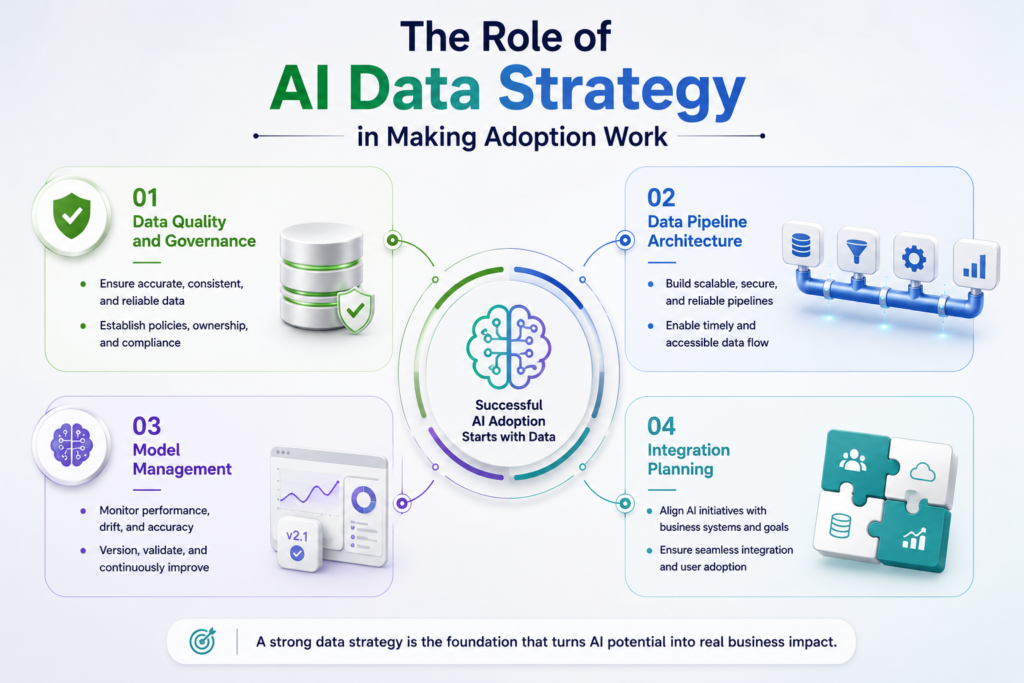
An effective AI data strategy for logistics addresses:
- Data quality and governance — ensuring inputs are accurate, consistent, and compliant
- Data pipeline architecture — building the infrastructure to move data between systems in real time
- Model management — tracking how AI models perform over time and retraining them as conditions change
- Integration planning — connecting AI outputs to the systems that actually run operations
Without this foundation, even the best enterprise AI solutions will underperform. With it, AI adoption in logistics becomes a compounding advantage — each new use case builds on the same infrastructure.
How AI Consulting Services Accelerate Logistics AI Adoption
For many logistics businesses, the challenge is not a lack of ambition — it is a lack of clarity on where to start and how to structure the journey. This is where AI consulting services and AI development services play a critical role.
Working with an experienced AI consulting partner helps organizations:
- Identify the highest-impact use cases for AI adoption in logistics specific to their operations
- Audit existing data infrastructure and close gaps before deployment
- Design AI workflow automation solutions that integrate with legacy ERP and WMS systems
- Build a roadmap that moves from pilot to production without losing momentum
The difference between companies that see lasting returns from AI adoption in logistics and those that stall in proof-of-concept is almost always execution quality — and that starts with the right strategic and technical foundation.
Conclusion
AI adoption in logistics is not a future investment — it is a present-day operational necessity. Businesses that build structured AI foundations today, covering data pipeline architecture, intelligent automation, AI data processing, and automated decision-making, are creating compounding advantages that are increasingly difficult for late movers to close. The results are real: faster invoice cycles, smarter forecasting, optimized routes, and leaner operations across the board. At AnavClouds Analytics.ai, we help logistics enterprises move beyond fragmented automation toward outcome-driven AI adoption in logistics — from strategy and data infrastructure to full-scale AI development services that deliver measurable, lasting results.
Frequently Asked Questions
What is AI adoption in logistics, and why does it matter?
The implementation of AI in logistics involves leveraging artificial intelligence technologies throughout the logistics value chain, from supply chains to transportation and warehouses, to automate processes, enable better decision-making, and minimize expenses.
How does AI improve invoice processing in logistics companies?
Invoice processing with AI takes care of the tedious tasks of extracting, validating, and routing invoices automatically by using machine learning and document intelligence, thus saving labor, avoiding mistakes, and improving the payment cycle a lot.
What is the difference between supply chain automation and AI workflow automation?
Tasks that are repetitive and follow the rules are handled by supply chain automation. AI workflow automation takes it a step further by adjusting to changing environments, intelligently handling exceptions, and making decisions based on the context rather than constant human monitoring.
How long does it take to see results from AI adoption in logistics?
The time to notice measurable operational improvements varies by use case and complexity, but companies with a solid foundation of data and a well-defined use case see measurable improvements within six to twelve weeks after deployment.